OH, SNAP! Federal Policy Changes Threaten the Stability of Florida's Supplemental Nutrition Assistance Program

/ Categories: Research, Budget/Approps, Cost Savings, Federal Government, Health Care

Administered by the United States Department of Agriculture’s (USDA)’s Food and Nutrition Service (FNS), the Supplemental Nutrition Assistance Program (SNAP) provides funds to help low-income households afford low-cost, nutritious meals. In July 2025, President Trump signed the One Big Beautiful Bill Act of 2025 (the OBBB Act), tightening SNAP policies that determine eligibility, benefits, and program administration. Florida TaxWatch undertakes this independent research project to better understand how the upcoming changes in SNAP requirements will impact Florida’s budget and its ability to provide much needed food assistance to needy Floridians.

LUCA Primer: The First Step In Preparing for the 2030 Census

LUCA Primer: The First Step in Preparing for the 2030 Census explains how Florida’s statistically significant undercount of approximately 750,000 residents in the 2020 Census cost the state an additional U.S. House seat, up to $21 billion in federal funds, and weakened the quality of the data that businesses and community leaders rely on for planning.

Economic and Fiscal Impacts of Florida Goodwill Association

FY 2024

/ Categories: Research, Economic Development, Workforce Development, ROI Study

Goodwill’s Economic and Workforce Impact in Florida: FY 2024 quantifies how the Florida Goodwill Association and its nine territories convert donated goods and mission-driven operations into jobs, higher earnings, and stronger local economies across the state. Using FY 2024 operational, employment, and capital spending data and the IMPLAN input-output model, Florida TaxWatch estimates that Goodwill generated $1.52 billion in total economic output, added $893.9 million to Florida’s GDP, and supported 21,471 jobs statewide.

New Labor Data Shows Weaker Labor Market Than Previously Expected

/ Categories: Research, Workforce Development, Blog

Since January 2025, the federal interest rate has remained unchanged at 4.25 to 4.5 percent. The rates have been steady in hopes of curbing inflation and bringing it down to two percent, as unemployment numbers were not concerning until now. The latest revision data, however, will likely push the Federal Reserve to cut rates in their next meeting this month to 4.00 to 4.25 percent.

Interdisciplinary Pain Management As a Means to Help Address Solvency of the State Employees' Health Insurance Trust Fund

/ Categories: Research, Cost Savings, Health Care, Insurance

Interdisciplinary Pain Management as a Means to Help Address Solvency of the State Employees’ Health Insurance Trust Fund examines how treating chronic pain through integrated, team-based care can both improve outcomes for State Group Insurance Program (SGIP) members and lower overall claims paid by Florida’s State Employees’ Health Insurance Trust Fund. With the Trust Fund projected to face a nearly $1.7 billion shortfall by FY 2029-30 without action, Florida TaxWatch outlines a pragmatic path that reduces costs by treating pain more effectively—not just shifting them to employees.

Florida Economic Forecast 2025 - 2034

Q2 2025

/ Categories: Research, Economic Forecast

Florida's economy, valued at $1.76 trillion, entered 2025 on a strong footing but is projected to see its growth moderate to pre-pandemic levels over the next decade. This forecast from Florida TaxWatch indicates a shift from the high growth of recent years to a more sustainable, albeit slower, pace. While the state's population is expected to increase by 2.3 million by 2034, the rate of new residents moving to Florida is projected to decline, influenced by rising living costs.

Options to Eliminate or Reduce the Property Tax Burden on Florida Homeowners

/ Categories: Research, Education, Housing Affordability, Taxes, Local Government

Florida's property tax system is at a critical juncture, with total levies surging by 108% over the last decade, far exceeding the combined rate of population growth and inflation. This rapid increase, generating $55 billion in 2024 for local governments, has intensified the financial strain on homeowners and raised fundamental questions about the nature of property ownership, which currently resembles a form of "perpetual rent" to the government. This report from Florida TaxWatch analyzes the current landscape and explores five distinct options for reform, ranging from the complete elimination of property taxes for homeowners to more immediate statutory changes aimed at increasing transparency and accountability.

Trends in the Cost of Construction Materials

/ Categories: Research, Manufacturing, Public Infrastructure & Utilities

Construction is a cornerstone of Florida's economy, contributing $97 billion (5.7 percent) to the state's GDP in 2024. However, rising material costs are presenting significant challenges to the industry, impacting everything from large-scale infrastructure projects to residential home building and affordability for Florida taxpayers. This report from Florida TaxWatch examines the national and statewide trends driving these price increases and their potential consequences.

The Taxpayer's Guide to Florida's FY2025-26 State Budget

/ Categories: Research, Budget/Approps, Taxpayer Guide

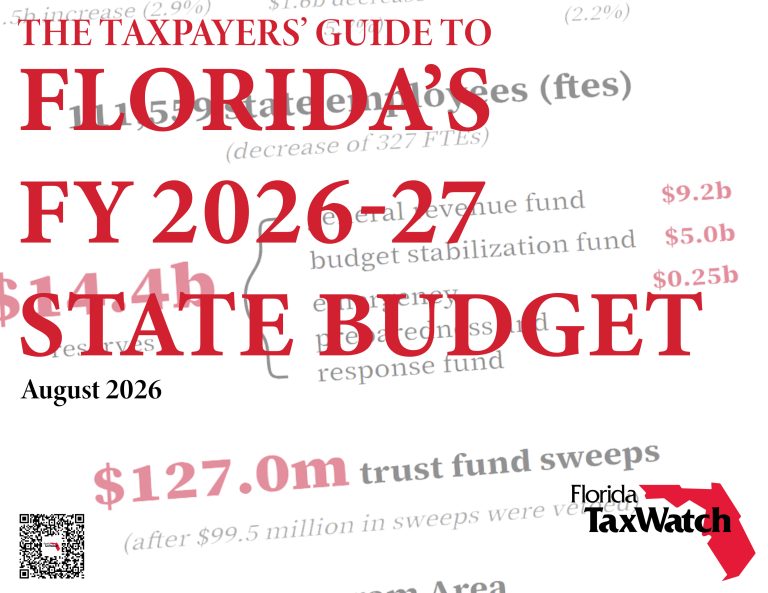
Florida TaxWatch’s The Taxpayers’ Guide to Florida’s FY2025-26 State Budget explains the Legislature’s $114.8 billion spending plan (after $376 million in line-item vetoes)—a 3.2% decrease from FY2024-25—while maintaining $12.6 billion in reserves. General Revenue (GR) spending rises by $556 million, and the recurring GR base increases by $1.9 billion, even as total positions fall to 111,886 (-1,871).

Apportionment Changes Amid Policy Proposals

/ Categories: Research, Census Institute, Census, Federal Government

Apportionment Changes Amid Policy Proposals explains how Florida’s 2020 Census undercount—about 750,000 residents (3.48%)—reduced the state’s political representation and likely cost billions of dollars in federal funding over the decade. The report examines what Florida stood to gain if the count had been accurate and how proposed changes to who is counted could affect future apportionment.

134Last
«March 2025»
MonTueWedThuFriSatSun
2425
Enhancing Lives, Ensuring Accountability: The Value of Florida’s Behavioral Health Managing Entities

Enhancing Lives, Ensuring Accountability: The Value of Florida’s Behavioral Health Managing Entities

Florida’s Behavioral Health Managing Entities (BHMEs) are at the heart of an innovative, community-based network delivering critical mental health and substance use services across the state. This report’s summary reveals how BHMEs efficiently coordinate a vast network of providers with minimal overhead—ensuring accessible, continuous care for vulnerable populations—while highlighting the risk that stagnant operational funding poses to their long-term sustainability. It ultimately recommends boosting operational funding from 3% to 5% to maintain the system’s effectiveness and guide future policy decisions.

Read more
26272812
3456
An Independent Assessment of the Economic Impacts of South Florida’s St. Thomas University on Florida’s Economy

An Independent Assessment of the Economic Impacts of South Florida’s St. Thomas University on Florida’s Economy

St. Thomas University (STU) plays a large role in Florida’s economy, fostering workforce development and economic mobility, particularly for underrepresented communities. This Florida TaxWatch ROI report evaluates STU’s impact, highlighting its contributions to job creation, income growth, and return on investment. With record-breaking enrollment, a diverse student body, and strong financial stability, STU generates over $1.5 billion in economic output and supports more than 8,500 jobs. Every $1 spent on STU results in $21.50 of economic output.

Read more
789
101112
More States Are Using State-Level Tax Credits to Address Workforce and Affordable Housing Deficits

More States Are Using State-Level Tax Credits to Address Workforce and Affordable Housing Deficits

This Florida TaxWatch report highlights a severe affordable housing crisis in Florida, where rising housing costs and a limited supply of affordable units place significant financial and social burdens on low-income families and essential workers. It advocates for the adoption of state-level tax credits to supplement federal programs, thereby incentivizing the construction of affordable housing, stimulating local economies, and reducing public costs.

Read more
13141516
17181920212223
24252627282930
31123
The What, Why, and How of the Florida TaxWatch Budget Turkey Watch Report

The What, Why, and How of the Florida TaxWatch Budget Turkey Watch Report

Florida TaxWatch’s annual Budget Turkey Watch Report for 2025 meticulously examines the state budget to identify appropriations that deviate from sound fiscal management principles. Below is an expanded overview of what Budget Turkeys are, why they are identified, and how they are determined.

Read more
4
Using Microelectronic Sensors to Continuously Monitor Vertical Infrastructure

Using Microelectronic Sensors to Continuously Monitor Vertical Infrastructure

This Florida TaxWatch report explores how microelectronic smart sensor networks can proactively monitor vertical infrastructure to detect issues such as structural fatigue, corrosion, or damage before they lead to catastrophic failures, as seen in the 2021 Champlain Towers South collapse (98 deaths) and the 2018 Florida International University pedestrian bridge collapse (6 deaths).

Read more
56

Archive