/ Categories: Research, Economic Forecast

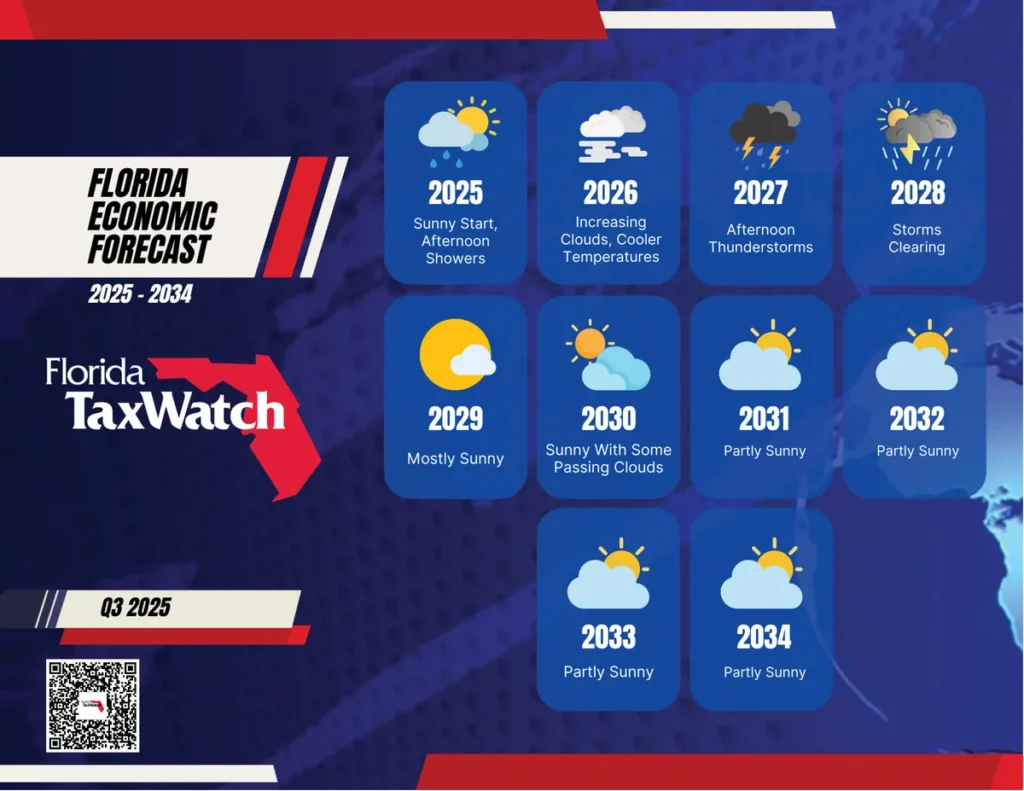
Florida Economic Forecast: 2025-2034

Q3 2025

Florida Economic Forecast 2025-2034 | Q3 2025 - Report Cover

Executive Summary

Florida’s economy—valued at $1.76 trillion in Q1 2025—entered the year with strong momentum, but this Q3 2025 Florida TaxWatch forecast projects a return toward more “normal,” pre-pandemic growth rates over the next several years. While Florida’s population is still expected to climb to roughly 25.9 million by 2034, net migration is projected to cool as higher costs (housing, insurance, taxes) and other pressures weigh on in-migration.

Key Forecast Highlights (2025-2034):

  • Population Keeps Rising, Migration Slows: Population is projected to increase by about 2.4 million (about 23.5M to 25.9M) by 2034, but daily net migration is projected to fall from 922 per day (2025) to 702 per day (2034).
  • Employment Grows, But More Slowly: Total employment is projected to increase from about 10.0 million (2025) to about 10.8 million (2034), reflecting continued job growth at a more moderate pace.
  • Unemployment Rises Before Easing: The unemployment rate is projected to move from 4.0% (2025) up to 4.5% in 2026–2027, then gradually settle around 4.1% by 2034.
  • Real GDP Growth Normalizes: Real GDP growth is projected at 2.3% in 2026 and is expected to cool to about 1.9% by 2034—consistent with a slower, steadier expansion.
  • Income Growth: Up, Then Levels Off: Income growth is projected to rise to about 5.1% through 2028, then hover near 4.9% through 2034—suggesting growing spending capacity, but not at the breakneck pace of recent years.
  • Tourism: Short-Term Soft Patch, Then Modest Growth: After 2024’s record visitation, visitor growth is projected to be just 0.8% in 2025, strengthen through 2027, and then taper—pointing to a longer-run “reversion” toward pre-pandemic tourism growth rates.

Bottom line: Florida is still growing—but the forecast expects the state to shift from the post-pandemic sprint to a more sustainable jog, shaped by easing (but still present) economic uncertainty and a cooling pace of in-migration.

Meet the Author:

Headshot of Jui Shah
Jui Shah
Research Economist — Lead Author
LinkedIn

Documents to download

Previous Article Florida Sheriffs’ Offices Staffing Analysis
Next Article Save Our Taxpayers - Property Tax Relief Must be Accomplished Equitably
Print
1690
2Upvote 0Downvote
«February 2026»
MonTueWedThuFriSatSun
26
Florida’s Space Coast is Well-Positioned to Dominate the Future of the Aerospace Industry

Florida’s Space Coast is Well-Positioned to Dominate the Future of the Aerospace Industry

For more than 60 years, Florida’s Space Coast—anchored by Kennedy Space Center (KSC) and Cape Canaveral Space Force Station (CCSFS)—has served as a premier gateway to space, driving tourism, high-tech jobs, and statewide economic output. After major federal program shifts in the 2010s led to significant regional job losses, Florida’s modern commercial-space resurgence—supported by Space Florida’s strategy to diversify the supply chain, modernize infrastructure, and attract private capital—has positioned the Space Coast to lead the next era of aerospace growth.

Read more
27282930311
2345
New General Revenue Forecast Adds $572.5 Million for the Next Budget

New General Revenue Forecast Adds $572.5 Million for the Next Budget

The General Revenue (GR) Estimating Conference met on January 23 to adopt Florida’s latest GR forecast—the estimate that tells lawmakers how much is available for the next state budget. The updated forecast adds $572.5 million to the amount available for the upcoming budget year, but while meaningful, it amounts to only about one percent of total GR collections.

Read more
678
910
Clearwater’s Plan to Establish Its Own Municipal Electric Utility Puts Taxpayers at Risk

Clearwater’s Plan to Establish Its Own Municipal Electric Utility Puts Taxpayers at Risk

Florida TaxWatch examines the City of Clearwater’s plan to acquire Duke Energy Florida’s electric distribution assets and establish a municipal electric utility (MEU) in response to concerns over electric rates and service quality. While the City’s feasibility study projects modest short-term rate savings, Florida TaxWatch finds those projections rely on unrealistic assumptions—most notably an “overnight” conversion that ignores the likely decade-long, costly eminent domain process required to acquire Duke’s assets. Drawing on national municipalization case studies, the report highlights high failure rates, underestimated acquisition and severance costs, loss of economies of scale, and substantial financial exposure for taxpayers. Florida TaxWatch concludes that the proposed MEU represents a high-risk endeavor with limited upside and recommends the City pursue a renegotiated franchise agreement with Duke Energy Florida as a more prudent path forward.

Read more
1112131415
16171819202122
2324252627281
2345678

Archive