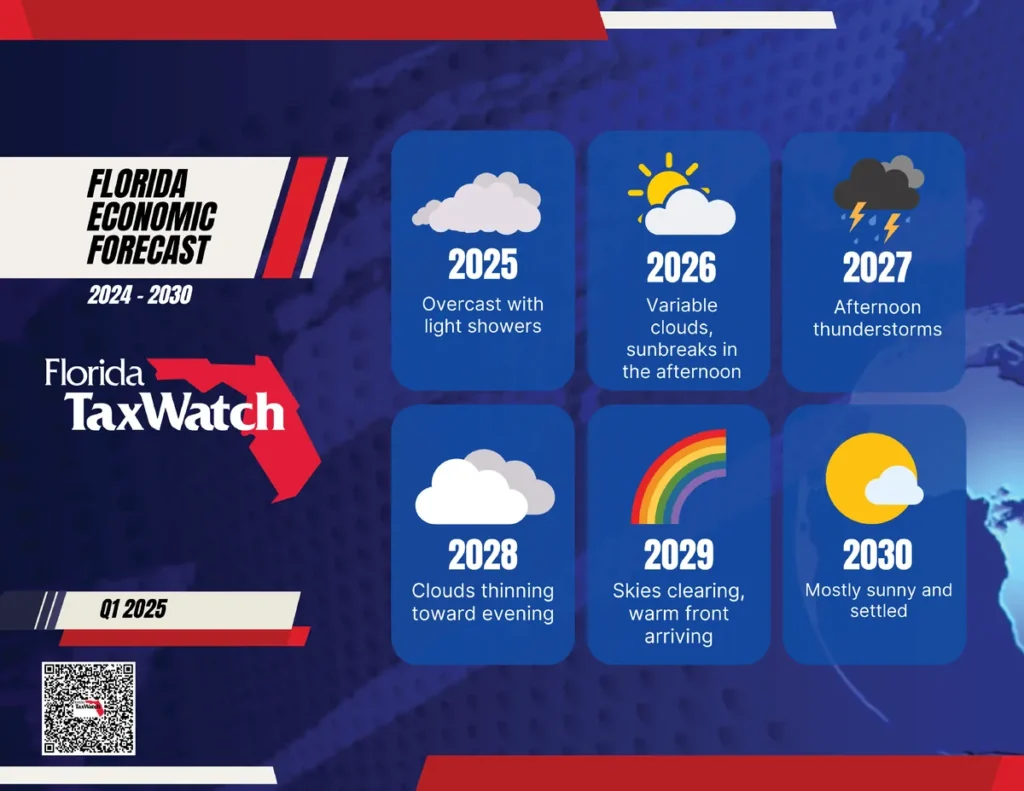
Florida Economic Forecast: Q1 2025

2024-2030

Florida Economic Forecast Report Cover

Florida's economy has been growing to new heights these past years—reaching nearly $1.5 trillion. The Q1 2025 economic forecast by Florida TaxWatch examines key trends in population growth, employment, income, GDP, and tourism, offering valuable insights for policymakers, business leaders, and taxpayers.

Key Highlights:

  • Population & Net Migration:
    • Florida’s population is projected to grow by 1.4 million between 2025 and 2030.
    • Daily net migration slows from 972 new residents in 2024 to 789 by 2030.
    • Rising costs of living, insurance, and weather concerns are some of the reasons driving people to leave the state.
  • Jobs & Economy:
    • Employment is expected to rise from 10 million to 10.9 million by 2030.
    • Unemployment rate increases slightly, peaking at 4.5% in 2027 before falling again.
    • Real GDP growth slows from 3.6% in 2024 to 2.1% by 2030.
    • Personal income per capita peaks at 5.0% growth in 2027, before decreasing to 4.3% by 2030.
  • Tourism:
    • Florida welcomed a record 142.9 million visitors in 2024, the third consecutive year with record numbers.
    • A study shows that tourism supports 2.1 million jobs and saves each household $1,910 annually in state and local taxes.
    • Visitor growth rate is expected to dip in 2025 down to 0.3%, with an expected zero percent growth in 2027, before gradually rising again at low rates.
  • Florida vs. U.S. Economy:
    • Florida’s unemployment rate remains consistently below the national average.
    • Personal income growth in Florida is projected to surpass the U.S. average from 2027 onward.
    • The state's economic growth trends closely align with national patterns, showing an overall steady performance.

Meet the Author:

Jui Shah
Jui Shah
Research Economist
LinkedIn

Documents to download

Previous Article Florida TaxWatch 2025 Legislative Session Wrap-Up
Next Article The Census Undercount’s Toll on Florida Roads
Print
19412
2Upvote 0Downvote
«December 2025»
MonTueWedThuFriSatSun
24252627282930
1234
OH, SNAP! Federal Policy Changes Threaten the Stability of Florida's Supplemental Nutrition Assistance Program

OH, SNAP! Federal Policy Changes Threaten the Stability of Florida's Supplemental Nutrition Assistance Program

Administered by the United States Department of Agriculture’s (USDA)’s Food and Nutrition Service (FNS), the Supplemental Nutrition Assistance Program (SNAP) provides funds to help low-income households afford low-cost, nutritious meals. In July 2025, President Trump signed the One Big Beautiful Bill Act of 2025 (the OBBB Act), tightening SNAP policies that determine eligibility, benefits, and program administration. Florida TaxWatch undertakes this independent research project to better understand how the upcoming changes in SNAP requirements will impact Florida’s budget and its ability to provide much needed food assistance to needy Floridians.

Read more
567
891011121314
15
2025 How Florida Counties Compare

2025 How Florida Counties Compare

This report compares the revenue and expenditure profiles of Florida’s 67 counties to give taxpayers an overview of how their local government stacks up with the rest of the state.

Read more
16
The Fiscal and Economic Impacts of Nova Southeastern University on Florida’s Economy

The Fiscal and Economic Impacts of Nova Southeastern University on Florida’s Economy

NSU generated an estimated $293.1 million in state and local taxes within the Tri-County region in FY 2024-25 and an estimated $305.1 million in state and local taxes in FY 2024-25.

Read more
17
Transferring Utility Profits to a Municipality's General Fund Increases the Risk of Undercapitalization of Water Assets and Violate Taxpayer Accountability

Transferring Utility Profits to a Municipality's General Fund Increases the Risk of Undercapitalization of Water Assets and Violate Taxpayer Accountability

Setting water utility rates that incorporate the recovery of the costs associated with standard operating expenses and debt obligations is essential to ensuring the short-term and longer-term financial stability of the utility. Once these costs are covered, many publicly owned utilities make transfers to the General Fund (a practice known as “sweeping”) ostensibly to help pay for governmental services that do not generate revenue (e.g., roadway maintenance, public safety, etc.) and to help keep property taxes lower. Keeping property taxes low often means higher municipal utility rates to balance the general budget, a habitual practice that burdens utility customers with cross-subsidies and normalizes underinvestment in infrastructure.

Read more
18
Florida Sheriffs’ Offices Staffing Analysis

Florida Sheriffs’ Offices Staffing Analysis

In May 2025, Florida TaxWatch and the Florida Sheriff Association conducted a joint survey to local sheriff offices to learn more about law enforcement’s workforce challenges.

Read more
192021
22232425262728
2930311234

Archive