2026 Florida Legislative Session Wrap-Up

Pre-Budget Edition

/ Categories: Research, Budget/Approps, Taxes

For the second year in a row, the Florida Legislature ended its 60-day session without completing its only constitutionally required task — passing a state budget. House Speaker Daniel Perez cited a "fundamental disagreement on what the state budget should look like," with the House seeking to spend less and the Senate more. The House and Senate budget proposals total $113.6 billion and $115.0 billion, respectively.

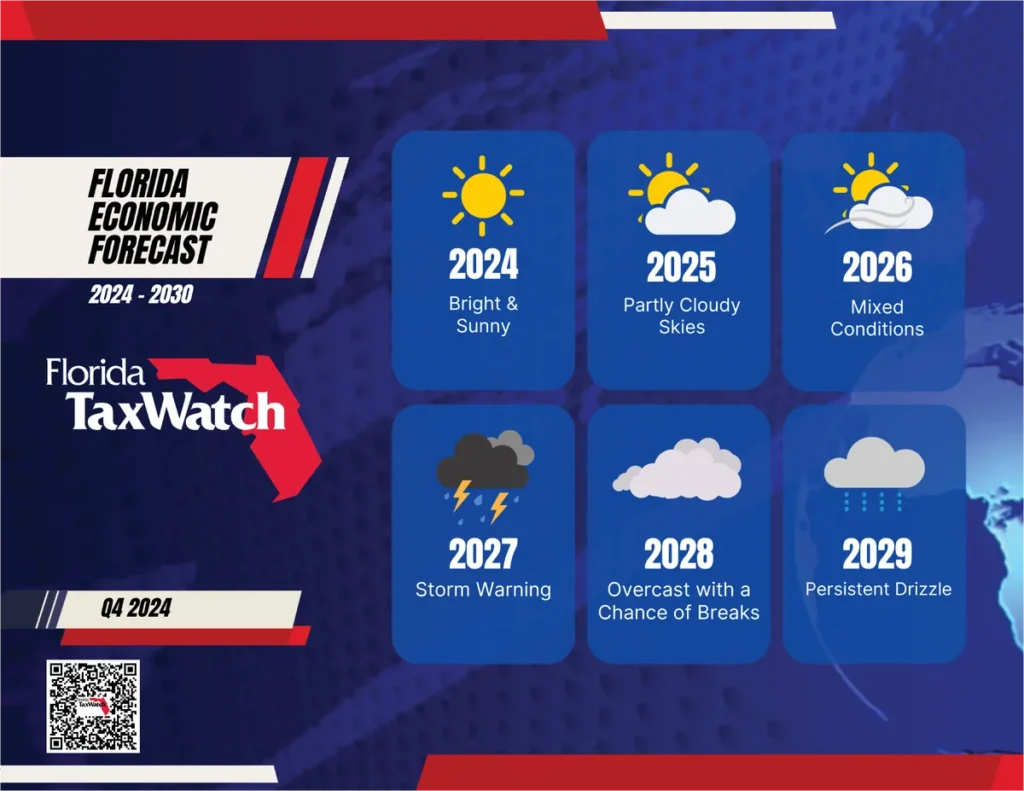
Florida Economic Forecast 2025 - 2035

Q4 2025

/ Categories: Research

Florida's economy reached $1.85 trillion in Q3 2025, ranking first among all 50 states and the District of Columbia in economic growth. This fourth installment of Florida TaxWatch's quarterly economic forecast series — produced in partnership with the Regional Economic Consulting Group — examines whether that momentum is sustainable through 2035.

Building The Force: An Analysis of Florida’s Law Enforcement Apprenticeship Program (LEAP)

/ Categories: Research, Cost Savings, Workforce Development, Public Safety

Florida’s Law Enforcement Apprenticeship Program (LEAP) is an innovative workforce solution addressing persistent staffing shortages in law enforcement, particularly in rural and fiscally constrained communities. Backed by $3.25 million in state funding, the program currently supports 117 apprentices across 25 Sheriff’s Offices, allowing participants to earn a salary while completing required training. By removing financial barriers to entry, LEAP is expanding access to law enforcement careers, strengthening local recruitment pipelines, and helping agencies improve staffing levels while building a more diverse and sustainable workforce.

2025 MakeMore Manufacturing Summit: Summary Report

/ Categories: Research, Economic Development, Manufacturing, Workforce Development, Technology

Manufacturing is one of Florida’s leading industries and a key driver of job growth and economic strength, contributing more than $80 billion to Florida’s annual GDP. With more than 27,000 manufacturers—most of them small businesses with fewer than 20 employees—Florida’s manufacturing sector supports more than 430,000 high-wage jobs, with average salaries exceeding $78,000.

Clearwater’s Plan to Establish Its Own Municipal Electric Utility Puts Taxpayers at Risk

Florida TaxWatch examines the City of Clearwater’s plan to acquire Duke Energy Florida’s electric distribution assets and establish a municipal electric utility (MEU) in response to concerns over electric rates and service quality. While the City’s feasibility study projects modest short-term rate savings, Florida TaxWatch finds those projections rely on unrealistic assumptions—most notably an “overnight” conversion that ignores the likely decade-long, costly eminent domain process required to acquire Duke’s assets. Drawing on national municipalization case studies, the report highlights high failure rates, underestimated acquisition and severance costs, loss of economies of scale, and substantial financial exposure for taxpayers. Florida TaxWatch concludes that the proposed MEU represents a high-risk endeavor with limited upside and recommends the City pursue a renegotiated franchise agreement with Duke Energy Florida as a more prudent path forward.

New General Revenue Forecast Adds $572.5 Million for the Next Budget

/ Categories: Research, Budget/Approps, Local Government

The General Revenue (GR) Estimating Conference met on January 23 to adopt Florida’s latest GR forecast—the estimate that tells lawmakers how much is available for the next state budget. The updated forecast adds $572.5 million to the amount available for the upcoming budget year, but while meaningful, it amounts to only about one percent of total GR collections.

Florida’s Space Coast is Well-Positioned to Dominate the Future of the Aerospace Industry

For more than 60 years, Florida’s Space Coast—anchored by Kennedy Space Center (KSC) and Cape Canaveral Space Force Station (CCSFS)—has served as a premier gateway to space, driving tourism, high-tech jobs, and statewide economic output. After major federal program shifts in the 2010s led to significant regional job losses, Florida’s modern commercial-space resurgence—supported by Space Florida’s strategy to diversify the supply chain, modernize infrastructure, and attract private capital—has positioned the Space Coast to lead the next era of aerospace growth.

Save Our Taxpayers - Property Tax Relief Must be Accomplished Equitably

/ Categories: Research, Housing Affordability, Taxes, Insurance, Local Government

Florida property tax levies have been rising rapidly—increasing by nearly 40 percent in just the last three years and more than doubling in the last ten years—with property taxes now totaling $59.2 billion (FY2025–26). With the Legislature’s increased focus on affordability, especially housing affordability, property taxes are expected to be a top issue during the 2026 legislative session.

Florida Economic Forecast: 2025-2034

Q3 2025

/ Categories: Research, Economic Forecast

Florida’s economy—valued at $1.76 trillion in Q1 2025—entered the year with strong momentum, but this Q3 2025 Florida TaxWatch forecast projects a return toward more “normal,” pre-pandemic growth rates over the next several years. While Florida’s population is still expected to climb to roughly 25.9 million by 2034, net migration is projected to cool as higher costs (housing, insurance, taxes) and other pressures weigh on in-migration.

Transferring Utility Profits to a Municipality's General Fund Increases the Risk of Undercapitalization of Water Assets and Violate Taxpayer Accountability

/ Categories: Research, Taxes, Local Government, Public Infrastructure & Utilities

Setting water utility rates that incorporate the recovery of the costs associated with standard operating expenses and debt obligations is essential to ensuring the short-term and longer-term financial stability of the utility. Once these costs are covered, many publicly owned utilities make transfers to the General Fund (a practice known as “sweeping”) ostensibly to help pay for governmental services that do not generate revenue (e.g., roadway maintenance, public safety, etc.) and to help keep property taxes lower. Keeping property taxes low often means higher municipal utility rates to balance the general budget, a habitual practice that burdens utility customers with cross-subsidies and normalizes underinvestment in infrastructure.

The Fiscal and Economic Impacts of Nova Southeastern University on Florida’s Economy

NSU generated an estimated $293.1 million in state and local taxes within the Tri-County region in FY 2024-25 and an estimated $305.1 million in state and local taxes in FY 2024-25.

134Last
«April 2024»
MonTueWedThuFriSatSun
2526
2024 Florida Legislative Session Wrap-Up

2024 Florida Legislative Session Wrap-Up

The 2024 Florida Legislative Session Wrap-Up offers a concise yet thorough review of the session's key outcomes. With a $117.5 billion budget, over $1 billion in tax relief, and nearly $10 billion in reserves, the Legislature addressed crucial issues in healthcare, education, insurance, and the environment. The report provides an insightful overview of the bills and budget items that passed, as well as notable legislation that failed to advance, making it an essential resource for understanding the current state of Florida policy and its implications for residents and taxpayers.

Read more
27
2020 Census – How Florida Counties Compare

2020 Census – How Florida Counties Compare

"2020 Census Participation: How Florida Counties Compare," provides valuable insights into census participation across the state in 2020 and emphasizes the importance of securing a complete count in the upcoming 2030 Census.

The report examines key metrics, highlights the costly impacts of undercounts, and outlines actionable steps businesses and individuals can take now to support a complete count.

With Census Day 2030 approaching, the time to prepare is now. Download the full report to learn more and discover how you can help ensure Florida receives its fair share of federal funding and representation.

Read more
28293031
1234567
89
“If You Build It, He Will Come”: Florida TaxWatch Looks At  The Tampa Bay Rays’ Ballpark Proposal

“If You Build It, He Will Come”: Florida TaxWatch Looks At The Tampa Bay Rays’ Ballpark Proposal

This report analyzes the key aspects of the deal and identifies critical questions that local officials should consider before deciding whether the proposed ballpark is in the best interest of taxpayers.

The report does not draw conclusions on the merits of the deal but instead focuses on outlining the important factors that need to be weighed, such as the total public costs, the best use of public funds, and the fairness of the cost-sharing agreement. While the project is expected to generate significant economic impacts over 30 years, research shows that the benefits of publicly subsidized sports facilities are often overstated.

To learn more about this critical issue affecting the Tampa Bay region, download the full report for an in-depth, independent analysis.

Read more
1011121314
151617
Florida Taxpayer Independence Day 2024

Florida Taxpayer Independence Day 2024

In 2024, Floridians will spend an average of 107 days working to pay off their tax obligations. The state's total tax burden is estimated at $455 billion, with federal, state, and local taxes accounting for 71%, 15%, and 14%, respectively. Over the past decade, total taxes paid by Floridians have increased by 90%. Despite the challenges, Florida's state tax burden remains one of the lowest in the nation. Download the full report to learn more about the tax landscape in Florida.

Read more
18192021
22232425262728
293012345

Archive