Update on the Implementation of the Live Local Act

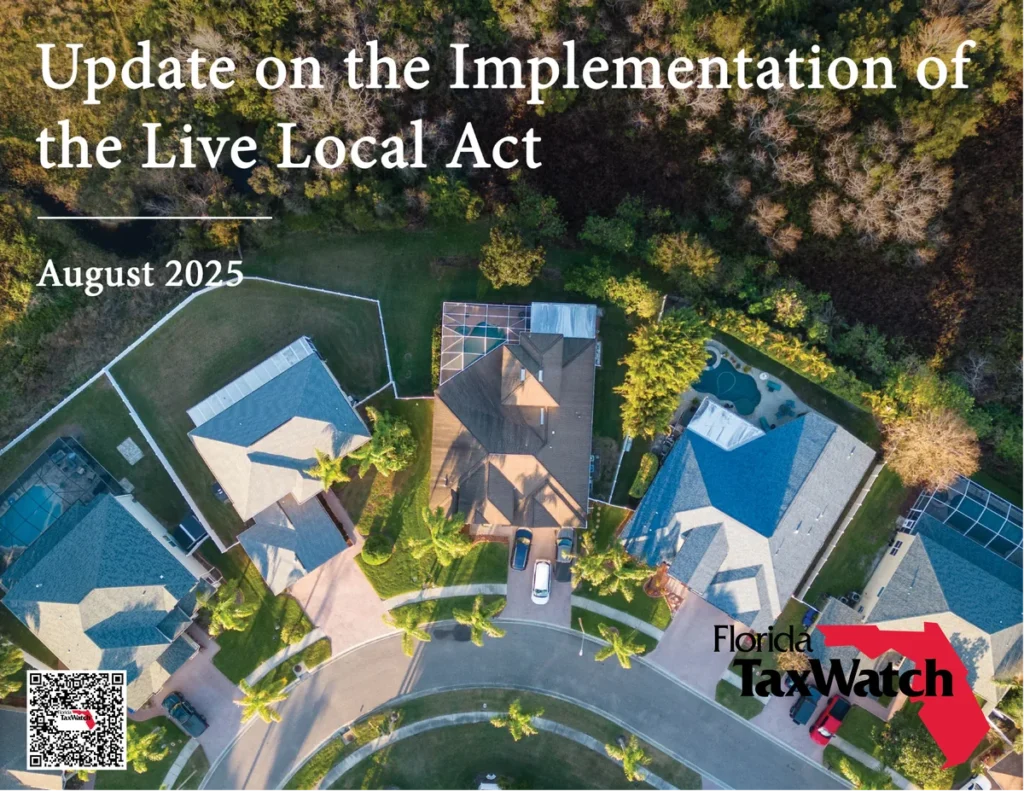
Update on the Implementation of the Live Local Act Report Cover

Florida continues to face a severe affordability gap in housing. In 2022, 35% of households were cost-burdened, and by 2024 the state was short more than 323,000 affordable units for households at 0–30% of Area Median Income (AMI). The Legislature’s 2023 Live Local Act—amended in 2024 and 2025—was designed to accelerate supply by combining incentives (notably property-tax exemptions) with strong preemption and streamlined approvals for qualifying projects. The law requires that at least 40% of units in eligible projects remain affordable for 30 years, and it allows multifamily development in commercial, industrial, or mixed-use zones without rezoning, subject to administrative review.

Implementation has produced real gains but also real friction. Since inception, the Act has helped add 3,171 affordable units across 23 properties, and local adjustments such as Tampa’s reduced parking ratios and flexible greenspace options show how municipalities can use the Act to lower delivery costs. Large mixed-use proposals—Catchlight Crossings in Orange County and HueHub and Cymbal DLT Midtown in Miami-Dade—demonstrate the potential for transit-served, amenity-rich communities to expand access for workers from roughly 0–120% AMI.

At the same time, several factors are constraining impact. Many eligible taxing authorities have opted out of the 75% “missing middle” (80–120% AMI) exemption, citing concerns that benefits accrue to developers without guaranteed rent relief and that lost revenue shifts to other taxpayers. Financing is also a hurdle: because exemptions generally apply only after completion, some lenders discount them at underwriting, dampening uptake. On the process side, retroactive code changes and local resistance have forced developers into litigation in some jurisdictions, slowing approvals and adding cost—undercutting the statute’s intent.

Recent amendments strengthen enforcement (priority court handling, fee awards, and municipal reporting beginning Nov. 1, 2026), but more is needed to close the gap—especially for the “missing middle.” Florida TaxWatch recommends adding state-level tax credits (e.g., a homebuilder credit for attainable single-family, a state low-income housing credit to complement the federal LIHTC, and adaptive-reuse credits) and encouraging consistent local implementation. Bottom line: the Act is moving units, but opt-outs, financing friction, and uneven local execution are limiting scale. Sustained collaboration and targeted state incentives can convert early progress into a durable pipeline.

Download Full Report (PDF)

Meet the Author:

Jessica Cimijotti-Little
Research Analyst
LinkedIn

Documents to download

Previous Article Hospice and Palliative Care
Next Article 2025 Principal Leadership Awards Roundtable Summary
Print
8926
0Upvote 0Downvote
«February 2026»
MonTueWedThuFriSatSun
26
Florida’s Space Coast is Well-Positioned to Dominate the Future of the Aerospace Industry

Florida’s Space Coast is Well-Positioned to Dominate the Future of the Aerospace Industry

For more than 60 years, Florida’s Space Coast—anchored by Kennedy Space Center (KSC) and Cape Canaveral Space Force Station (CCSFS)—has served as a premier gateway to space, driving tourism, high-tech jobs, and statewide economic output. After major federal program shifts in the 2010s led to significant regional job losses, Florida’s modern commercial-space resurgence—supported by Space Florida’s strategy to diversify the supply chain, modernize infrastructure, and attract private capital—has positioned the Space Coast to lead the next era of aerospace growth.

Read more
27282930311
2345
New General Revenue Forecast Adds $572.5 Million for the Next Budget

New General Revenue Forecast Adds $572.5 Million for the Next Budget

The General Revenue (GR) Estimating Conference met on January 23 to adopt Florida’s latest GR forecast—the estimate that tells lawmakers how much is available for the next state budget. The updated forecast adds $572.5 million to the amount available for the upcoming budget year, but while meaningful, it amounts to only about one percent of total GR collections.

Read more
678
910
Clearwater’s Plan to Establish Its Own Municipal Electric Utility Puts Taxpayers at Risk

Clearwater’s Plan to Establish Its Own Municipal Electric Utility Puts Taxpayers at Risk

Florida TaxWatch examines the City of Clearwater’s plan to acquire Duke Energy Florida’s electric distribution assets and establish a municipal electric utility (MEU) in response to concerns over electric rates and service quality. While the City’s feasibility study projects modest short-term rate savings, Florida TaxWatch finds those projections rely on unrealistic assumptions—most notably an “overnight” conversion that ignores the likely decade-long, costly eminent domain process required to acquire Duke’s assets. Drawing on national municipalization case studies, the report highlights high failure rates, underestimated acquisition and severance costs, loss of economies of scale, and substantial financial exposure for taxpayers. Florida TaxWatch concludes that the proposed MEU represents a high-risk endeavor with limited upside and recommends the City pursue a renegotiated franchise agreement with Duke Energy Florida as a more prudent path forward.

Read more
1112131415
16171819202122
2324252627281
2345678

Archive