State COVID-19 Restrictions & the Road Back to Economic Normal
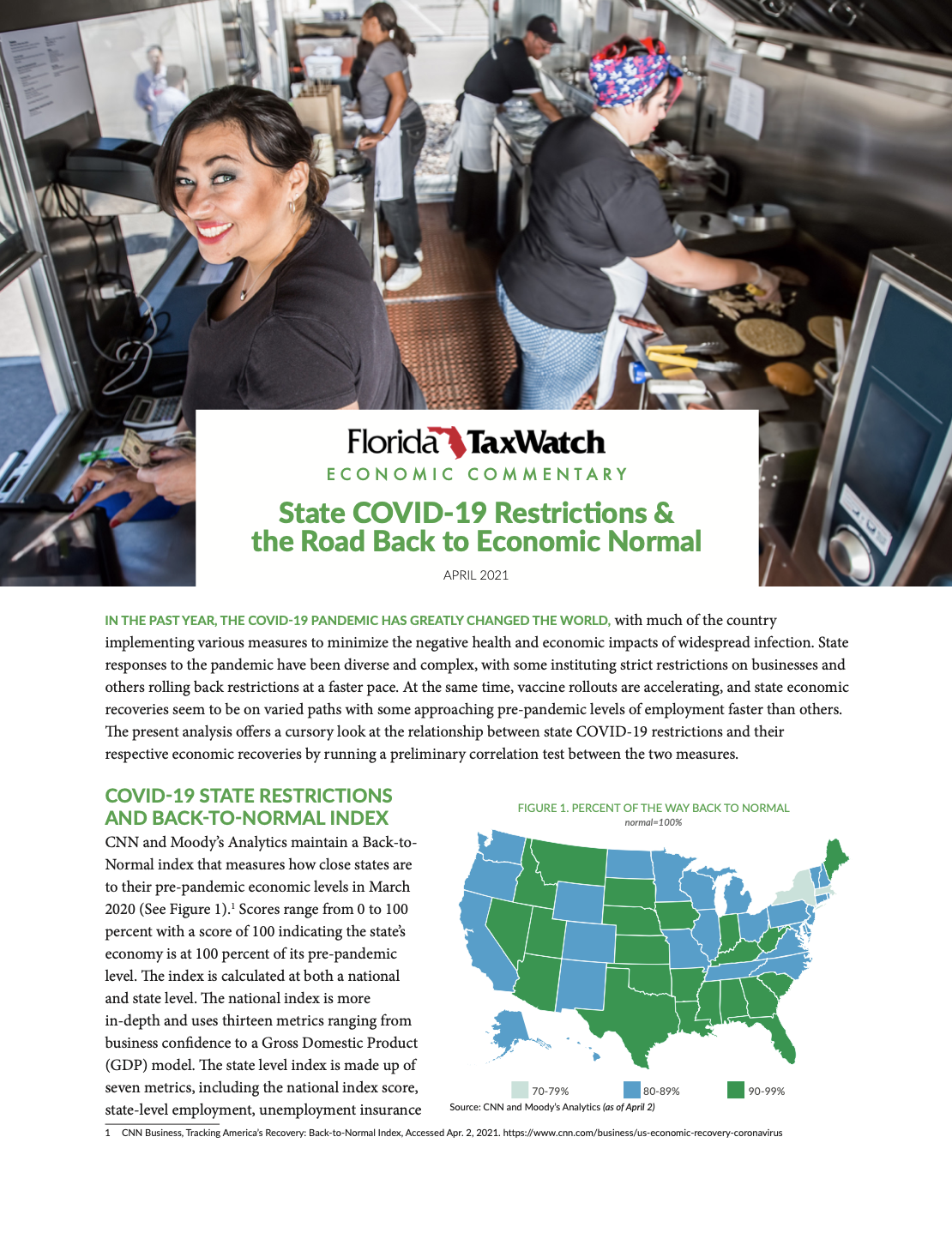
In the past year, the COVID-19 pandemic has greatly changed the world, with much of the country implementing various measures to minimize the negative health and economic impacts of widespread infection. State responses to the pandemic have been diverse and complex, with some instituting strict restrictions on businesses and others rolling back restrictions at a faster pace. At the same time, vaccine rollouts are accelerating, and state economic recoveries seem to be on varied paths with some approaching pre-pandemic levels of employment faster than others. 

The most basic way to study the potential relationship between a state’s level of COVID-19 restrictions and economic recovery is through a simple correlation test. This test compares the two indices and allows for general inference as to whether there is a positive or negative correlation between the two measures. The correlation test shows a moderately positive relationship with a correlation coefficient of 0.65. This positive correlation means states with fewer COVID-19 restrictions are typically found to have stronger economic recoveries.

Overall the data suggest that states implementing stricter COVID-19 guidelines are recovering at slower speeds compared to states that have lifted restrictions sooner. Even though the correlational results should be viewed with a degree of caution, it is worth understanding this trend in the data. The effect of restrictions on employment outcomes, especially among small businesses, appears to be driving the relationship in the results. For both measures—both the Back-to-Normal index and the state restriction level—employment is heavily weighted. As such, state measures that negatively impact local employment are likely to hurt economic recovery efforts.

Across the U.S., states will continue to grapple with differing economic recoveries even as the pace of vaccine administration quickens. Cross-country and cross-state research studies seem to suggest that although stay-at-home orders, lockdowns, and other restrictions can minimize the transmission of the virus and reduce health care utilization, these measures come with economic and societal costs that may hamper economic recoveries. Tradeoffs between restrictions and recovery exist and warrant more evidence-based research to understand their complex relationship. The emergence of more contagious virus strains coupled with an imprecise timeline for widespread herd immunity means the “health and wealth” tradeoffs debate will continue for the foreseeable future. For Florida specifically, the decision to maintain relatively fewer COVID-19 restrictions throughout the course of the pandemic has positioned the state in a stronger economic recovery relative to other states.

Documents to download

Previous Article Revisiting Efforts to Deregulate Florida’s Electric Power Market What We Learned from Texas' Blackouts
Next Article Beyond the Pandemic: Long-Term Changes and Challenges for Health in Florida
Print
4994
0Upvote 0Downvote
«December 2025»
MonTueWedThuFriSatSun
24252627282930
1234
OH, SNAP! Federal Policy Changes Threaten the Stability of Florida's Supplemental Nutrition Assistance Program

OH, SNAP! Federal Policy Changes Threaten the Stability of Florida's Supplemental Nutrition Assistance Program

Administered by the United States Department of Agriculture’s (USDA)’s Food and Nutrition Service (FNS), the Supplemental Nutrition Assistance Program (SNAP) provides funds to help low-income households afford low-cost, nutritious meals. In July 2025, President Trump signed the One Big Beautiful Bill Act of 2025 (the OBBB Act), tightening SNAP policies that determine eligibility, benefits, and program administration. Florida TaxWatch undertakes this independent research project to better understand how the upcoming changes in SNAP requirements will impact Florida’s budget and its ability to provide much needed food assistance to needy Floridians.

Read more
567
891011121314
15
2025 How Florida Counties Compare

2025 How Florida Counties Compare

This report compares the revenue and expenditure profiles of Florida’s 67 counties to give taxpayers an overview of how their local government stacks up with the rest of the state.

Read more
16
The Fiscal and Economic Impacts of Nova Southeastern University on Florida’s Economy

The Fiscal and Economic Impacts of Nova Southeastern University on Florida’s Economy

NSU generated an estimated $293.1 million in state and local taxes within the Tri-County region in FY 2024-25 and an estimated $305.1 million in state and local taxes in FY 2024-25.

Read more
17
Transferring Utility Profits to a Municipality's General Fund Increases the Risk of Undercapitalization of Water Assets and Violate Taxpayer Accountability

Transferring Utility Profits to a Municipality's General Fund Increases the Risk of Undercapitalization of Water Assets and Violate Taxpayer Accountability

Setting water utility rates that incorporate the recovery of the costs associated with standard operating expenses and debt obligations is essential to ensuring the short-term and longer-term financial stability of the utility. Once these costs are covered, many publicly owned utilities make transfers to the General Fund (a practice known as “sweeping”) ostensibly to help pay for governmental services that do not generate revenue (e.g., roadway maintenance, public safety, etc.) and to help keep property taxes lower. Keeping property taxes low often means higher municipal utility rates to balance the general budget, a habitual practice that burdens utility customers with cross-subsidies and normalizes underinvestment in infrastructure.

Read more
18
Florida Sheriffs’ Offices Staffing Analysis

Florida Sheriffs’ Offices Staffing Analysis

In May 2025, Florida TaxWatch and the Florida Sheriff Association conducted a joint survey to local sheriff offices to learn more about law enforcement’s workforce challenges.

Read more
192021
22232425262728
2930311234

Archive