The Backbone of the Economy: How Small Businesses in Florida Have Fared During the Pandemic
Small businesses are major drivers in the U.S. economy, spurring local job creation and innovation while also fostering entrepreneurship among women, minorities, veterans, and other portions of the population. Nationally, small businesses account for 48 percent of all American jobs and contribute 43.5 percent of U.S. Gross Domestic Product (GDP). Even though these businesses are considered the “backbone of the economy,” small businesses have faced an economic and existential crisis during the COVID-19 pandemic.

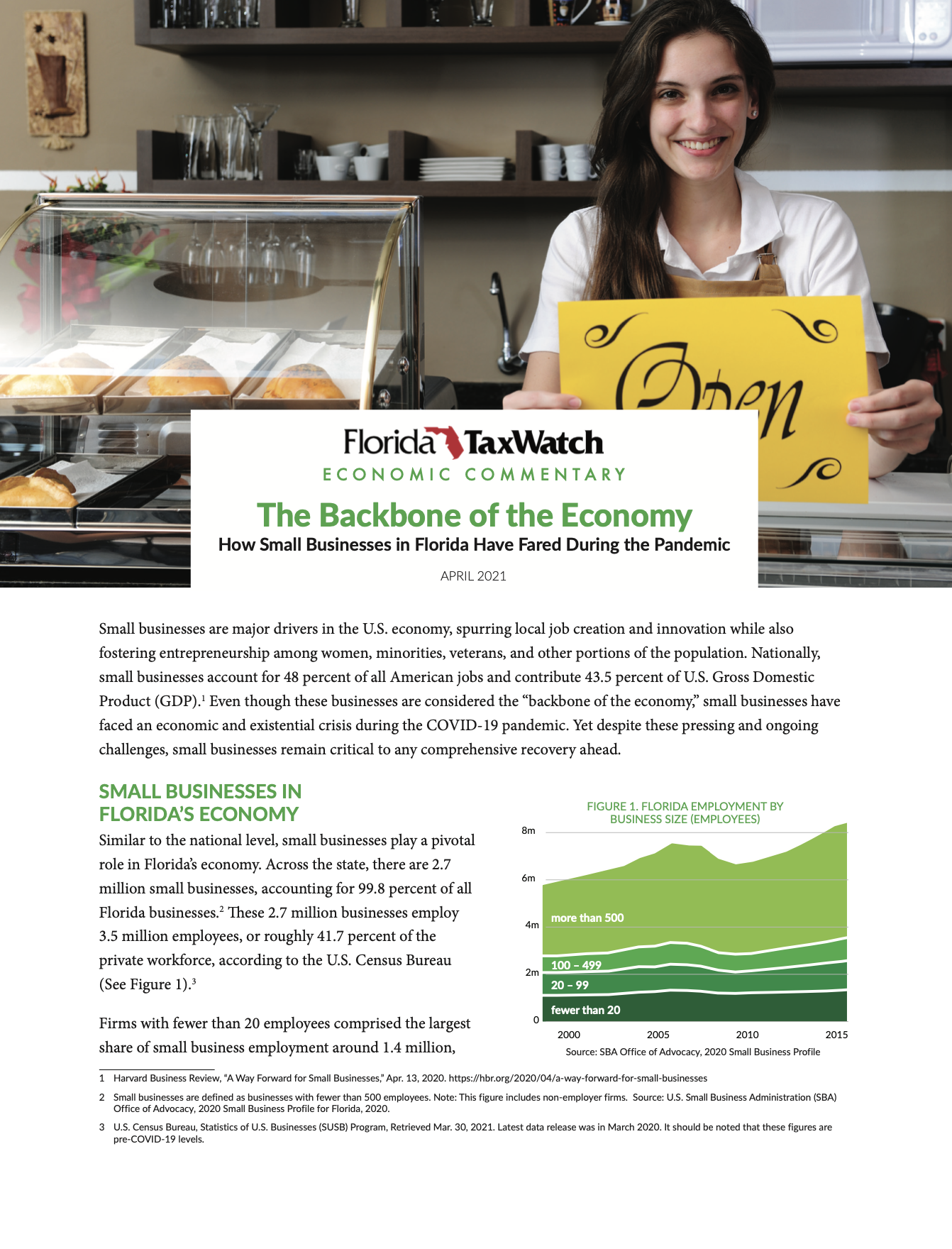
Similar to the national level, small businesses play a pivotal role in Florida’s economy. Across the state, there are 2.7 million small businesses, accounting for 99.8 percent of all Florida businesses. Based on data from Harvard University’s Economic Tracker, the number of small businesses open in Florida (compared to January 2020 before the pandemic) reached a low of -44.2 percent in April 2020 and since then has remained relatively stagnate around -32.0 percent since 2021 started. Paralleling the drop in small business openings, the drop in small business revenue has also been relegated below pre-pandemic levels. As of March 31, 2021, small business revenue in Florida was -31.0 percent relative to the beginning of 2020.

The situation becomes even more grave when looking at Florida’s hardest-hit economic sectors and when considering lending became more constricted as small businesses faced declining cash flow from falling consumer demand. The federal government’s Paycheck Protection Program (PPP) offered a lifeline in response. So far, Florida has received roughly 579,000 PPP loans, totaling an estimated $41 billion in aid.

Regardless of the challenges that small businesses presently face, they remain crucial to Florida’s long-term economic recovery. Before COVID-19, small businesses were responsible for 133,000 net new jobs in Florida, and of the state’s net new jobs since 2012, more than 81.4 percent come from small businesses with fewer than 500 employees. A few common threads run through the difficulties small businesses will continue to experience. First, of all the potential solution to mitigate risk and adapt, a lack of capital and financial resources will confine most businesses. Targeted federal assistance as seen through PPP loans is a necessary lifeline; however, these policies ultimately postpone, not eliminate, financial pressures. Furthermore, most small businesses will continue to endure slim operating margins as cash inflow will depend on consumer confidence. For Florida, since most small businesses are directly or indirectly related to the Leisure and Hospitality industry, they may continue to lag behind broader U.S. recovery efforts until a general uptick in tourism resumes. For policymakers and local leaders, understanding how policy changes may inordinately impact small businesses will be an important consideration for future discussions and decisions surrounding economic growth and development.

Documents to download

Previous Article Letter to the Governor on E-Fairness
Next Article Revisiting Efforts to Deregulate Florida’s Electric Power Market What We Learned from Texas' Blackouts
Print
8968
0Upvote 0Downvote
«December 2025»
MonTueWedThuFriSatSun
24252627282930
1234
OH, SNAP! Federal Policy Changes Threaten the Stability of Florida's Supplemental Nutrition Assistance Program

OH, SNAP! Federal Policy Changes Threaten the Stability of Florida's Supplemental Nutrition Assistance Program

Administered by the United States Department of Agriculture’s (USDA)’s Food and Nutrition Service (FNS), the Supplemental Nutrition Assistance Program (SNAP) provides funds to help low-income households afford low-cost, nutritious meals. In July 2025, President Trump signed the One Big Beautiful Bill Act of 2025 (the OBBB Act), tightening SNAP policies that determine eligibility, benefits, and program administration. Florida TaxWatch undertakes this independent research project to better understand how the upcoming changes in SNAP requirements will impact Florida’s budget and its ability to provide much needed food assistance to needy Floridians.

Read more
567
891011121314
15
2025 How Florida Counties Compare

2025 How Florida Counties Compare

This report compares the revenue and expenditure profiles of Florida’s 67 counties to give taxpayers an overview of how their local government stacks up with the rest of the state.

Read more
16
The Fiscal and Economic Impacts of Nova Southeastern University on Florida’s Economy

The Fiscal and Economic Impacts of Nova Southeastern University on Florida’s Economy

NSU generated an estimated $293.1 million in state and local taxes within the Tri-County region in FY 2024-25 and an estimated $305.1 million in state and local taxes in FY 2024-25.

Read more
17
Transferring Utility Profits to a Municipality's General Fund Increases the Risk of Undercapitalization of Water Assets and Violate Taxpayer Accountability

Transferring Utility Profits to a Municipality's General Fund Increases the Risk of Undercapitalization of Water Assets and Violate Taxpayer Accountability

Setting water utility rates that incorporate the recovery of the costs associated with standard operating expenses and debt obligations is essential to ensuring the short-term and longer-term financial stability of the utility. Once these costs are covered, many publicly owned utilities make transfers to the General Fund (a practice known as “sweeping”) ostensibly to help pay for governmental services that do not generate revenue (e.g., roadway maintenance, public safety, etc.) and to help keep property taxes lower. Keeping property taxes low often means higher municipal utility rates to balance the general budget, a habitual practice that burdens utility customers with cross-subsidies and normalizes underinvestment in infrastructure.

Read more
18
Florida Sheriffs’ Offices Staffing Analysis

Florida Sheriffs’ Offices Staffing Analysis

In May 2025, Florida TaxWatch and the Florida Sheriff Association conducted a joint survey to local sheriff offices to learn more about law enforcement’s workforce challenges.

Read more
192021
22232425262728
2930311234

Archive