What is a K-Shaped Recovery and Why It Matters
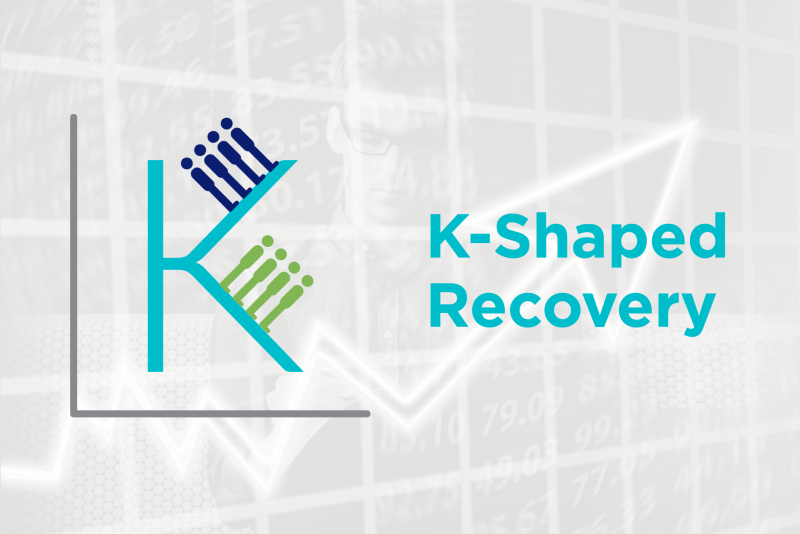
As the federal government continues to negotiate another round of fiscal stimulus, chances are you have heard the term “K-shaped recovery” thrown around. The issue became a common talking point during last year’s presidential election as some candidates discussed their plans to heal the economy. But what exactly is a K-shaped recovery and what does it have to do with the economy?
Economists are notorious for ascribing letters to describe the path of recovery during a recession. A “V” shaped recovery refers to a recession that begins with a steep decline but then quickly rebounds. A “U” shaped recovery begins with a slightly slower decline but then stagnates at the bottom before improving. Finally, a “W” shaped recovery indicates a situation where the economy quickly declines and recovers swiftly, only to turn down again after displaying a false sign of strength.
Unlike all these previous shapes, a “K” shaped recovery is a newly coined term that refers to an uneven economic recovery where certain subsets of the population recover at different rates. There is a divergence between those who can recover fast and those who are unable to—hence, the “K” shape. Most commonly, the divergence occurs along income or industry lines.
The evidence seems to suggest this form of recovery is underway in the overall economy. The COVID-19 pandemic disproportionately affected certain service industries, such as travel, retail, entertainment, hospitality, and food services. According to the U.S. Chamber of Commerce, leisure and entertainment have only brought back 74% of their workforce. At the same time, industries that allowed for easier adoption of remote work recovered at a faster rate, such as technology and financial services. By some estimates, the financial services sector has already reclaimed 94% of its pre-pandemic employment.[1]
These effects have rippled throughout the economy and have placed a sizeable burden on low-income individuals who often hold jobs in these affected industries. In Florida, as of mid-December 2020, employment among workers in the bottom wage quartile stood at -16.1% relative to January 2020. At the same time, those Floridians among the highest wage quartile saw employment at +5.8% relative to January 2020.[2]
Of particular concern, an ongoing K-shaped recovery will have lasting implications for low-income families and children. Throughout the pandemic, low-income parents have been less likely to be able to work from home and arrange child care compared to higher-income parents. When K-12 schools closed last year, many low-income students did not have stable internet access or suitable learning environments at home, making them more prone to educational losses.
Estimates suggest that across the U.S. only 60% of low-income students are regularly logging into online instruction, while 90% of their higher-income peers are. Lower mathematical and literacy skills will widen the achievement gap by as much as 15 to 20 percent. The loss of learning for low-income students will increase high-school dropout rates in coming years and is expected to translate into lost lifetime earnings of between $61,000 and $82,000 per student.[3]
Children in poverty will also face major challenges to their long-term development and maturation. Food insecurity is a major risk among families that traditionally rely on school lunches to provide free or reduced meals. Kids suffering from food insecurity are twice as likely to be in fair or poor health and are more likely to experience deficiencies with their motor, social, and cognition skills.[4] All these effects would further worsen education outcomes and prompt higher health care costs later in life. Since these long-term impacts from COVID-19 will not fully manifest until students are much older, any present study that seeks to quantify the cost to society will likely underestimate the true cost.
A few months into 2021, it seems that the national economy is on an accelerating path to recovery. Reports suggesting that national GDP growth is quickly rising is encouraging news; however, what must not be glossed over is the uneven impact for different parts of the population, particularly for low-income families. A K-shaped recovery is more than just a new term for economists to equip their academic jargon. It is a real feature with important, long-term outcomes—many of which may prove detrimental in the years to come. There remains a lot of work to be done, even as the economy begins the steady climb out of the pandemic pit.
[1] U.S. Chamber of Commerce, “What is a K-Shaped Recovery?” Published on September 3, 2020.
[2] Harvard University, Opportunity Insights: Economic Tracker, Accessed on March 1, 2021.
[3] McKinsey & Company, “COVID-19 and Student Learning in the United States: The Hurt Could Last a Lifetime,” Published on June 1, 2020.
[4] USA Today, “Why Partisan Politics Keeps 14 Million Hungry Children from Getting the Food they Need,” Published on Oct. 28, 2020.