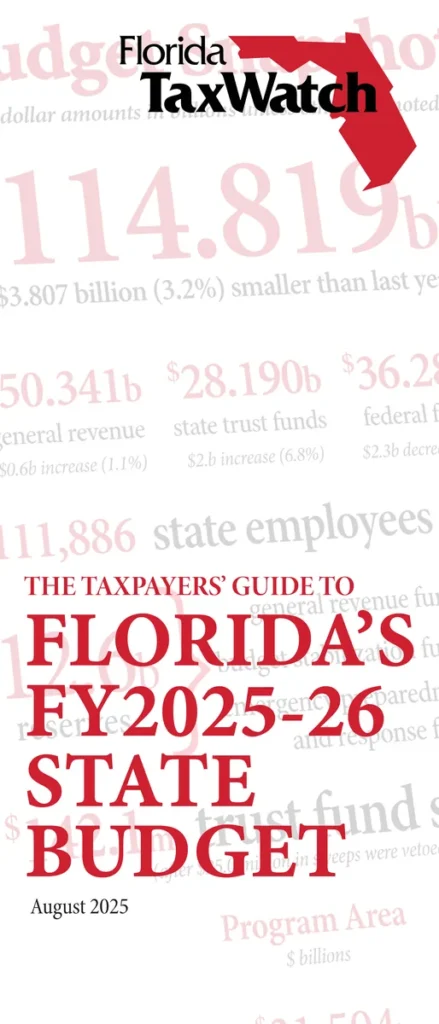
The Taxpayer's Guide to Florida's FY2025-26 State Budget

The Taxpayers’ Guide to Florida’s FY2025-26 State Budget Cover

Florida TaxWatch’s The Taxpayers’ Guide to Florida’s FY2025-26 State Budget explains the Legislature’s $114.8 billion spending plan (after $376 million in line-item vetoes)—a 3.2% decrease from FY2024-25—while maintaining $12.6 billion in reserves. General Revenue (GR) spending rises by $556 million, and the recurring GR base increases by $1.9 billion, even as total positions fall to 111,886 (-1,871).

The Guide highlights major taxpayer impacts: $2.1 billion in tax relief anchored by the final elimination of the Business Rent Tax (~$1.5 billion annual savings for Florida businesses) and a continued focus on debt reduction—$580 million this year plus a new $250 million/year Debt Reduction Program. It also flags the scale of member projects (~1,700, well over $2.5 billion) and the redirection of key environmental funding streams.

  • Education: FEFP totals $29.5B; per-student rises to $9,130 (+$143). Local property taxes cover 71.4% of the increase (~$674M). New Academic Acceleration supplement: $596.7M. Teacher/Instructional compensation: $1.357B.
  • Human Services: Medicaid/TANF appropriations at $36.1B with targeted rate increases; KidCare +$135.8M (209,438 kids). Health Care Innovation revolving loans: $50M. Expanded elder-care access and Alzheimer’s funding ($73.9M).
  • Environment: Dedicated gaming-revenue stream for the Water Quality Improvement (WQI) program is eliminated; WQI funded at $436.5M but used entirely for 314 member projects. Everglades investment: $810.5M. Resilient Florida: $150M. Florida Forever: $18M; Rural & Family Lands: $250M.
  • Transportation: DOT Work Program $13.7B (highways, bridges, resurfacing, transit, ports, aviation, trails). Local member transportation projects total $210.9M (41 vetoes, $38.9M).
  • General Gov & Public Safety: State employee pay raise 2% (min $1,000). My Safe Florida Home $280M. Job Growth Grant Fund $50M. VISIT FLORIDA $80M. Judiciary gains 39 new judges; multiple justice/public-safety IT upgrades.

Download Full Report (PDF)

Meet the Author:

Kurt Wenner
Kurt Wenner
Senior Vice President of Research
LinkedIn

Documents to download

Previous Article Apportionment Changes Amid Policy Proposals
Next Article Trends in the Cost of Construction Materials
Print
4552
1Upvote 0Downvote
«February 2026»
MonTueWedThuFriSatSun
26
Florida’s Space Coast is Well-Positioned to Dominate the Future of the Aerospace Industry

Florida’s Space Coast is Well-Positioned to Dominate the Future of the Aerospace Industry

For more than 60 years, Florida’s Space Coast—anchored by Kennedy Space Center (KSC) and Cape Canaveral Space Force Station (CCSFS)—has served as a premier gateway to space, driving tourism, high-tech jobs, and statewide economic output. After major federal program shifts in the 2010s led to significant regional job losses, Florida’s modern commercial-space resurgence—supported by Space Florida’s strategy to diversify the supply chain, modernize infrastructure, and attract private capital—has positioned the Space Coast to lead the next era of aerospace growth.

Read more
27282930311
2345
New General Revenue Forecast Adds $572.5 Million for the Next Budget

New General Revenue Forecast Adds $572.5 Million for the Next Budget

The General Revenue (GR) Estimating Conference met on January 23 to adopt Florida’s latest GR forecast—the estimate that tells lawmakers how much is available for the next state budget. The updated forecast adds $572.5 million to the amount available for the upcoming budget year, but while meaningful, it amounts to only about one percent of total GR collections.

Read more
678
910
Clearwater’s Plan to Establish Its Own Municipal Electric Utility Puts Taxpayers at Risk

Clearwater’s Plan to Establish Its Own Municipal Electric Utility Puts Taxpayers at Risk

Florida TaxWatch examines the City of Clearwater’s plan to acquire Duke Energy Florida’s electric distribution assets and establish a municipal electric utility (MEU) in response to concerns over electric rates and service quality. While the City’s feasibility study projects modest short-term rate savings, Florida TaxWatch finds those projections rely on unrealistic assumptions—most notably an “overnight” conversion that ignores the likely decade-long, costly eminent domain process required to acquire Duke’s assets. Drawing on national municipalization case studies, the report highlights high failure rates, underestimated acquisition and severance costs, loss of economies of scale, and substantial financial exposure for taxpayers. Florida TaxWatch concludes that the proposed MEU represents a high-risk endeavor with limited upside and recommends the City pursue a renegotiated franchise agreement with Duke Energy Florida as a more prudent path forward.

Read more
1112131415
16171819202122
2324252627281
2345678

Archive