Florida TaxWatch 2025 Legislative Session Wrap-Up: Extended Session Edition - Includes Final Budget, Tax Package, and Vetoes

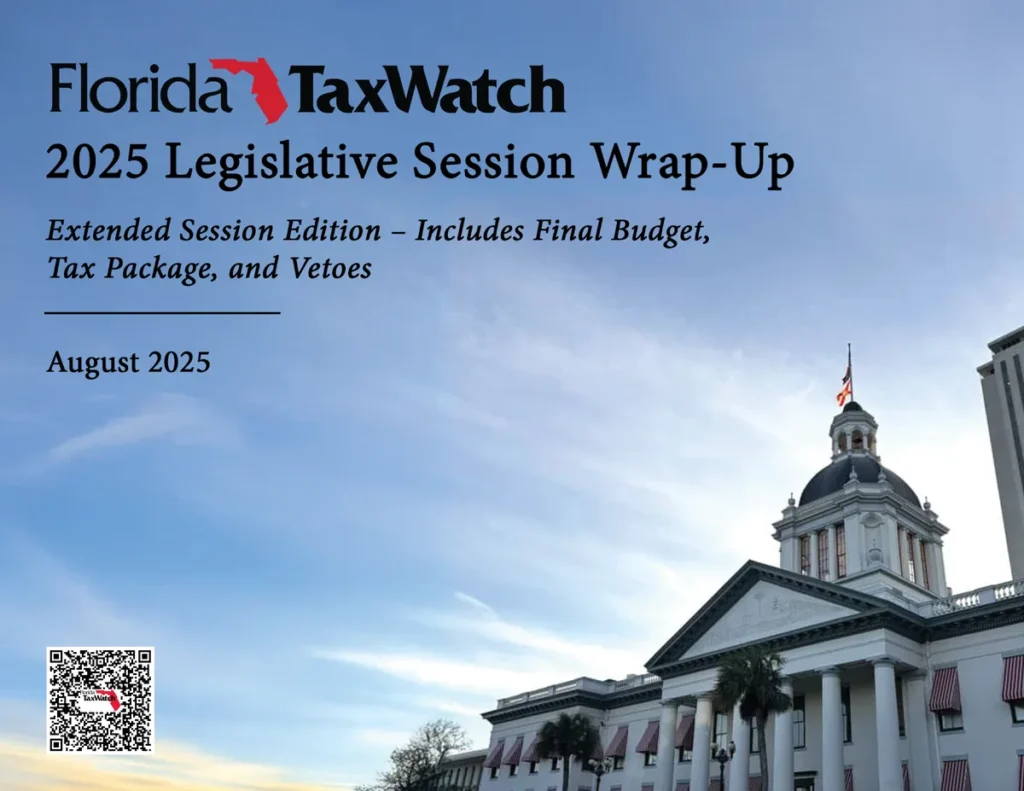
2025 Legislative Session Wrap-up Report Cover

Florida TaxWatch's 2025 Legislative Session Wrap-up Report provides a comprehensive analysis of Florida's extended legislative session that concluded June 16 with a $115.1 billion budget and $2.0 billion tax package. The Governor signed the budget on June 30 and issued $376 million in line-item vetoes, resulting in a net budget of $114.8 billion while maintaining strong fiscal reserves of $12.6 billion.

The report examines key legislative achievements including the repeal of the Business Rent Tax (BRT) effective October 1, 2025, delivering $1.3 billion in state savings, and making the Back-to-School sales tax holiday permanent with $217 million in annual consumer savings. It also analyzes continued challenges with member projects—approximately 1,700 earmarks totaling over $2.5 billion—and highlights Florida's accelerated debt reduction efforts, including $580 million dedicated this year and a cumulative $7.3 billion in tax-supported debt retired since 2019.

The analysis covers education funding with FEFP at $29.5 billion ($9,130 per student), health and human services anchored by $36.5 billion for Medicaid/KidCare, substantial environmental investments exceeding $4 billion across various water and conservation programs, and a 2% state workforce pay raise. Florida TaxWatch recommends continued fiscal discipline, enhanced transparency in project selection, and systematic implementation of tax reforms to maximize taxpayer value and maintain Florida's strong fiscal position.

Download Full Report (PDF)

Meet the Author:

Kurt Wenner
Kurt Wenner
Senior Vice President of Research
LinkedIn

Documents to download

Previous Article The Census Undercount Limits Florida’s Political Influence
Next Article Hospice and Palliative Care
Print
1018
0Upvote 0Downvote
«December 2025»
MonTueWedThuFriSatSun
24252627282930
1234
OH, SNAP! Federal Policy Changes Threaten the Stability of Florida's Supplemental Nutrition Assistance Program

OH, SNAP! Federal Policy Changes Threaten the Stability of Florida's Supplemental Nutrition Assistance Program

Administered by the United States Department of Agriculture’s (USDA)’s Food and Nutrition Service (FNS), the Supplemental Nutrition Assistance Program (SNAP) provides funds to help low-income households afford low-cost, nutritious meals. In July 2025, President Trump signed the One Big Beautiful Bill Act of 2025 (the OBBB Act), tightening SNAP policies that determine eligibility, benefits, and program administration. Florida TaxWatch undertakes this independent research project to better understand how the upcoming changes in SNAP requirements will impact Florida’s budget and its ability to provide much needed food assistance to needy Floridians.

Read more
567
891011121314
15
2025 How Florida Counties Compare

2025 How Florida Counties Compare

This report compares the revenue and expenditure profiles of Florida’s 67 counties to give taxpayers an overview of how their local government stacks up with the rest of the state.

Read more
16
The Fiscal and Economic Impacts of Nova Southeastern University on Florida’s Economy

The Fiscal and Economic Impacts of Nova Southeastern University on Florida’s Economy

NSU generated an estimated $293.1 million in state and local taxes within the Tri-County region in FY 2024-25 and an estimated $305.1 million in state and local taxes in FY 2024-25.

Read more
17
Transferring Utility Profits to a Municipality's General Fund Increases the Risk of Undercapitalization of Water Assets and Violate Taxpayer Accountability

Transferring Utility Profits to a Municipality's General Fund Increases the Risk of Undercapitalization of Water Assets and Violate Taxpayer Accountability

Setting water utility rates that incorporate the recovery of the costs associated with standard operating expenses and debt obligations is essential to ensuring the short-term and longer-term financial stability of the utility. Once these costs are covered, many publicly owned utilities make transfers to the General Fund (a practice known as “sweeping”) ostensibly to help pay for governmental services that do not generate revenue (e.g., roadway maintenance, public safety, etc.) and to help keep property taxes lower. Keeping property taxes low often means higher municipal utility rates to balance the general budget, a habitual practice that burdens utility customers with cross-subsidies and normalizes underinvestment in infrastructure.

Read more
18
Florida Sheriffs’ Offices Staffing Analysis

Florida Sheriffs’ Offices Staffing Analysis

In May 2025, Florida TaxWatch and the Florida Sheriff Association conducted a joint survey to local sheriff offices to learn more about law enforcement’s workforce challenges.

Read more
192021
22232425262728
2930311234

Archive