The Impacts of Impact Fees on the Cost of Housing
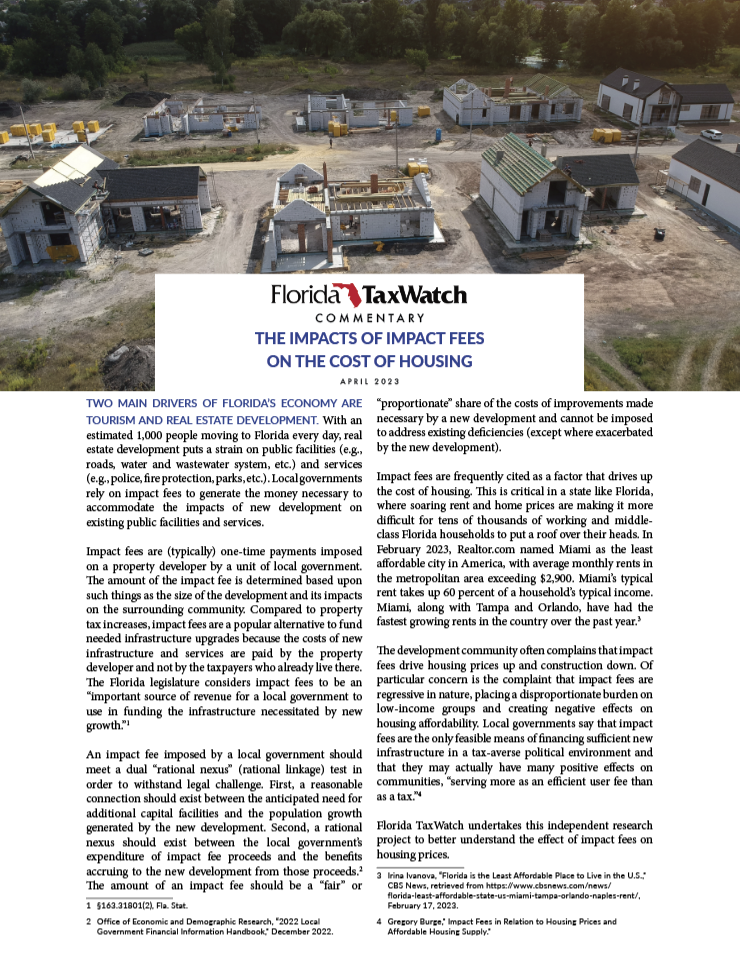 Impact fees are (typically) one-time payments imposed on a property developer by a unit of local government. The amount of the impact fee is determined based upon such things as the size of the development and its impacts on the surrounding community. Compared to property tax increases, impact fees are a popular alternative to fund needed infrastructure upgrades because the costs of new infrastructure and services are paid by the property developer and not by the taxpayers who already live there. The Florida legislature considers impact fees to be an “important source of revenue for a local government to use in funding the infrastructure necessitated by new growth.”
An impact fee imposed by a local government should meet a dual “rational nexus” (rational linkage) test in order to withstand legal challenge. First, a reasonable connection should exist between the anticipated need for additional capital facilities and the population growth generated by the new development. Second, a rational nexus should exist between the local government’s expenditure of impact fee proceeds and the benefits accruing to the new development from those proceeds. The amount of an impact fee should be a “fair” or “proportionate” share of the costs of improvements made necessary by a new development and cannot be imposed to address existing deficiencies (except where exacerbated by the new development).
Impact fees are frequently cited as a factor that drives up the cost of housing. This is critical in a state like Florida, where soaring rent and home prices are making it more difficult for tens of thousands of working and middle-class Florida households to put a roof over their heads. In February 2023, Realtor.com named Miami as the least affordable city in America, with average monthly rents in the metropolitan area exceeding $2,900. Miami’s typical rent takes up 60 percent of a household’s typical income. Miami, along with Tampa and Orlando, have had the fastest growing rents in the country over the past year.
The development community often complains that impact fees drive housing prices up and construction down. Of particular concern is the complaint that impact fees are regressive in nature, placing a disproportionate burden on low-income groups and creating negative effects on housing affordability. Local governments say that impact fees are the only feasible means of financing sufficient new infrastructure in a tax-averse political environment and that they may actually have many positive effects on communities, “serving more as an efficient user fee than as a tax.”
Florida TaxWatch undertakes this independent research project to better understand the effect of impact fees on housing prices.