A Key to Overcoming Disasters: Complete Census Data Reinforces Resiliency
Florida beaches are a treasure to the state, and as such, many residents strive to remain in close proximity to the shoreline. Statewide, 64.2 percent of employment and 79.2 percent of businesses are found within Florida’s 35 coastal counties.1 Unfortunately, the luring lifestyle of beaches comes at a cost; the homes and livelihoods of most Floridians are tied to areas susceptible to hurricane havoc.
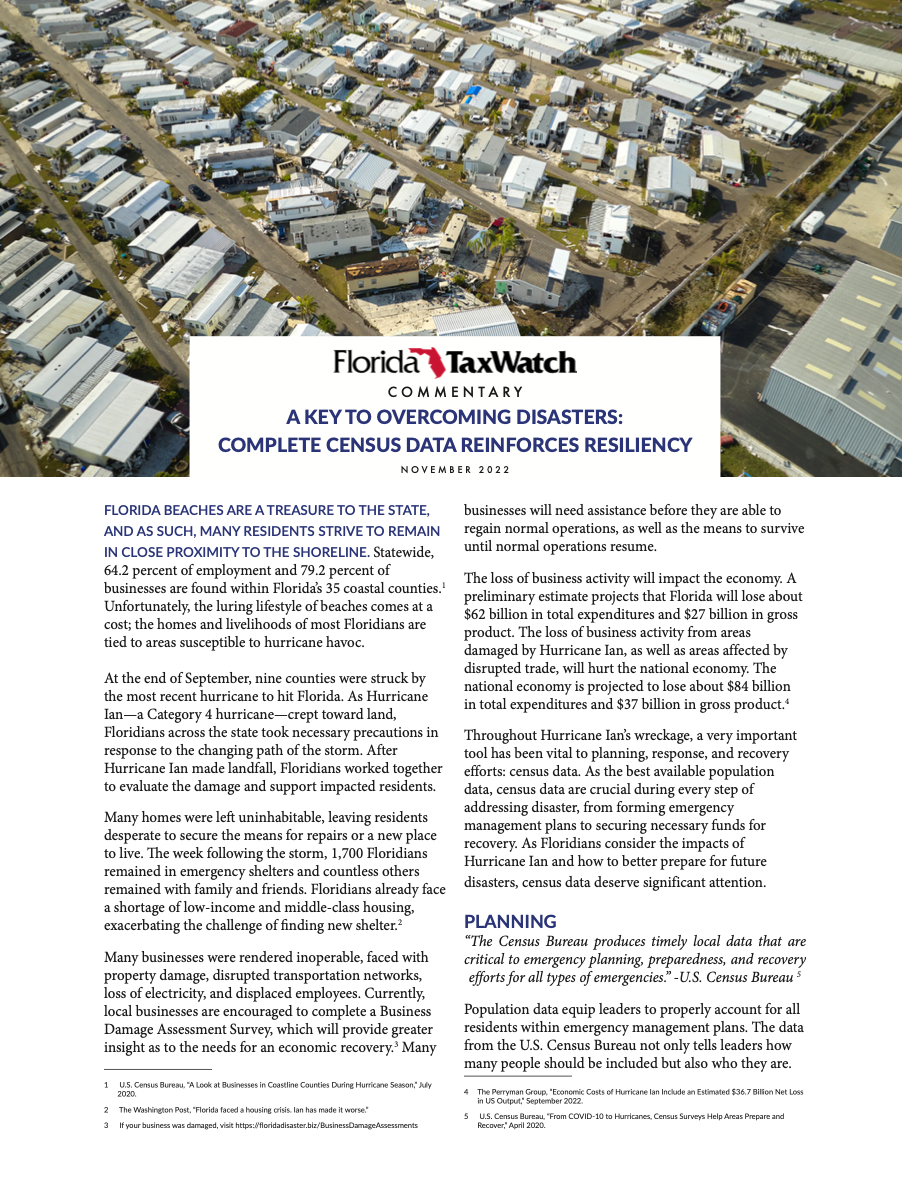
At the end of September, nine counties were struck by the most recent hurricane to hit Florida. As Hurricane Ian—a Category 4 hurricane—crept toward land, Floridians across the state took necessary precautions in response to the changing path of the storm. After Hurricane Ian made landfall, Floridians worked together to evaluate the damage and support impacted residents.
Many homes were left uninhabitable, leaving residents desperate to secure the means for repairs or a new place to live. The week following the storm, 1,700 Floridians remained in emergency shelters and countless others remained with family and friends. Floridians already face a shortage of low-income and middle-class housing, exacerbating the challenge of finding new shelter.
Many businesses were rendered inoperable, faced with property damage, disrupted transportation networks, loss of electricity, and displaced employees. Currently, local businesses are encouraged to complete a Business Damage Assessment Survey, which will provide greater insight as to the needs for an economic recovery.3 Many
businesses will need assistance before they are able to regain normal operations, as well as the means to survive until normal operations resume.
The loss of business activity will impact the economy. A preliminary estimate projects that Florida will lose about $62 billion in total expenditures and $27 billion in gross product. The loss of business activity from areas damaged by Hurricane Ian, as well as areas affected by disrupted trade, will hurt the national economy. The national economy is projected to lose about $84 billion in total expenditures and $37 billion in gross product.
Throughout Hurricane Ian’s wreckage, a very important tool has been vital to planning, response, and recovery efforts: census data. As the best available population data, census data are crucial during every step of addressing disaster, from forming emergency management plans to securing necessary funds for recovery. As Floridians consider the impacts of Hurricane Ian and how to better prepare for future disasters, census data deserve significant attention.
RESPONSE
Population data equip leaders to properly account for all residents within emergency management plans. The data from the U.S. Census Bureau not only tells leaders how many people should be included but also who they are. The decennial census count is the backbone of the American Community Survey (ACS) estimates, which share the economic, demographic, and social characteristics of residents. The ACS estimates can share narrow but important details about communities, such as how many people may struggle to afford transportation during an evacuation or how many people lack internet access as a means of tracking the storm. This information is invaluable to decision-makers, helping them create nuanced, thorough plans.
RECOVERY
An early estimate projects that the storm surge and winds caused by Hurricane Ian produced $28 billion to $47 billion of loss for residential and commercial properties. If the greater side of the range is accurate, Ian will be the 8th costliest hurricane in the history of the United States. As Floridians try to build back their communities following the wreckage of Hurricane Ian, census-derived federal funding provides crucial support.
The affected regions will witness effects for years, and to assess the damage and track progress, stakeholders will rely upon census data. The data share many essential indicators that tend to waver after a disaster, such as the number of people using federal assistance, changes in homeownership, estimated poverty levels, commute times to work, and changes in employment. This data will also help emergency planners understand vulnerabilities to consider before the next disaster approaches.
FLORIDA’S MISSED OPPORTUNITY: A COMPLETE CENSUS COUNT SUPPORTS RESILIENCE
Higher self-response rates for the census are correlated with more complete census data, because the remaining methods for data collection are less reliable. Florida’s undercount limits data and resources, restraining its full potential to overcome disasters. A census undercount means emergency plans are based upon population counts smaller than reality, creating a blind spot for evacuation strategies, recovery efforts, and attempts to track the changing needs of the community. Federal spending is allocated without consideration for the uncounted individuals, leaving money on the table that should be used to help Floridians.
LOOKING AHEAD
Florida will always be at the mercy of hurricanes. As Florida’s climate continues to change, the threat of more frequent and intense coastal storms will increase. To secure the best information for planning and rescues, as well as to ensure the state has abundant funding to rebuild, residents should be encouraged to complete their census surveys. Completing a census survey is a civic duty, and as Floridians face inevitable storms like Hurricane Ian, they deserve accurate and complete data to bolster optimal outcomes.