Florida's FY2022-23 State Budget
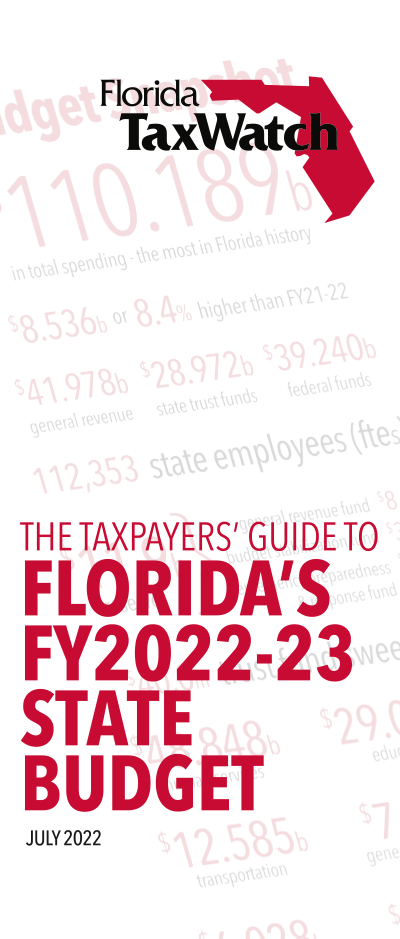
 

Florida TaxWatch is pleased to present taxpayers with a guide to the FY2022-23 state budget, which went into effect July 1, 2022. The report includes all appropriations for the new fiscal year— the General Appropriations Act (GAA), “back-of-bill” spending, and general bills—net of the Governor’s vetoes.

With billions in federal aid coming to Florida during the pandemic, and state revenue collections well-above pre-COVID levels, the 2022 Legislature came into session with an historically high budget surplus. Including the $3.5 billion in federal fiscal recovery funds not yet spent, lawmakers had almost $54 billion in GR available for the new budget. As a comparison, the 2021 Legislature appropriated $36.5 billion in GR.

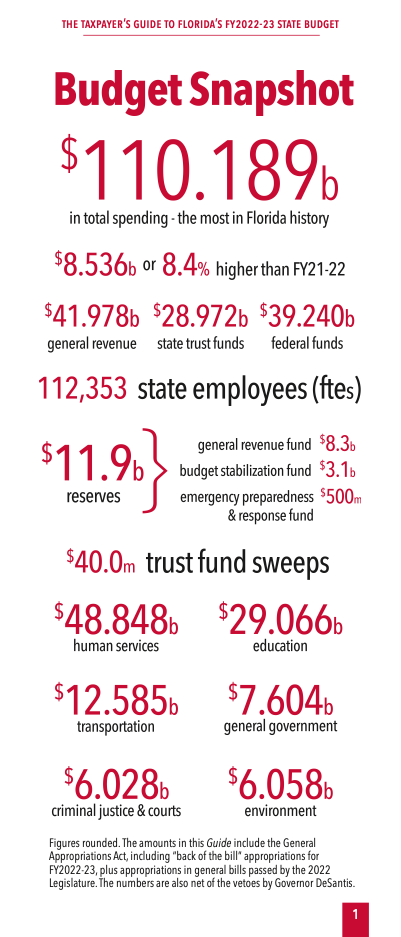
The 2022 Legislature passed a record $112.1 billion budget. After adjusting for other appropriations and vetoes, appropriations for FY2022-23 total $110.189 billion, an 8.4 percent increase over current spending. The state budget has grown by nearly 20 percent in two years. In addition, the GAA includes $3.5 billion in federal fiscal recovery funds and another $2.1 billion in federal and state funds in the “back-of-the-bill” which are not included in these totals (because they are technically appropriated for FY2021-22).

This increased revenue led the 2022 Legislature to invest in state employees with an across-the-board 5.4 percent pay raise (plus numerous other targeted pay enhancements) and provide substantial increases in per-student spending and education facilities, environmental, and health care spending. And, of course, legislators passed an unprecedented number of local projects to take back home. (See the Florida TaxWatch 2022 Budget Turkey Watch report).

Lawmakers also provided $1 billion in tax relief, most of it going to individual taxpayers, with relatively little targeted at businesses. Even with all these spending initiatives, the state still has record General Revenue (GR) reserves of $11.9 billion (a number that is sure to grow considerably when the next revenue estimates are adopted in August).

These reserves were boosted by the Governor’s $3 billion in line-item vetoes. While not all these vetoes reduced the size of the budget, they did cut FY2022-23 spending by $2.1 billion ($1.9 billion in GR). In addition to many facts and figures explaining this year’s budget, this guide also provides past data to put it in historical context. We hope this annual budget pocket guide gives you the information you need to better understand where and how your hard-earned tax dollars are being spent.

Documents to download

Previous Article 2022 Florida Legislative Session Wrap-Up
Next Article Why Taxpayers Should Care about Workforce Instability with Florida’s Public Defenders and State Attorneys
Print
13725
0Upvote 0Downvote
«December 2025»
MonTueWedThuFriSatSun
24252627282930
1234
OH, SNAP! Federal Policy Changes Threaten the Stability of Florida's Supplemental Nutrition Assistance Program

OH, SNAP! Federal Policy Changes Threaten the Stability of Florida's Supplemental Nutrition Assistance Program

Administered by the United States Department of Agriculture’s (USDA)’s Food and Nutrition Service (FNS), the Supplemental Nutrition Assistance Program (SNAP) provides funds to help low-income households afford low-cost, nutritious meals. In July 2025, President Trump signed the One Big Beautiful Bill Act of 2025 (the OBBB Act), tightening SNAP policies that determine eligibility, benefits, and program administration. Florida TaxWatch undertakes this independent research project to better understand how the upcoming changes in SNAP requirements will impact Florida’s budget and its ability to provide much needed food assistance to needy Floridians.

Read more
567
891011121314
15
2025 How Florida Counties Compare

2025 How Florida Counties Compare

This report compares the revenue and expenditure profiles of Florida’s 67 counties to give taxpayers an overview of how their local government stacks up with the rest of the state.

Read more
16
The Fiscal and Economic Impacts of Nova Southeastern University on Florida’s Economy

The Fiscal and Economic Impacts of Nova Southeastern University on Florida’s Economy

NSU generated an estimated $293.1 million in state and local taxes within the Tri-County region in FY 2024-25 and an estimated $305.1 million in state and local taxes in FY 2024-25.

Read more
17
Transferring Utility Profits to a Municipality's General Fund Increases the Risk of Undercapitalization of Water Assets and Violate Taxpayer Accountability

Transferring Utility Profits to a Municipality's General Fund Increases the Risk of Undercapitalization of Water Assets and Violate Taxpayer Accountability

Setting water utility rates that incorporate the recovery of the costs associated with standard operating expenses and debt obligations is essential to ensuring the short-term and longer-term financial stability of the utility. Once these costs are covered, many publicly owned utilities make transfers to the General Fund (a practice known as “sweeping”) ostensibly to help pay for governmental services that do not generate revenue (e.g., roadway maintenance, public safety, etc.) and to help keep property taxes lower. Keeping property taxes low often means higher municipal utility rates to balance the general budget, a habitual practice that burdens utility customers with cross-subsidies and normalizes underinvestment in infrastructure.

Read more
18
Florida Sheriffs’ Offices Staffing Analysis

Florida Sheriffs’ Offices Staffing Analysis

In May 2025, Florida TaxWatch and the Florida Sheriff Association conducted a joint survey to local sheriff offices to learn more about law enforcement’s workforce challenges.

Read more
192021
22232425262728
2930311234

Archive