INTERNATIONAL TRADE AS A CATALYST FOR FLORIDA’S ECONOMY
Critical for Florida’s continued innovation, growth, and diversification, international trade must be a key priority in the dynamic post-pandemic economy. Despite facing significant headwinds in recent years, Florida will continue to serve as a global trading hub, leveraging its multimodal transportation network, advanced manufacturing capabilities, and unparalleled access to markets in Latin America and the Caribbean. Yet the combination of localized lockdowns, supply chain disruptions, and geopolitical conflicts around the world speak to ongoing uncertainties and underscore an urgency for adequate resiliency. Florida can take proactive steps to improve resiliency against unforeseen disruptions while also catalyzing future economic prosperity through international trade.

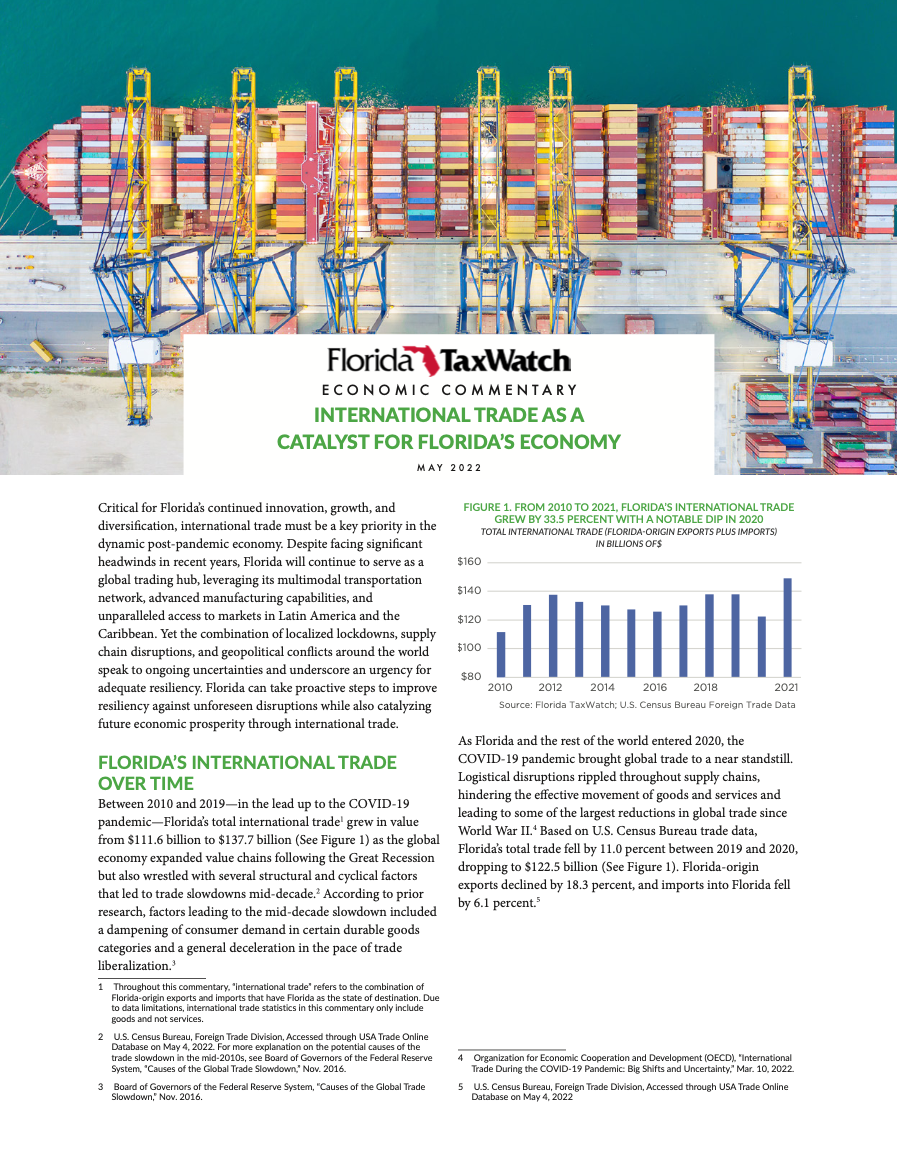
Between 2010 and 2019—in the lead up to the COVID-19 pandemic—Florida’s total international trade grew in value from $111.6 billion to $137.7 billion (See Figure 1) as the global economy expanded value chains following the Great Recession but also wrestled with several structural and cyclical factors that led to trade slowdowns mid-decade. As Florida and the rest of the world entered 2020, the COVID-19 pandemic brought global trade to a near standstill. Despite the considerable decline, trade came roaring back in 2021—a testament to Florida’s “open for business” strategy and a general easing in some pandemic pressures. By the end of 2021, total trade eclipsed $149.1 billion (higher than pre-pandemic levels), and Florida-based exports reached $55.5 billion. For comparison, pre-pandemic Florida-based exports were $55.9 billion in 2019.

Looking ahead to the remainder of 2022, Florida’s monthly exports appear poised to steadily grow. Based on Florida TaxWatch forecasts, monthly exports are anticipated to average $5.6 billion through the rest of 2022 (See Figure 2). For Florida to continue capturing the economic benefits that accrue from international trade, the state must pursue several strategies, including but not limited to: manufacturing more in the state; improving supply chain resiliency through tools like Connex Florida; boosting Florida-origin exports; and expanding trade opportunities with international partners in Latin America, the Caribbean, and emerging markets.

Entering 2022, global trade was forecasted to rise by 4.7 percent year-over-year; however, due to geopolitical tensions in eastern Europe and escalating commodity prices, the World Trade Organization (WTO) lowered growth predictions to 3.0 percent.  Despite the downside risk in parts of the world, international trade opportunities for Florida are forecasted to rise throughout the year, reflecting the advantages of an “open-for-work” strategy, strengthening the manufacturing sector, and burgeoning consumer demand. For Florida’s long-term future, taking proactive steps to invest in the state’s manufacturing sector, supply chain resiliency,  export capacity, and trade opportunities with partners in Latin America and the Caribbean are among some of the various strategies that will generate benefits for Florida businesses and families.


Documents to download

  • May-22-EC(.pdf, 1.63 MB) - 2338 download(s)

Previous Article 2022 Budget Turkey Watch
Next Article Breakfast Briefing on Property Insurance- A Special Session Primer
Print
5816
0Upvote 0Downvote
«December 2025»
MonTueWedThuFriSatSun
24252627282930
1234
OH, SNAP! Federal Policy Changes Threaten the Stability of Florida's Supplemental Nutrition Assistance Program

OH, SNAP! Federal Policy Changes Threaten the Stability of Florida's Supplemental Nutrition Assistance Program

Administered by the United States Department of Agriculture’s (USDA)’s Food and Nutrition Service (FNS), the Supplemental Nutrition Assistance Program (SNAP) provides funds to help low-income households afford low-cost, nutritious meals. In July 2025, President Trump signed the One Big Beautiful Bill Act of 2025 (the OBBB Act), tightening SNAP policies that determine eligibility, benefits, and program administration. Florida TaxWatch undertakes this independent research project to better understand how the upcoming changes in SNAP requirements will impact Florida’s budget and its ability to provide much needed food assistance to needy Floridians.

Read more
567
891011121314
15
2025 How Florida Counties Compare

2025 How Florida Counties Compare

This report compares the revenue and expenditure profiles of Florida’s 67 counties to give taxpayers an overview of how their local government stacks up with the rest of the state.

Read more
16
The Fiscal and Economic Impacts of Nova Southeastern University on Florida’s Economy

The Fiscal and Economic Impacts of Nova Southeastern University on Florida’s Economy

NSU generated an estimated $293.1 million in state and local taxes within the Tri-County region in FY 2024-25 and an estimated $305.1 million in state and local taxes in FY 2024-25.

Read more
17
Transferring Utility Profits to a Municipality's General Fund Increases the Risk of Undercapitalization of Water Assets and Violate Taxpayer Accountability

Transferring Utility Profits to a Municipality's General Fund Increases the Risk of Undercapitalization of Water Assets and Violate Taxpayer Accountability

Setting water utility rates that incorporate the recovery of the costs associated with standard operating expenses and debt obligations is essential to ensuring the short-term and longer-term financial stability of the utility. Once these costs are covered, many publicly owned utilities make transfers to the General Fund (a practice known as “sweeping”) ostensibly to help pay for governmental services that do not generate revenue (e.g., roadway maintenance, public safety, etc.) and to help keep property taxes lower. Keeping property taxes low often means higher municipal utility rates to balance the general budget, a habitual practice that burdens utility customers with cross-subsidies and normalizes underinvestment in infrastructure.

Read more
18
Florida Sheriffs’ Offices Staffing Analysis

Florida Sheriffs’ Offices Staffing Analysis

In May 2025, Florida TaxWatch and the Florida Sheriff Association conducted a joint survey to local sheriff offices to learn more about law enforcement’s workforce challenges.

Read more
192021
22232425262728
2930311234

Archive