/ Categories: Research

Every Child a Swimmer

Watch the full press conference here.
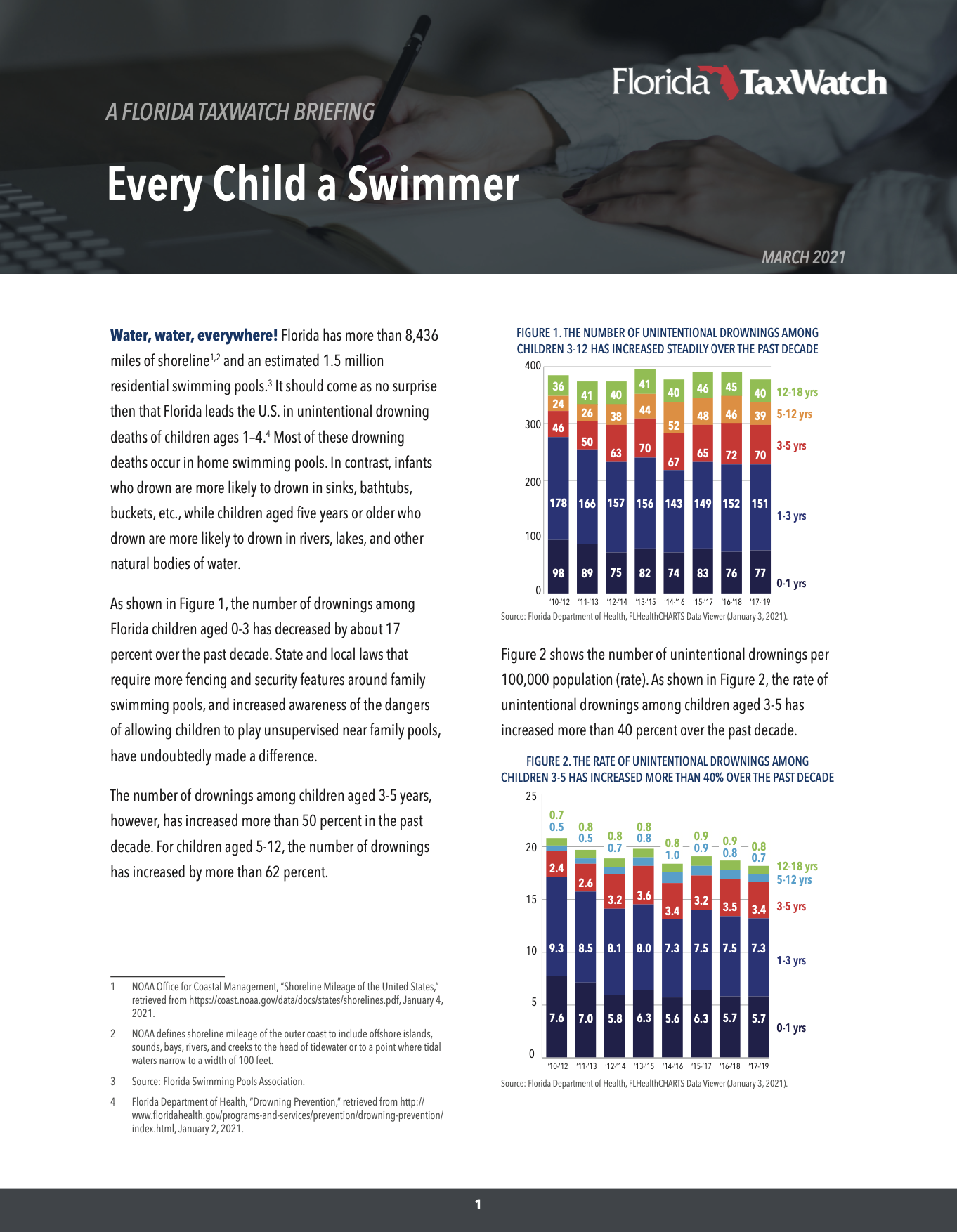
 

Water, water, everywhere! Florida has more than 8,436 miles of shoreline and an estimated 1.5 million residential swimming pools. It should come as no surprise then that Florida leads the U.S. in unintentional drowning deaths of children ages 1–4. Most of these drowning deaths occur in home swimming pools. In contrast, infants who drown are more likely to drown in sinks, bathtubs, buckets, etc., while children aged five years or older who drown are more likely to drown in rivers, lakes, and other natural bodies of water.

The real tragedy lies in the fact that most of these childhood drownings could be prevented by making sure everyone in the family knows how to swim. In furtherance of this, Senator Lori Berman has filed Senate Bill (SB) 358 which, if enacted into law, would require each child who is entitled to admittance to kindergarten, or who is entitled to any other initial entrance into a public or private school in Florida, to present a certificate showing they had successfully completed a nationally recognized water safety education course and nationally recognized age-appropriate swimming lessons within one year prior to enrollment in school. It is important to note that a child may be exempted from the certification requirement if the child’s parent submits a written objection, based on any grounds, to the school in which the child is enrolled or into which the child is entering.

Florida TaxWatch believes it is essential that children are taught how to swim at an early age. Swimming is perhaps the only sport or physical activity that will save a life, so making sure children are comfortable in and around the water is paramount to their safety. Swimming also helps to build endurance, muscle strength and cardiovascular fitness. Like other forms of exercise, swimming has been linked to improved mental health by reducing stress, anxiety, and depression.13 Florida TaxWatch commends Senator Berman and Representatives Daley and Mooney for their efforts to prevent unintentional childhood drownings.

Documents to download

Previous Article What is a K-Shaped Recovery and Why It Matters
Next Article Economic Commentary - The State of Medicaid in Florida
Print
5363
0Upvote 0Downvote
«December 2025»
MonTueWedThuFriSatSun
24252627282930
1234
OH, SNAP! Federal Policy Changes Threaten the Stability of Florida's Supplemental Nutrition Assistance Program

OH, SNAP! Federal Policy Changes Threaten the Stability of Florida's Supplemental Nutrition Assistance Program

Administered by the United States Department of Agriculture’s (USDA)’s Food and Nutrition Service (FNS), the Supplemental Nutrition Assistance Program (SNAP) provides funds to help low-income households afford low-cost, nutritious meals. In July 2025, President Trump signed the One Big Beautiful Bill Act of 2025 (the OBBB Act), tightening SNAP policies that determine eligibility, benefits, and program administration. Florida TaxWatch undertakes this independent research project to better understand how the upcoming changes in SNAP requirements will impact Florida’s budget and its ability to provide much needed food assistance to needy Floridians.

Read more
567
891011121314
15
2025 How Florida Counties Compare

2025 How Florida Counties Compare

This report compares the revenue and expenditure profiles of Florida’s 67 counties to give taxpayers an overview of how their local government stacks up with the rest of the state.

Read more
16
The Fiscal and Economic Impacts of Nova Southeastern University on Florida’s Economy

The Fiscal and Economic Impacts of Nova Southeastern University on Florida’s Economy

NSU generated an estimated $293.1 million in state and local taxes within the Tri-County region in FY 2024-25 and an estimated $305.1 million in state and local taxes in FY 2024-25.

Read more
17
Transferring Utility Profits to a Municipality's General Fund Increases the Risk of Undercapitalization of Water Assets and Violate Taxpayer Accountability

Transferring Utility Profits to a Municipality's General Fund Increases the Risk of Undercapitalization of Water Assets and Violate Taxpayer Accountability

Setting water utility rates that incorporate the recovery of the costs associated with standard operating expenses and debt obligations is essential to ensuring the short-term and longer-term financial stability of the utility. Once these costs are covered, many publicly owned utilities make transfers to the General Fund (a practice known as “sweeping”) ostensibly to help pay for governmental services that do not generate revenue (e.g., roadway maintenance, public safety, etc.) and to help keep property taxes lower. Keeping property taxes low often means higher municipal utility rates to balance the general budget, a habitual practice that burdens utility customers with cross-subsidies and normalizes underinvestment in infrastructure.

Read more
18
Florida Sheriffs’ Offices Staffing Analysis

Florida Sheriffs’ Offices Staffing Analysis

In May 2025, Florida TaxWatch and the Florida Sheriff Association conducted a joint survey to local sheriff offices to learn more about law enforcement’s workforce challenges.

Read more
192021
22232425262728
2930311234

Archive