Introduction
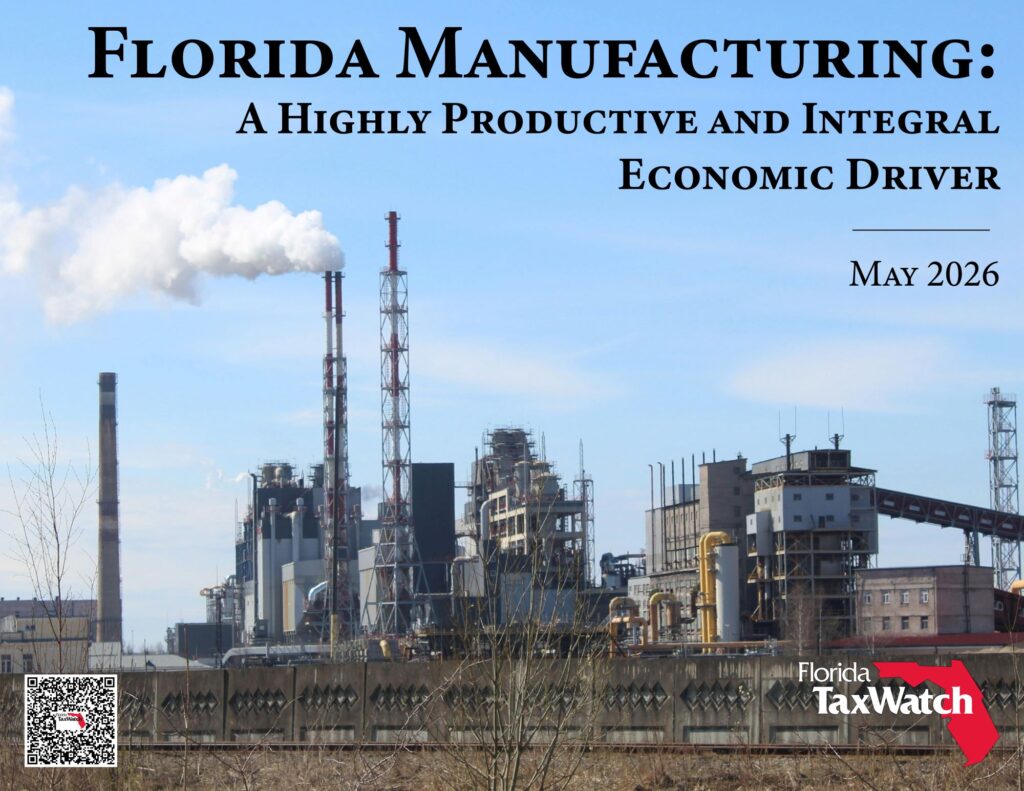
According to Newton’s first law of motion, an object in motion stays in motion unless acted upon by an outside force. Florida’s manufacturing sector has shown exactly that kind of motion. It is an $86.6 billion industry that ranks sixth in the nation in the value of exported manufactured goods, employs more than 434,000 workers, and quietly outpaces tourism and agriculture as a contributor to the state’s Gross Domestic Product (GDP). Anchored by a cluster of aerospace, defense, and space manufacturing firms along the Space Coast, it is a high-powered and productive engine of the Florida economy. But no industry operates in a vacuum. Tariff-driven input cost increases, slowing trade activity, and a fast-approaching workforce crisis have applied considerable force against manufacturing and its growth. This commentary examines the current state of Florida’s manufacturing sector, the headwinds it faces, and the policy steps needed to keep it moving.
Manufacturing in Florida
Manufacturing plays an essential role in Florida’s economy and workforce. While not being nationally renowned for it, Florida is one of the leading states in the nation for manufacturing. As measured in Q3 of 2025, Florida had a nominal manufacturing GDP of $86.6 billion1 and ranked 6th among all states in the total value of all manufactured goods exported.2 Its output made up 4.62 percent of Florida’s GDP during this time, surpassing that of tourism and agriculture.3 The industry’s backbone is a mix of aerospace, defense, and space manufacturing along the Space Coast corridor, anchored by global names like Lockheed Martin, Boeing, SpaceX, and Raytheon. Florida also produces a wide range of consumer and industrial goods including medical devices, pharmaceuticals, food and beverage imports, and recreational boats.
Manufacturing’s direct role in other industries means it is naturally connected to and usually moves with larger state and national trends, as its operations act as a gateway to productivity for all other industries. As Florida’s real GDP grew by 3.5 percent between Q2 2024 and 2025, real manufacturing GDP also grew by 2.7 percent. Figure 1 shows the propensity for these indicators to follow each other over the last ten years.
The industry’s employment impacts are just as notable. In 2025, the manufacturing industry employed more than 434,000 people, marking it as the 11th largest industry by workforce in Florida.4 The employment landscape in manufacturing is notable for its high-wage potential without barriers presented by advanced degrees. As shown in Figure 2, of the fifteen largest manufacturing jobs, only four require a degree beyond a high school diploma or equivalent. This, combined with an $87,000 average annual salary, shows the industry’s place as a high-earning opportunity for those who do not wish to go down the path of traditional schooling.
Additionally, conditions for manufacturing workers have improved into a position almost unrecognizable from the assembly lines of old. Florida’s manufacturing focus on aerospace parts, medical devices, semiconductors, and other intricate goods require a hospitable environment and more work on computers than with your hands. Despite people’s immediate image of what a manufacturing job should be, these positions have become about as physically demanding as a typical white-collar job with similar levels of pay.
National Trends
The U.S. manufacturing industry faced many difficulties in 2025 in the face of a changing economic and demographic landscape. Notably, the inconsistent status of tariffs during that time created an unstable setting and an increase in price inputs for American manufacturing and its international business partners. This increase in the price of inputs to production especially harmed Floridians, as not only are multiple deep seaports affected by the slowing trade activity, but the supplies from trade are necessary parts to manufacture the intricate goods in which Florida specializes. These difficulties were reflected by national employment statistics, where by December 2025 manufacturing employed nearly 70,000 fewer workers than a year prior.5 As shown in Figure 3, the subsectors most impacted were transportation equipment, computers and electronic products, and machinery — all vital aspects of Florida manufacturing.
The impact of the slowing in trade activity was reflected by the Institute for Supply Management’s (ISM) Manufacturing Purchasing Manager’s Index (PMI) in 2025, an index which tracks the health and sentiment of manufacturing companies in the United States by accounting for new orders, employment, prices, and other factors. A reading above 50 indicates companies anticipate expansion, while one below 50 indicates activity is contracting. In December 2025, the PMI registered the lowest reading of the year at 47.9, marking ten straight months of contraction.6
Heading into 2026 there was a bit of optimism; the February 2026 PMI rose to 52.4, driven by a surge in new orders and backlogs of orders. The March report, however, was much more mixed; the overall index rose to 52.7, although new orders, employment, and inventories were in contraction as prices skyrocketed. The word that best describes the industry right now is “uncertainty” — respondents specifically cite the recent IEEPA (International Emergency Economic Powers Act) ruling7 and the Iran conflict as having the largest impacts to their business that they are unsure how to navigate.
Statewide Trends
As mentioned before, Florida’s reliance on imported components for its manufacturing exposed it to the same challenges as the rest of the nation. Thankfully, its strong economy and deep seaport activity mitigated many of those issues during the same period. Where the national PMI was well below 50 in December 2025, Florida’s sat even at 50, indicating stabilization.8 Similarly, while the rest of the nation lost more than 65,000 manufacturing positions from December 2024 to December 2025, Florida only lost a little less than 3,000.9 While manufacturing in Florida is still navigating many of the lingering effects of national policy, manufacturers are certainly beginning to move past the thick of the fog.
Unfortunately, there is one national trend that Florida’s manufacturing sector is particularly vulnerable to: an aging workforce. Florida’s Secretary of Commerce testified in October 2025 that more than half of the manufacturing workforce is 45 years of age or older, disproportionately different from most other workforce sectors in Florida.10 Even in a major metropolitan area like Tampa, only ten percent of workers entering the trades are between 19 and 24 years old.11 This “industrial brain drain,” as many have phrased it, presents big problems for manufacturing in the future. The most obvious is the sheer numbers: U.S. manufacturing is on track to have 2.1 million unfilled jobs by 2030,12 an issue that will likely be exacerbated in Florida considering their demographics. This could potentially lead to a loss of more than $1 trillion in lost output.13
While not as obvious, the issue that concerns most manufacturers is a lack of process knowledge that can be passed between workforce generations. Much of the continuity value from long-standing manufacturing plants comes from the experience and knowledge that can be passed from master to apprentice: navigating unplanned outages, regulatory audits, vendor issues, and other important facets that can’t be taught through standardized workforce education. At the national level, 73 percent of senior manufacturing leaders are preparing to retire in the next decade, with 68 percent believing that at least half of their institutional knowledge will be lost permanently.14
This worker shortage will naturally raise wages, attracting more people to the industry, although it will not be nearly sufficient to replace the current workforce and will certainly not correct the long-term outlook for the labor supply in manufacturing. If anything, these wage hikes will incentivize a shift to machinery and capital in production, further limiting the full employment capacity in the industry. Unlike short-term national economic woes, this is not an issue that will naturally go away; it needs to be directly addressed.
Addressing the Issue
Approaches to this problem need to be dual-pronged, with manufacturers looking externally and internally. Externally, state investments in job training programs need to be expanded to strengthen pipelines between firms and prospective workers. Thankfully, economic studies suggest that manufacturing is in a prime position to receive maximum benefit from these sorts of programs. Within sector-based job training programs, some of the conditions most predictive of success are employers co-designing the curriculum, capital investments that provide the facilities to properly train, and follow-through mechanisms that ensure graduates enter the industry for which they were trained.15,16,17
Florida TaxWatch’s 2025 MakeMore Manufacturing Summit report highlights how many of these solutions are beginning to be put into place in Florida. A Master Credential List is being constructed in coordination with industry leaders, communicating the credentials the industry needs now and in the future to interested students.18 Florida’s Job Growth Grant Fund has recently made significant investments in Indian River State College and Miami-Dade College that will allow them to purchase the equipment necessary for manufacturing and other vocational education.19 With the employment issue as pressing and universal as it is now, manufacturing employer follow-through on training centers is a given. Manufacturing in Florida is a prime candidate for these training programs, and consistent support is key to restoring the manufacturing pipeline.
Internally, manufacturing companies need to refine their process of capturing and transferring knowledge from more tenured workers to newer ones. Having new employees does nothing without the infrastructure in place to get them up to speed. Utilizing digital tools such as video lessons and connected worker platforms can create vaults of resources. Also mentioned during multiple FloridaMakes’ MakeMore Manufacturing Summits was the need for manufacturing firms to invest in how manufacturing is perceived. As previously mentioned, manufacturing work conditions are far from the factories of old; yet that is exactly how they are still perceived. Whether it be through tours of facilities or press conferences, a window needs to be created for the public to see the reality of working in the manufacturing industry.
Conclusion
Florida’s manufacturing industry has continued to grow and show its value in the state. It operates as a highly productive and integral economic driver while also serving as a high-wage opportunity for those who do not want to go through traditional education routes. While the national manufacturing sector faces difficulties from increasing prices to production and slowing trade, Florida’s strong deep seaport presence can insulate the industry from some of these issues; however, it is facing a fast-approaching crisis in the form of an aging workforce that is currently on track to retire before their knowledge and experience can be shared and a new jobs pipeline to manufacturing can be formed. Solutions all revolve around getting this new generation of workers recruited and prepared before it is too late. It remains to be seen to what extent artificial intelligence can help to close this knowledge gap. Showing the better working conditions of new-age positions, lowering the barriers to education, and strengthening job programs can bring velocity to a valuable industry facing some strong resistance.
Endnotes
- U.S. Bureau of Economic Analysis, “Gross Domestic Product: Manufacturing (31-33) in Florida,” 2026.
- U.S. Census Bureau, “Exports of Goods: Manufactured Commodities for Florida,” 2026.
- U.S. Bureau of Economic Analysis, “Real Gross Domestic Product: Manufacturing (31-33) in Florida,” 2026.
- Florida Commerce, “Top Industries by Employment and Wages,” 2026.
- Cato Institute, “Manufacturing Employment Data Confirm the Concentrated Benefits – and Dispersed Costs – of Trump’s Tariffs,” January 2026.
- Trading Economics, “United States ISM Manufacturing PMI,” April 2026.
- Learning Resources, Inc., et al. v. Trump, President of the United States, et al., 607 U.S. 20 (2026).
- CareerSource Northeast Florida, “UNF manufacturers survey shows improvement in January,” 2026.
- Bureau of Labor Statistics, “All Employees: Manufacturing in Florida,” 2026.
- Florida Phoenix, “Florida’s manufacturing workforce is ‘aging out,’ says Commerce Secretary,” October 2025.
- Acara, “Tampa’s Manufacturing Labor Shortages: Navigating Talent Gaps in 2025,” August 2025.
- Deloitte Insights, “Creating pathways for tomorrow’s workforce today: Beyond reskilling in manufacturing,” May 2021.
- Ibid.
- CADDI, “Mitigating Knowledge Drain: Strategies for Capturing and Transferring Expertise in Manufacturing,” 2025.
- Card, Kluve, & Weber, “What Works? A Meta Analysis of Recent Active Labor Market Program Evaluations,” 2018.
- Houseman, S., “The Role of Temporary Agency Employment in Tight Labor Markets,” 2014.
- Maguire, S., et al., “Tuning into Local Labor Markets: Findings from the Sector Employment Impact Study,” 2010.
- Florida TaxWatch, “MakeMore Manufacturing Summit: Summary Report,” February 2026.
- Executive Office of the Governor, “Governor Ron DeSantis Announces Infrastructure and Workforce Development Investments Through the Job Growth Grant Fund,” 2025.
Meet the Author: