Budget Watch – Governor’s FY2018-19 Recommended Budget
Budget & Appropriations, Research, Taxpayer GuideGovernor Rick Scott recently released his eighth and final budget recommendation. This report details the proposal by budget area.
Governor Rick Scott recently released his eighth and final budget recommendation. This report details the proposal by budget area.
Having led in the enactment of Florida’s current consitutional state revenue limitation, Florida TaxWatch has been recommending a simpler and higher standard to pass tax increases since 1995.
The new Outlook forecasts that after funding a continuation budget, there will be $52.0 million in General Revenue (GR) left over, until the financial impacts of Hurricane Irma are considered.
Estimating Conference says that revenue from the gaming agreement that was reached in July between the state and the Seminole Tribe will more than offset a projected revenue loss for the state.
Florida TaxWatch is pleased to present taxpayers with a guide to the FY2017-18 state budget, which went into effect July 1, 2017. After deducting the Governor’s vetoes, the net result is FY2017-18 appropriations totaling $85.158 billion, a $2.9 billion (3.5%) increase over FY2016-17.
The 2017 Florida Legislature passed a $82.418 billion General Appropriations Act (GAA), already the largest in the state’s history. But this is not all the money appropriated this year.
The 2017 Legislature passed only 249 bills, the second lowest number in at least the last 15 years. This wrap-up details the issues TaxWatch followed this year.
This Session Spotlight is a look at the provisions in HB 7109, comparing the Senate amendment to the original House bill, and an examination of other bills and proposed constitutional amend- ments dealing with property taxes that have passed or are expected to pass and that could also reduce the taxes Floridians pay.
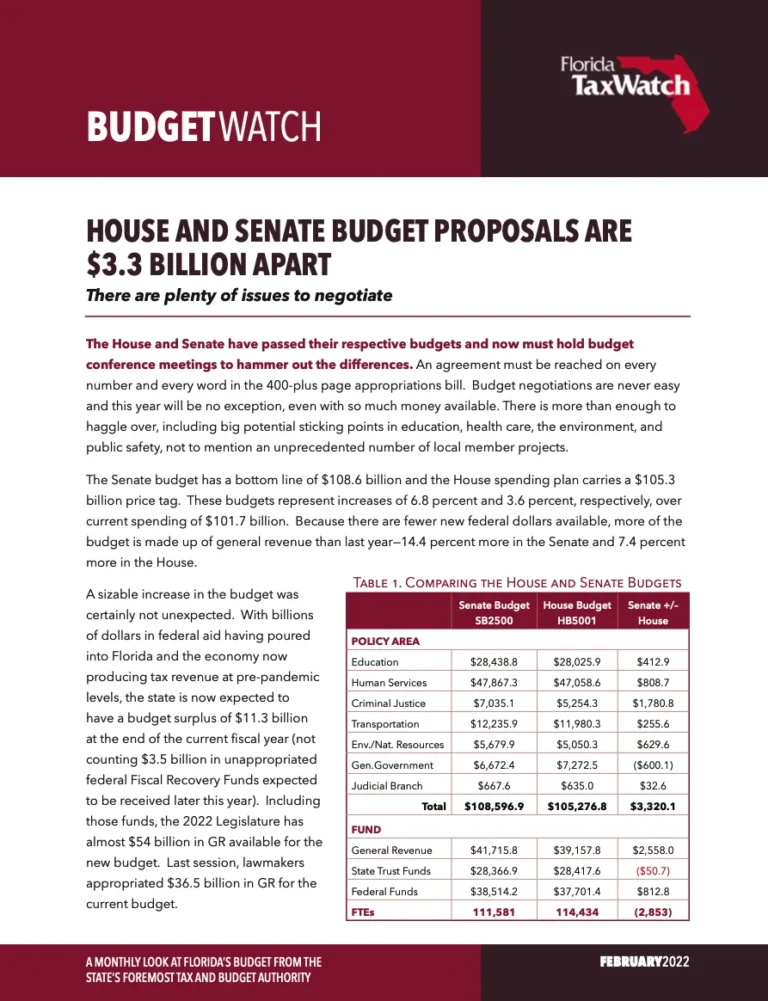
As we enter the penultimate week of the 2017 Legislative Session, the next state budget is still very much up in the air. The House and Senate spending plans are effectively $4 billion apart.
This report is a look at the provisions in HB 7109, along with the Senate bills that contain one of these provisions and that have cleared at least one committee. Following this analysis is an examination of several bills and proposed constitutional amendments dealing with property taxes that could also impact the taxes Floridians pay.
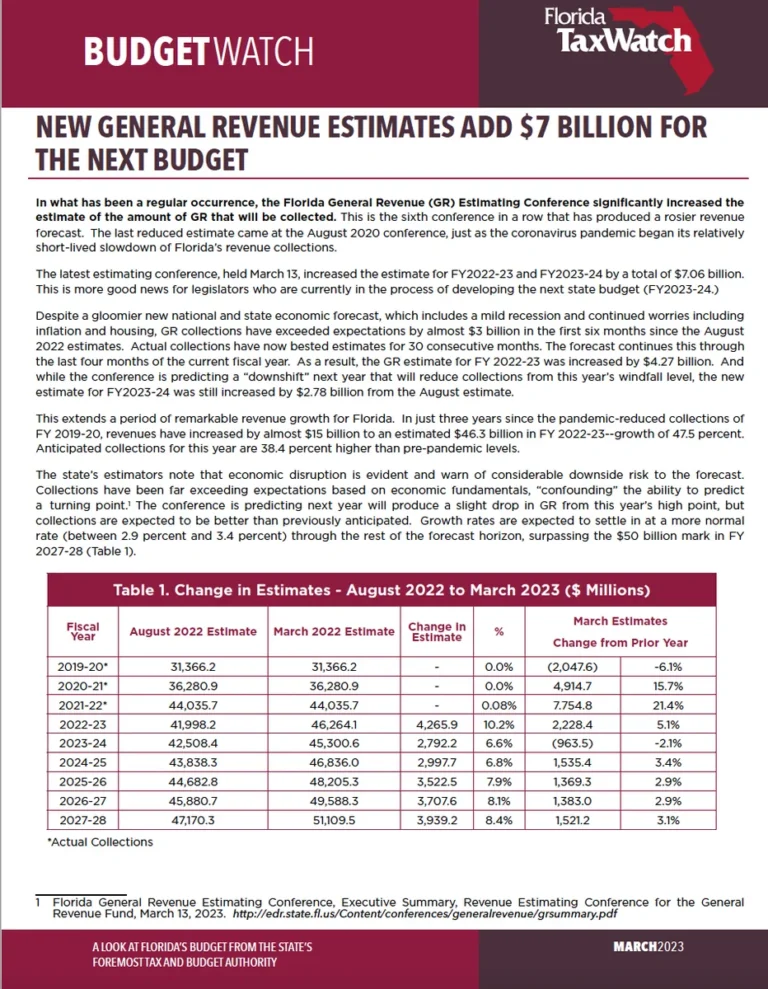
The General Revenue (GR) Estimating Conference met recently to determine how much money will be available to the 2017 Legislature for the new state budget.
Florida tourism is an absolutely critical industry to the state, employing millions of people and contributing millions of dollars to state coffers. Despite its importance to the Sunshine State, tourism is in the crosshairs of the Florida House, a costly decision according to this report.
Per-student spending is an easy-to-use measure by which taxpayers can evaluate public school spending and efficiency. This report finds a more accurate number for taxpayers to use.
Governor Rick Scott recently released his $83.474 billion proposed budget, which will be considered by the Legislature as it crafts the state’s new spending plan.
Lawmakers received a small measure of positive fiscal news from state economists this week. The General Revenue (GR) Estimating Conference met on December 12, 2016 and increased its revenue forecast by $119.3 million in the current year (FY2016-17) and by $22.6 million for the next budget year (FY2017-18).
In addition to the serious public health risk for Floridians, the Zika virus is also creating risk for the already tight state budget outlook for next year.
The 2017 Legislature will be facing a very tight budget year. After a string of three straight years with projected budget surpluses ranging from $336 million to $846 million, it is now estimated that during the next legislative session there will be just enough money to fund a continuation budget for FY2017-18. What’s more, significant budget shortfalls loom in subsequent years.
Over the years, Florida TaxWatch has produced several reports examining how Florida fares, relative to other states, in receiving grants and aid from the federal government. Consistent with our past research, this new analysis shows Florida continues to receive far less than its fair share of federal grant dollars.
Just as they did at their last conference in January, Florida’s revenue estimators reduced the state’s General Revenue (GR) projections. The GR Estimating Conference met on August 15, 2016 and reduced expected collections by $131.9 million in the current year (FY2016-17) and by $131.1 million for the next budget year (FY2017-18).
In dollars, America’s debt is forecast to reach an astonishing $87.9 trillion in 30 years. This is more than $200,000 for each of the 400 million men, women, and children expected to live in the United States in 2046. This Budget Watch looks at the long-term implications of such a debt.