Dear Fellow Taxpayer
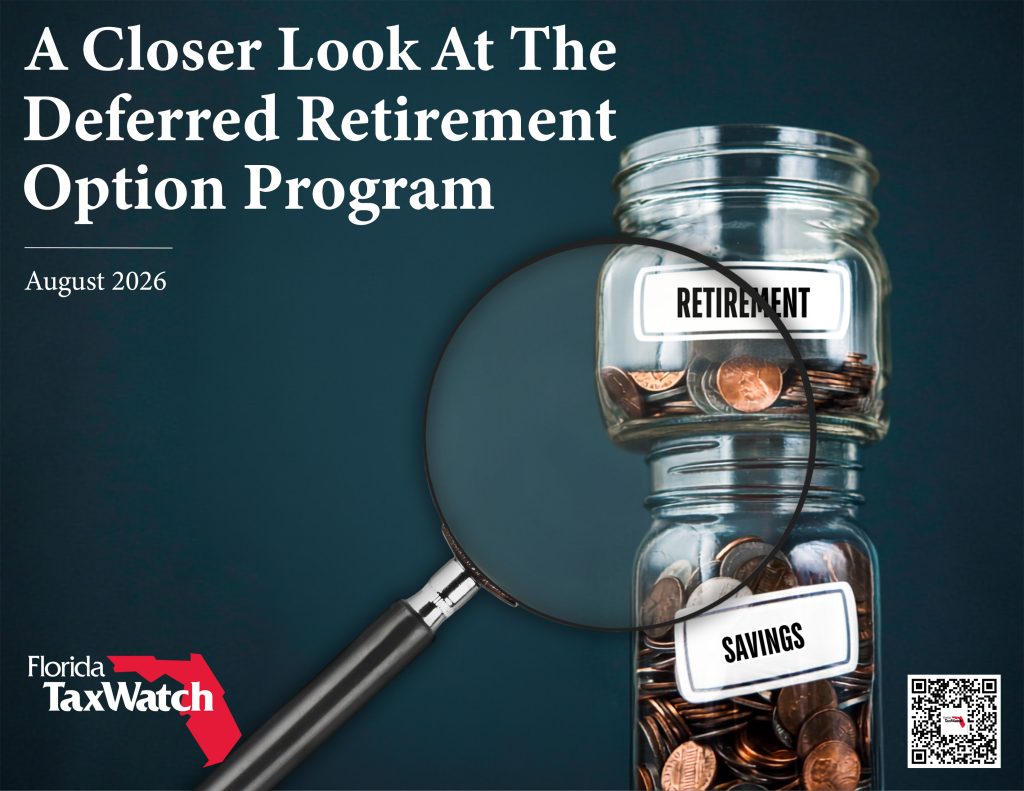
Many of Florida’s longest-serving public employees take part in a program that lets them formally retire “on paper” while continuing to work and collect their salaries. Under the Deferred Retirement Option Program (DROP), their monthly retirement benefits accumulate, with interest, in a trust fund and are paid out as a lump sum when they eventually leave public service.
More than 30,800 public employees across Florida currently participate in DROP. In 2023, the Legislature made two significant changes to the program: (1) eligible employees may now remain in DROP for up to eight years for most members, and up to ten years for law enforcement and instructional personnel (rather than the original five years); and (2) the guaranteed interest rate credited to their accounts was increased. State analysts estimated these changes would add about $350 million per year to the employer contributions that state agencies, school districts, cities, and ultimately the taxpayer make to the retirement system.
Programs like DROP involve real trade-offs. They can help retain experienced employees and give agencies time to plan for retirements, but they also carry costs, and the 2023 changes increased those costs at a time when the system already carried long-term obligations to fund. How those benefits and costs balance out, and whether the program is structured to deliver its intended value efficiently, are questions worth examining closely. Florida TaxWatch undertakes this independent research project to examine how DROP works; how its costs and benefits have evolved since 1997; and what the 2023 changes mean for Florida taxpayers. Our aim is to give policymakers and the public a clear, factual basis for evaluating the program.
Sincerely,

The Honorable Jeff Kottkamp, Esq.
President & CEO
Executive Summary
Since 1997, Florida has operated a retirement program allowing eligible public employees to begin collecting pension benefits while remaining on the job. Workers entering the Deferred Retirement Option Program (DROP) stop accruing additional pension credits, and their monthly retirement payments are deposited into special accounts earning interest. Upon actual departure from employment, participants receive everything accumulated in those accounts as a one-time cash payment and then begin receiving regular monthly pension checks.
Three years ago, state lawmakers approved sweeping changes making DROP substantially more attractive to more classes of employees. Eligible employees can now stay in the program for an additional three years, up to eight years for most participants or ten years for certain instructional personnel and special risk employees. The annual guaranteed return credited to DROP accounts increased substantially, from 1.3 percent to four percent, for all participants and new enrollees. These changes took effect even as professional actuaries calculated the Florida Retirement System’s (FRS’s) unfunded obligations at more than $38 billion as of the 2022 valuation. The FRS remained well-funded overall, with a funded ratio above 80 percent, a level generally considered healthy for a public pension system. Even so, the 2023 changes added an estimated $350 million per year to the employer contributions that fund the FRS.
Altogether, this represents a recurring new cost to Florida taxpayers. In absolute terms the increase is substantial, about $350 million per year. Measured against the scale of state finances it is more modest, roughly 0.3 percent of Florida’s $116.5 billion budget, or about $15 per resident per year. Whether a cost of that size is justified depends on what the program delivers in return, the question this report examines. Employer contributions to the FRS are funded by state appropriations, school district budgets, county and municipal tax revenues, and university operating funds. When contribution rates rise, those increases translate into higher public expenditures, which can require higher taxes and fees or cuts to services.
DROP was established in 1997 (Chapter 97-154, Laws of Florida) and was open to all FRS membership classes from the outset rather than limited to particular job sectors. The statute did not define a single purpose for the program, which has since been described both as an early-retirement incentive and as a tool for retaining experienced employees. The 2023 legislative changes substantially enhanced DROP benefits for all eligible FRS members, extending the length of the participation window (from five years to eight, or ten for certain classes) and increasing the interest rate credited to accumulated accounts.
The program treats DROP participants differently from other active FRS members. While in DROP, participants collect their public salary while their frozen retirement benefit accumulates (with interest) in a trust fund, and is paid as a lump sum upon termination of employment. The lump sum can also give participants the financial flexibility to delay claiming Social Security, which can increase their eventual monthly Social Security benefit.
Florida can choose between continuing to expand benefits as unfunded liabilities grow or begin making hard decisions now to ensure the retirement system remains viable for decades to come. Florida TaxWatch recommends the Legislature either close DROP to new enrollees after a defined date (e.g., June 30, 2027) or restrict further participation to only Special Risk Class employees and positions with documented workforce shortages, such as teachers, law enforcement officers, and firefighters. Regular Class positions vacated when employees exit DROP should be filled through open competitive hiring, instead of allowing every public employee the ability to enter DROP. These reforms would reduce costs for Florida taxpayers while preserving meaningful state workforce retention incentives where they matter most.
Introduction
What is DROP?
The Deferred Retirement Option Program (DROP) operates as a distribution mechanism within Florida’s defined benefit retirement structure, enabling qualified employees to formally retire on paper while maintaining their employment positions. Upon entering DROP, an employee’s monthly retirement benefit is calculated and frozen at that point in time. Rather than distributing these monthly amounts directly, the system deposits them into an interest-bearing account while the individual continues working at a full salary. When the participation window concludes, the employee receives the accumulated amount as a lump sum distribution, then begins receiving regular pension payments under one of several available payout options.
Program participants occupy a distinctive position within Florida’s retirement framework. To enter DROP, an employee must first be eligible for normal retirement under the Florida Retirement System (FRS). For Regular Class members, that generally means reaching age 62 with at least six years of service, or any age with 30 years of creditable service, if initially enrolled before July 1, 2011 (age 65 or 33 years for those enrolled on or after that date). For Special Risk Class members, normal retirement is generally age 55 or 25 years of special risk service. The 2023 legislation set the normal retirement date for Special Risk members initially enrolled on or after July 1, 2011 at the earlier of 25 years of creditable service or age 55, reducing it from the 30-year threshold that had applied to that group. Members are considered formally retired, continue earning their full employment wages, and have their frozen retirement benefit accumulating at a guaranteed four percent interest rate in the FRS Trust Fund, a balance that will be distributed as a lump sum when they actually separate from employment.[1]
While enrolled in DROP, participants no longer make the standard three percent employee contribution that active members pay, because their retirement benefit is already fixed and they are accruing no additional service credit. As discussed later in this report, employers nonetheless pay a higher contribution rate for DROP participants than for active Regular Class members. That difference reflects how the defined benefit plan is funded actuarially rather than a deliberate enhancement of DROP compensation: a DROP participant’s benefit is a fully accrued, near-term obligation that must be funded over a shorter horizon, with no offsetting future service.
Because that obligation is spread over a smaller base than for Regular Class employees, who are expected to keep working and contributing, it raises the contribution rate on a percentage basis. In this sense DROP does not create new liabilities so much as concentrate existing ones, which is what makes the employer rate higher. Each employer contribution rate includes a component for the system’s unfunded actuarial liability (UAL), the gap between the assets the FRS holds and the long-term benefit obligations it has already promised; this report refers to that component as the UAL rate.
DROP is open to members of all FRS membership classes that meet normal retirement criteria. The FRS divides covered employees into the following classes (see Table 1), which determines their normal retirement requirements and the employer contribution rates that fund their benefits.[2]
Because a DROP participant’s monthly benefit is deposited into the account and earns interest until they leave, the account pays out more than the sum of the deposits. The longer an employee stays in DROP and the higher the guaranteed rate, the larger that gap grows. The 2023 increase in the guaranteed rate, from 1.3 percent to four percent, therefore raises the eventual lump sum for every participant: the same stream of deposits now accumulates more interest for a period of time that can run up to eight years. This is a benefit to the participant, but it is also a cost to the system, which must credit that guaranteed return regardless of what its investments actually earn.
Florida TaxWatch undertakes this independent research project to better understand how the costs and benefits of DROP have evolved since 1997. A central question this report examines is whether the 2023 changes are best understood as strengthening workforce retention across the public sector, or whether expanding compensation for long-tenured and senior personnel, beyond what a retention rationale alone would justify, was itself an intended effect of the changes rather than an incidental one. Some would argue that DROP functions as a retention tool across the workforce, including in positions without documented shortages, because retaining experienced employees preserves institutional knowledge and because competitive benefits help the state attract and keep staff generally. This report weighs that view, including the possibility that compensation expansion was itself a deliberate design choice, against the program’s costs.
Original Implementation in Florida
Florida incorporated a retirement deferral program beginning on July 1, 1997, initially establishing a five-year participation ceiling.[3] The program was applied broadly to eligible FRS members under certain service conditions to address critical workforce shortages. Legislators designed the initiative as a distribution option within the existing defined state employment benefit structure rather than creating a separate retirement system.
Deferred Retirement Option Programs are most often described as a tool to retain experienced employees beyond their earliest retirement eligibility; in other cases they have been adopted as an enhancement to the pension benefit. A DROP also gives employers some advance notice of an employee’s eventual departure and allows the employee to accumulate a lump sum while continuing to work. The Government Finance Officers Association cautions that DROP costs are difficult to assess and have often proved higher than anticipated, and on that basis recommends against including DROPs in public defined benefit plans.[4] Florida’s program operates within this general framework, though Florida statute does not specify a defined purpose for DROP.[5]
2023 Program Shift
Key Changes to the Program
Governor Ron DeSantis signed retirement legislation on June 28, 2023, implementing significant enhancements to DROP, including restoring and expanding several provisions that had been restricted following the 2008 recession. Prior to 2011, the DROP interest rate was 6.5 percent annually; post-2011 reforms cut it to 1.3 percent. The 2023 legislation raised the rate to four percent and lengthened the participation window (the number of years an employee may remain in DROP), which had been constrained since 2011.[6]
The modifications, effective July 1, 2023, fundamentally restructured multiple program elements. Standard participation windows extended from five to eight years for most employee classes, while educators were authorized to participate for up to ten years. The bill (SB 7024) also removed the prior 12-month restriction on the election window, the limited period during which an eligible employee may choose to enroll in DROP, and enhanced disability compensation and line-of-duty death.[7] The interest rate increase is the change with the largest dollar effect. Although a participant's monthly pension benefit is frozen at entry and does not change, the balance in their DROP account continues to grow, and for an employee participating in the full window, raising the credited rate from 1.3 to four percent adds tens of thousands of dollars in interest over the participation period.[8]
Justifications for the Shift
The 2023 changes were generally framed to retain experienced public employees in fields facing high vacancy rates with more favorable program terms encouraging retirement-eligible professionals to extend their service.[9] Although the retention rationale has long centered on education and public safety, DROP eligibility has been open to all eligible FRS members since 1997, and the 2023 changes likewise enhanced benefits for all classes rather than targeting only fields with documented shortages.
The ongoing shortages in teaching and law enforcement also raises questions about how much DROP contributes to its core retention purpose. Florida has continued to pursue separate recruitment initiatives, including out-of-state cash bonuses for teachers and law enforcement officers, which suggest that DROP by itself has not closed these workforce gaps. Staffing shortages have many causes, so the persistence of these programs is not proof that DROP is ineffective, but it does indicate that the program is not sufficient on its own to resolve the shortages it is intended to address.
Financial Impact on Taxpayers
The financial ramifications of the 2023 expansion are significant. Legislative staff calculated that employer contribution requirements, which are funded by state agencies, universities, school districts, counties, and cities, rose by $350 million annually, totaling $3.1 billion in employer responsibilities for the fiscal year 2023-2024.[10] Because these employer payments derive from tax revenue, this $350 million annual increase represents a recurring public cost. To provide perspective, this annual amount is roughly 2.5 percent of Florida’s approximately $14 billion annual transportation work program; would fund approximately 5,000 additional teacher positions at $70,000 in base salary annually (not including benefits and retirement costs); or significant investments in school security, healthcare, or environmental protection programs.[11]
The changes also increase total unfunded commitments in Florida’s retirement plan. DROP participants are classified as “retired” under Florida law, so they make no employee contributions during participation. A participant’s benefit is fixed at DROP entry, so DROP does not by itself create new benefit liabilities; rather, it accelerates and concentrates the funding of obligations the system has already promised, without an offsetting employee contribution stream during the participation years.[12] An important aspect is that lawmakers implemented these increases when the retirement system was carrying a funded ratio of 82.4 percent in 2022 that has since declined to 81.4 percent in 2023, with growing unfunded liabilities.[13]
DROP’S Impact on The Florida Retirement System
FRS Unfunded Pension Liability
Florida’s retirement system carries a substantial and growing unfunded liability. As shown in Table 2, the system’s unfunded actuarial liability grew from $34.7 billion as of the July 1, 2021 valuation to $45.8 billion as of July 1, 2024, even as the funded ratio remained above 80 percent.[14] Future taxpayers will confront either decreased services, increased taxes, or both as this obligation grows.
How DROP Expansion Exacerbates the Problem
DROP affects the FRS’s funding gap in three ways, some of which predate 2023 and were amplified by the 2023 changes. First, DROP participants are classified as “retired” and so do not make the three percent contribution every other active FRS member pays. This exemption is a long-standing feature of DROP rather than a 2023 change, but each additional participation year added by the 2023 changes extends the period over which the contribution is not collected.[15]
Second, employers pay a higher contribution rate for DROP participants than for active Regular Class members. As noted above, this difference is set by the plan’s actuarial funding formula and amortization schedule rather than by a policy choice, because a DROP participant’s fully accrued benefit must be funded over a shorter horizon.[16]
Finally, the FRS must credit DROP accounts a guaranteed annual return regardless of actual fund performance. DROP accounts have long earned a guaranteed return; in 2023 that rate was raised to four percent. In any year the guaranteed rate exceeds what the Fund earns, the FRS must make up the difference.[17] Because employer contribution rates to the FRS include a component for the system's unfunded actuarial liability, that cost is ultimately borne by the employers and taxpayers who fund the system, and because the FRS is a single shared trust, any shortfall also weighs on the funded position that backs every member's benefits.[18]
Together, these three mechanisms mean the 2023 expansion did not simply extend a benefit, it increased the financial obligations placed on the retirement system and on the taxpayers who fund it by adding additional program participants. This was all done at a time when the FRS was already carrying a growing unfunded liability for its existing program enrollees where the program effectiveness was already faltering and losing its appeal for retaining employees. The full cost implications of each funding gap mechanism are examined later in this analysis.
The Cost of DROP
A useful way to assess DROP’s fiscal impact is to compare what it costs the FRS when an employee enters DROP against what would occur if that same employee simply retired at the point of DROP eligibility.
Higher Employer Contribution Rates for DROP
According to the Florida Senate’s fiscal analysis of SB 7024, the recommended employer contribution rate for DROP participants for Fiscal Year 2023-2024 was 18.19 percent of payroll (8.18 percent normal cost plus 10.01 percent UAL rate).[19] By comparison, the recommended employer contribution rate for Regular Class employees was 10.86 percent of payroll (6.14 percent normal cost plus 4.72 percent UAL rate). As shown in Table 3, that is a premium difference of 7.33 percentage points,[20] meaning that, measured against the Regular Class rate, employers pay roughly 67 percent more per payroll dollar for a DROP participant than for an otherwise comparable Regular Class employee who has not entered DROP.
When this is applied to the approximately 30,800 employees enrolled in DROP in 2024 (see Figure 1), the 7.33-point premium translates into roughly $190 million per year[21] in additional employer contributions above what those same employees would cost at the Regular Class rate. This rate differential means employers pay a meaningfully higher share of payroll for each DROP participant than they would for the same employees if they simply retired and were replaced.
Foregone Employee Contributions
Active FRS members contribute three percent of their salary toward retirement but DROP participants do not. Because they are classified as retired, they make no employee contribution for the entire time they remain in DROP, even though they are still working and drawing a salary. At an average DROP-covered salary of about $84,300, that exemption is worth roughly $2,530 per participant each year. As of the June 30, 2022 valuation the FRS had 28,827 active DROP participants, a number that had grown to roughly 30,800 by 2024. Applied to the program’s total DROP-covered payroll, the foregone employee contributions total on the order of $78 million[22] per year. Each year an employee spends in DROP is a year the system collects no contribution on their salary, and the 2023 extension of the participation window lengthens that gap.[23]
The Cost of the Guaranteed Interest Rate
When an employee enters DROP, their frozen pension accumulates in the FRS Trust Fund at a guaranteed four percent annual interest rate (post-2023). The FRS’s own long-term investment return assumption is 6.70 percent.[24] This creates a built-in cost differential: the Fund must credit four percent to DROP accounts regardless of market performance. As an illustration, for an employee with a $5,000 monthly ($60,000 annual) frozen benefit, monthly deposits compounding at four percent accumulate to roughly $565,000 over an eight-year DROP period, of which about $85,000 is guaranteed interest credited on top of the deposited benefits.[25] The cost concern for the Fund is not this credited interest itself, which represents the participant’s benefit, but the guarantee --- in years when the Fund earns less than four percent, it must still credit four percent, drawing on other assets to do so.
Across roughly 30,800 DROP participants, the guarantee represents a recurring obligation on the Fund in any year its investments return less than four percent. The precise net cost depends on actual investment performance each year and has not been separately quantified in a published FRS analysis. If those employees had simply retired, no guaranteed-interest obligation would exist, and the corresponding balances would remain fully subject to the Fund’s long-term expected return rather than a floor rate.[26]
The Understatement of DROP’s Actuarial Cost
Florida’s actuarial valuations have historically not fully accounted for DROP’s expected future cost. An Office of Program Policy Analysis and Government Accountability (OPPAGA) review of the 2009 actuarial valuation found that if the valuation had properly reflected the probability of future DROP participation by active members, the unfunded actuarial liability would have increased by more than $2 billion total.[27] OPPAGA recommended that future valuations include disclosures that fully reflect expected DROP participation, a reform that would provide the Legislature with a more complete picture of what DROP costs the system.
Separately, the same report examined how DROP is funded and recommended a more class-specific approach. Because DROP uses a single uniform employer contribution rate for all participants regardless of retirement class, OPPAGA found that the system produces substantial cost shifting between classes: in Fiscal Year 2008-09, employers of Regular Class participants (such as school boards, universities, and state colleges) paid an estimated $20.3 million more than they otherwise would have, effectively subsidizing the lower-than-actual-cost contributions made for Special Risk and other classes, whose employers saved a comparable amount. OPPAGA recommended establishing employer contribution rates that include DROP for each membership class, which would tie contributions to the actual cost of each class and eliminate the cross-class subsidy.[28]
OPPAGA’s Direct Cost Estimate
A 2010 OPPAGA analysis estimated that in Fiscal Year 2008-2009 alone, the FRS paid an additional $71.4 million to fund DROP compared to what it would have cost if those same employees had retired instead. [29] This additional cost arose because DROP allows eligible employees to begin drawing a retirement benefit earlier than they otherwise would, increasing the amount of time they draw pension benefits while simultaneously reducing the years available for employers to fund their retirement.
The above estimate is based on pre-2023 rules with a 6.5 percent guaranteed interest rate and a five-year maximum participation window. Under the post-2023 rules, with a four percent interest rate on a larger trust fund balance (larger because the longer participation window allows more monthly benefit deposits to accumulate before payout), and participation windows extended to eight or ten years, the annual cost differential is likely substantially higher. Florida’s DROP today has longer participation windows and larger accumulated balances than when that $71.4 million excess cost was measured in 2010, though the guaranteed interest rate is lower now (four percent) than the 6.5 percent in effect at that time.[30]
Effects on Career Advancement and Workforce Mobility
DROP is often credited with making succession easier to plan for, since a participant’s departure date is fixed and known well in advance. In practice, that benefit comes with a cost of its own. Because a DROP participant continues to occupy their position for up to eight or ten years under the post-2023 rules, the employees below them in the chain of command cannot move into that role until the participant actually leaves. For agencies with a limited number of leadership positions, this means capable employees who are ready to lead may be asked to wait years longer than they otherwise would, even though they remain formally eligible for promotion elsewhere.
Florida’s own legislative history reflects this tension. In 2023, the Legislature extended DROP’s maximum participation window from five to eight years, and to ten years for K-12 instructional personnel. The stated goal was to keep veteran employees in their current positions for longer, in response to concerns that eligible staff were leaving before the state could persuade them to stay.[31] That goal runs counter to the promotion rationale often cited for DROP: the longer an eligible employee is encouraged to remain in place, the longer the employees behind them wait for the opening the program is meant to eventually create.
The scale of this kind of tradeoff has been studied more rigorously outside the United States. A National Bureau of Economic Research analysis of an Italian pension reform found that a one-year increase in a manager’s retirement age reduced the number of younger employees promoted into management by nearly half.[32] Comparable Florida-specific data is not available, but the underlying mechanism it measures, an eligible employee who remains in place rather than vacating a role, is the same one DROP creates, now for windows of eight to ten years rather than one.
If Florida’s expanded program, with participation windows now extended to eight or ten years, has a similar effect on internal advancement, agencies risk losing qualified staff to frustration with stalled promotion timelines even as DROP is offered to them as a retention tool. This is a workforce cost that does not appear in DROP’s direct fiscal accounting, but it is worth weighing alongside it and would benefit from further study specific to Florida’s public workforce.
Intended Purpose and What the Evidence Shows
DROP was designed to serve several legitimate workforce-management purposes. The most cited is retention: by allowing employees who are already eligible to retire to keep working for a defined period, DROP encourages experienced personnel to remain on the job rather than leave as soon as they qualify for a pension, helping preserve institutional knowledge and reduce the training and turnover costs of replacing them.[33]
DROP can also give employers more predictable workforce planning. Because a participant sets a fixed departure date when entering the program, agencies receive advance notice of upcoming retirements, which allows time to recruit, hire, and transfer knowledge to successors before an experienced employee leaves. For positions that are specialized or difficult to fill, this combination of retention and orderly succession can be of real value to the state.[34]
Some would argue that retention is a legitimate goal for all public employers, not only those facing documented shortages. On this view, governments, like private-sector employers, build the most competitive benefit packages they can in order to attract and keep capable employees for the long term, and a program that encourages experienced staff to remain on the job is serving that purpose even in roles that are not difficult to fill. Under this reasoning, DROP functioning as a retention tool across the workforce, rather than only in shortage fields, would be a feature of the program rather than a flaw. The question is not whether retention has value, which it plainly can, but whether the specific structure of DROP delivers that value at a cost proportionate to the benefit, the question that the cost analysis in the preceding section and the recommendations below address.
Florida statute never defines a specific purpose for DROP.[35] Returning to the question posed earlier in this report, whether the 2023 changes are best read as strengthening retention or as an expansion of compensation beyond what retention alone would justify, three factors point toward retention: the program's incentive structure, its implementation in Florida, and the stated rationale for the 2023 changes, which centered on retaining employees in high-demand sectors through increased compensation. Together, they indicate that DROP was designed primarily as a workforce-retention tool, even where its current costs now exceed what that rationale alone would justify. Its secondary effects, giving employees flexibility over how and when retirement income is received and giving employers some predictability over turnover, are minor relative to its cost and are not the focus here.
As a tool for delaying retirement, DROP has been studied very little. The average time employees spend enrolled is a poor measure on its own, because employees do not enroll when they intend to retire; they enroll at the point that maximizes their pension for the retirement age they have already chosen. The most rigorous study available, from Boston College's Center for Retirement Research, examined how Philadelphia's DROP affected the retirement timing of fire, police, and municipal employees. At a credited interest rate close to the four percent Florida now pays, the program delayed retirement by roughly 11 months for firefighters and about 2 months for police officers, and by around 17 months for municipal employees. The effect also varied by employee quality: among firefighters, higher-quality employees delayed retirement substantially longer than their peers, while among police officers the reverse held, with higher-quality officers actually retiring earlier than they would have without the program. [36]
Despite these modest delays, employees across all three groups remained enrolled for an average of roughly 40 to 46 months, confirming that participants time their entry and exit to maximize pension value rather than to extend their careers. The study estimated that the program cost Philadelphia approximately $258 million through 2009, and its authors concluded that under no plausible combination of interest-rate and wage-growth assumptions was the program cost-neutral to the pension plan.[37] Philadelphia's plan rules differ from Florida's, so these specific figures are illustrative rather than directly transferable; the relevant lesson for Florida is structural. If DROP extends careers by only a matter of months while participants remain enrolled for three to four years, the same dynamic that drove large net costs in Philadelphia, paying a guaranteed return on frozen benefits for years while gaining little additional service, is now embedded in Florida's expanded program, where roughly 30,800 participants and an estimated $350 million in added annual employer cost make the imbalance considerably more consequential.
Conclusions and Recommendations
This analysis reveals that DROP, as currently structured, imposes substantial costs on the Florida Retirement System and on the employers who fund it, costs that are not fully offset by documented workforce benefits. Employer contribution rates are higher for DROP participants than for comparable Regular Class employees, and the guaranteed four percent interest rate shifts investment risk onto the system and the employers and taxpayers who fund it. OPPAGA measured $71.4 million in excess annual cost as far back as 2009, before the program was significantly changed. The 2023 changes extended these costs further, adding $350 million per year in employer contributions at a time when the FRS was already carrying more than $38 billion in unfunded liability (2022 valuation; the figure has since risen to $45.8 billion as of the 2024 valuation). Meanwhile, evidence that DROP is effectively resolving the workforce shortages it was designed to address remains limited.
Florida TaxWatch recommends the Florida Legislature pursue one of two reforms. First, close DROP to new enrollees after a defined date, for example June 30, 2027, while honoring all benefits accrued by current participants, whose vested retirement rights are protected under Florida law. Second, if full closure is not pursued, hold the program at its current scope rather than extending it further. The 2023 changes lengthened participation windows and raised the credited interest rate for all classes, including Special Risk; this report recommends against any further expansion of Special Risk eligibility, participation length, or benefit enhancements absent a specific, documented workforce need that DROP is shown to address.
Whether an employee or class should participate in DROP is best judged against that standard: participation is most justified where an agency can demonstrate that retaining a specific experienced employee, or filling a hard-to-staff role, delivers value the state would otherwise lose, and least justified where the same position could be filled through ordinary hiring without measurable disruption. Applying that test would keep DROP available where it serves a genuine retention purpose while ending its use as an across-the-board benefit enhancement. Under either approach, positions vacated when an employee completes DROP and separates would continue to be filled through ordinary competitive hiring, as they are today. Replacing a departing employee is not cost-free, since each new hire also accrues future benefit obligations of their own; the intended effect of these recommendations is therefore not that new hires close the funding gap, but that holding the program at its current scope slows the growth of its incremental costs.
Florida TaxWatch also recommends a full actuarial cost comparison of DROP against a baseline scenario in which eligible employees retire at DROP entry age and are replaced by new hires. No such analysis has been published, and it would provide important information for legislators making further decisions about the program’s future.
The fiscal context of mid-2026 adds further urgency to these recommendations. Florida enters fiscal year 2026-2027 projecting a $3.8 billion surplus, but state economists have warned that spending growth is on course to outpace revenue in subsequent years, with a projected deficit of $1.5 billion in fiscal year 2027-2028 growing more than $6.5 billion by fiscal year 2028-2029.[38] That trajectory makes the recurring costs of DROP directly relevant to the Legislature’s near-term budget choices. The $350 miliion in added annual employer contributions attributable to the 2023 expansion does not disappear when revenues tighten; it compounds alongside the broader spending pressures that economists are already flagging. Reining in DROP costs now before projected shortfalls materialize, would give the state more fiscal room to manage those gaps without resorting to service cuts or restricting it to classes with documented workforce needs, would slow the growth of that recurring obligation and reduce the structural imbalance between DROP’s costs and its demonstrated workforce benefits.
The FRS is a foundational commitment to Florida’s public workforce, and its long-term health depends on decisions made today. Extending or expanding a program that the available evidence suggests costs significantly more than it returns is a cost that will ultimately fall on Florida’s taxpayers and on the employees who depend on the system for their own retirement security.
[1] MyFRSGuide.com, “My FRS Guide | Florida Retirement System Help,” retrieved from https://myfrsguide.com/, accessed on January 19, 2026.
[2] Florida Office of Program Policy Analysis and Government Accountability (OPPAGA), “DROP Could Be Improved by Defining Its Purpose, Standardizing Requirements, and Ensuring That Benefits Are Equitably Funded,” Report No. 10-28, March 2010, p. 2; and Florida Department of Management Services, Division of Retirement, FRS membership class definitions.
[3] Florida Retirement System, Deferred Retirement Option Program Guide (PDF), Florida Department of Management Services, Division of Retirement, Edition 20 (July 2025), retrieved from https://frs.fl.gov/forms/DROP-Guide.pdf accessed on January 19,2026.
[4] Government Finance Officers Association (GFOA), “Deferred Retirement Option Plans,” retrieved from https://www.gfoa.org/materials/deferred-retirement-option-plans, accessed on January 19, 2026.
[5] Supra, see footnote 5.
[6] Florida Legislature, "Senate Bill 7024, 2023 Regular Session, Chapter No. 2023-193," June 6, 2023. accessed on January 19, 2026.
[7] Ibid.
[8] Ibid.
[9] Ryan Nicol, "New Law Boosts Retirement Benefits for Florida's Public Employees," retrieved from https://floridapolitics.com/archives/616527-new-law-boosts-retirement-benefits-for-public-employees/. accessed on January 19, 2026.
[10] Jeffrey Schweers, “Florida Hopes to Retain Employees With Expanded Pension Benefits,” Governing, June 28, 2023, retrieved from https://www.governing.com/work/florida-hopes-to-retain-employees-with-expanded-pension-benefits accessed on January 20, 2026.
[11] Illustrative comparisons based on the $350 million annual increase: $350M ÷ approximately $14 billion transportation work program ≈ 2.5 percent; $350M ÷ $70,000 base salary ≈ approximately 5,000 positions (salary only, excluding benefits and retirement costs). These figures illustrate scale and are not proposed budget transfers.
[12] Jordan Campbell and Zachary Christensen, "Florida Strengthens Retirement Plan but Also Increases Taxpayers' Burden and Rolls Back Pension Reforms," retrieved from https://reason.org/commentary/florida-strengthens-retirement-plan-but-also-increases-taxpayers-burden-and-rolls-back-pension-reforms/ accessed on January 19, 2026.
[13] Milliman, Inc., "Actuarial Valuation of the Florida Retirement System Pension Plan as of July 1, 2024," November 26, 2024. accessed on January 19, 2026.
[14] Ibid.
[15] Supra, see footnote 6.
[16] Ibid.
[17] Supra, see footnote 13.
[18] MyFRS Financial Guidance Program, "Plan Funding," retrieved from https://www.myfrs.com/Plan_Funding.htm, accessed on January 19, 2026.
[19] The UAL rate varies by membership class, reflecting the differing actuarial cost of each class. Florida Retirement System, “Contribution Rates Effective July 1, 2024,” 2025.
[20] Calculation: the 7.33 percentage-point premium equals the DROP normal cost minus the Regular Class normal cost (8.18% − 6.14% = 2.04 points) plus the DROP UAL rate minus the Regular Class UAL rate (10.01% − 4.72% = 5.29 points), totaling 7.33 points. Expressed relative to the 10.86% Regular Class rate, 7.33 ÷ 10.86 ≈ 67 percent. Rates from the SB 7024 fiscal analysis.
[21] Calculation based on total DROP-covered payroll of $2,597,795,608 across approximately 30,800 participants (see Figure 1). $2.60 billion × the 7.33 percentage-point rate differential ≈ $190 million per year.
[22] Calculation based on total DROP-covered payroll of $2,597,795,608 (see Figure 1), which implies an average salary of approximately $84,300 across roughly 30,800 participants. Three percent of payroll ≈ $2,530 per participant per year, or approximately $78 million per year in employee contributions not collected from DROP participants.
[23] Florida Division of Retirement, “DROP Data,” retrieved from https://frs.fl.gov/forms/DROP_data.pdf, accessed on January 19, 2026.
[24] Florida’s assumed long-term investment return is 6.70 percent. Supra, see footnote 13.
[25] Assumes a frozen monthly benefit of $5,000 ($60,000 per year) deposited monthly and credited at the guaranteed four percent annual rate, compounded monthly over eight years (96 deposits). Total deposits of $480,000 grow to approximately $565,000, of which approximately $85,000 is credited interest.
[26] Milliman, Inc., “Dear Actuary: Deferred Retirement Option Plans,” retrieved from https://www.milliman.com/en/insight/dear-actuary-deferred-retirement-option-plans, accessed on March 2, 2026.
[27] Florida Office of Program Policy Analysis and Government Accountability (OPPAGA), “Florida Retirement System Pension Plan Valuation Met Standards,” Report No. 10-46, June 2010.
[28] Supra, see footnote 2.
[29] Ibid.
[30] Ibid
[31] Supra, see footnote 10.
[32] Nicola Bianchi, Giulia Bovini, Jin Li, Matteo Paradisi, and Michael L. Powell, “Career Spillovers in Internal Labor Markets,” National Bureau of Economic Research, Working Paper No. 28605, March 2021, summarized in “Wage and Promotion Impacts of Older Workers Delaying Retirement,” NBER Digest, May 2021, retrieved from https://www.nber.org/digest/202105/wage-and-promotion-impacts-older-workers-delaying-retirement, accessed on July 1, 2026. This study examines a 2011 Italian pension reform and is included as international context; comparable Florida-specific data is not available.
[33] Supra, see footnote 2.
[34] Supra, see footnote 4.
[35] Author analysis of § 121.091(13), Fla. Stat.
[36] Samson Alva, Norma B. Coe, and Anthony Webb, “The Impact of a DROP Program on the Age of Retirement and Employer Pension Costs,” Center for Retirement Research at Boston College, Working Paper No. 2010-11, September 2010, retrieved from https://crr.bc.edu/the-impact-of-a-drop-program-on-the-age-of-retirement-and-employer-pension-costs/, accessed on March 2, 2026.
[37] Ibid.
[38] Florida Senate Committee on Appropriations, House Budget Committee, and Legislative Office of Economic and Demographic Research, Long-Range Financial Outlook: Fiscal Years 2026-27 Through 2028-29, Draft Fall 2025 Report as Presented to the Legislative Budget Commission, Septermber 12, 2025, p.4. Avaliable at State of Florida Long-Range Financial Outlook, accessed on June 22, 2026.
Meet the Author: