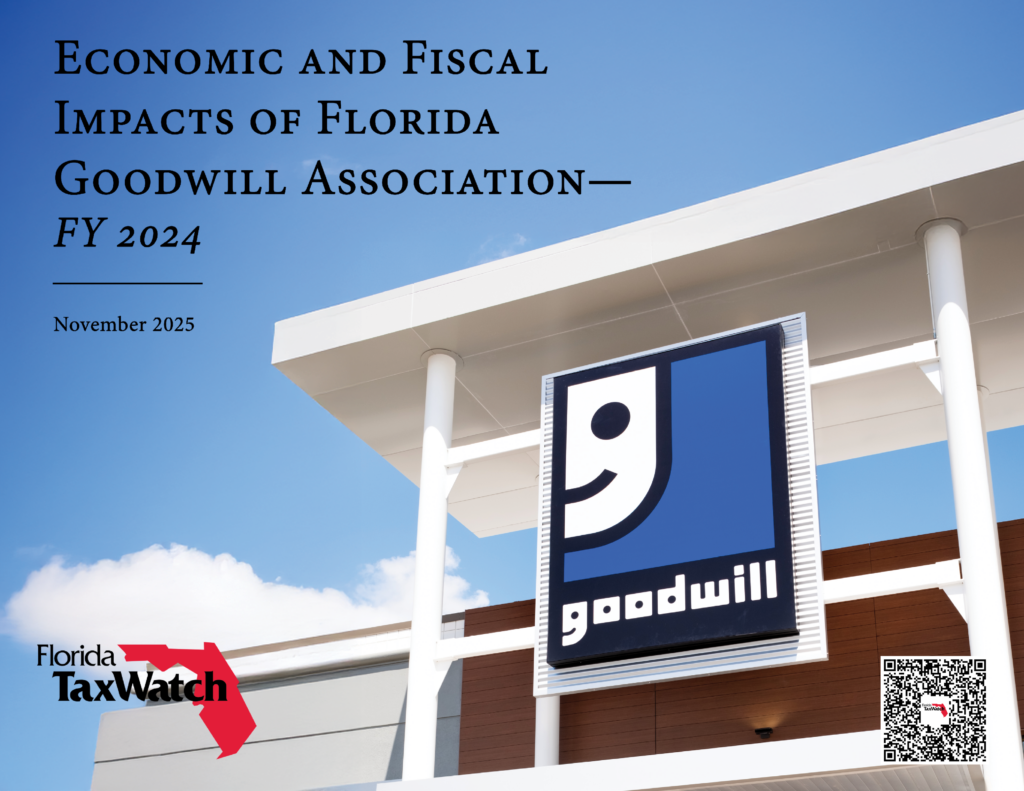
Economic and Fiscal Impacts of Florida Goodwill Association

FY 2024

Goodwill FY 2024 Economic and Workforce Impact Report Cover

Goodwill’s Economic and Workforce Impact in Florida: FY 2024 quantifies how the Florida Goodwill Association and its nine territories convert donated goods and mission-driven operations into jobs, higher earnings, and stronger local economies across the state. Using FY 2024 operational, employment, and capital spending data and the IMPLAN input-output model, Florida TaxWatch estimates that Goodwill generated $1.52 billion in total economic output, added $893.9 million to Florida’s GDP, and supported 21,471 jobs statewide.

Beyond its familiar retail presence, Goodwill functions as a major workforce development and barrier-removal partner. In 2024, Florida territories served 161,379 individuals, directly employed more than 11,000 people, and placed 4,694 individuals into jobs through community job placement programs—approximately one in every 27 new hires in Florida. These placements generated an estimated $146.37 million in additional annual personal income, while Goodwill’s recycling and salvage activities diverted 384.5 million pounds of materials from landfills.

Across the nine territories—Big Bend, Central Florida, Gulf Coast, Gulfstream, Manasota (including Palm Beaches & Treasure Coast), North Florida, South Florida, Southwest Florida, and Suncoast—Goodwill tailors services to local needs while maintaining a consistent focus on employment and independence. Territory-level impacts range from tens of millions to more than $300 million in annual economic output and from several hundred to nearly 4,000 jobs supported per territory, driven by programs in career readiness, housing stability, re-entry, veteran services, youth services, and supports for individuals with disabilities.

Financially, Goodwill’s model turns donations into sustained community investment. Roughly 90 percent of revenues in Florida territories are reinvested directly into program activities, far exceeding the Better Business Bureau’s 65-percent benchmark for charitable program spending. For donors, partners, and policymakers, this translates into a strong nonprofit return on investment: more than $1.5 billion in annual economic activity, higher household earnings for those facing employment barriers, and over $72.9 million in state and local tax revenues—positioning Goodwill as a critical ally in strengthening Florida’s workforce and reducing long-term reliance on public assistance.

Meet the Authors:

Jessica Cimijotti-Little
Research Analyst | Lead Author
LinkedIn
Jui Shah
Jui Shah
Research Economist | Contributing Author
LinkedIn

Documents to download

Previous Article 2025 Florida TaxWatch Annual Report
Next Article LUCA Primer: The First Step In Preparing for the 2030 Census
Print
1528
0Upvote 0Downvote
«December 2025»
MonTueWedThuFriSatSun
24252627282930
1234
OH, SNAP! Federal Policy Changes Threaten the Stability of Florida's Supplemental Nutrition Assistance Program

OH, SNAP! Federal Policy Changes Threaten the Stability of Florida's Supplemental Nutrition Assistance Program

Administered by the United States Department of Agriculture’s (USDA)’s Food and Nutrition Service (FNS), the Supplemental Nutrition Assistance Program (SNAP) provides funds to help low-income households afford low-cost, nutritious meals. In July 2025, President Trump signed the One Big Beautiful Bill Act of 2025 (the OBBB Act), tightening SNAP policies that determine eligibility, benefits, and program administration. Florida TaxWatch undertakes this independent research project to better understand how the upcoming changes in SNAP requirements will impact Florida’s budget and its ability to provide much needed food assistance to needy Floridians.

Read more
567
891011121314
15
2025 How Florida Counties Compare

2025 How Florida Counties Compare

This report compares the revenue and expenditure profiles of Florida’s 67 counties to give taxpayers an overview of how their local government stacks up with the rest of the state.

Read more
16
The Fiscal and Economic Impacts of Nova Southeastern University on Florida’s Economy

The Fiscal and Economic Impacts of Nova Southeastern University on Florida’s Economy

NSU generated an estimated $293.1 million in state and local taxes within the Tri-County region in FY 2024-25 and an estimated $305.1 million in state and local taxes in FY 2024-25.

Read more
17
Transferring Utility Profits to a Municipality's General Fund Increases the Risk of Undercapitalization of Water Assets and Violate Taxpayer Accountability

Transferring Utility Profits to a Municipality's General Fund Increases the Risk of Undercapitalization of Water Assets and Violate Taxpayer Accountability

Setting water utility rates that incorporate the recovery of the costs associated with standard operating expenses and debt obligations is essential to ensuring the short-term and longer-term financial stability of the utility. Once these costs are covered, many publicly owned utilities make transfers to the General Fund (a practice known as “sweeping”) ostensibly to help pay for governmental services that do not generate revenue (e.g., roadway maintenance, public safety, etc.) and to help keep property taxes lower. Keeping property taxes low often means higher municipal utility rates to balance the general budget, a habitual practice that burdens utility customers with cross-subsidies and normalizes underinvestment in infrastructure.

Read more
18
Florida Sheriffs’ Offices Staffing Analysis

Florida Sheriffs’ Offices Staffing Analysis

In May 2025, Florida TaxWatch and the Florida Sheriff Association conducted a joint survey to local sheriff offices to learn more about law enforcement’s workforce challenges.

Read more
192021
22232425262728
2930311234

Archive