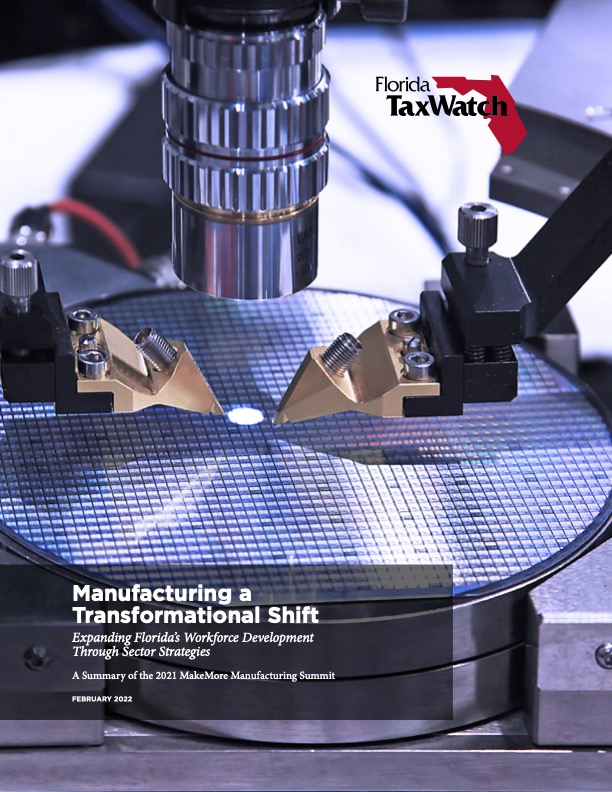
Manufacturing a Transformational Shift—Expanding Florida’s Workforce Development Through Sector Strategies

A Summary of the 2021 MakeMore Manufacturing Summit
FloridaMakes is a statewide, industry-led, public-private partnership operated by an alliance of Florida’s regional manufacturers’ associations. Since its inception in 2016, FloridaMakes has had an economic impact of $2.6 billion with almost 17,000 jobs created and/or retained. The pandemic underscored the important role Florida’s Manufacturing sector plays in providing products that are crucial to public health and safety, national security, and the continuity of many other industries.

The MakeMore Manufacturing Summit was born in 2018 as a leadership-focused initiative originally developed by FloridaMakes in partnership with the Associated Industries of Florida (AIF), CareerSource Florida, Enterprise Florida, and the Florida Chamber of Commerce. The collective goal of the Summit is to: (1) elevate the state’s more than 22,000 Manufacturing companies and demonstrate their impact on the economy; and (2) recognize the importance of diversifying the economy and prioritizing the growth of an industry that provides high-wage, high- value jobs and that can ultimately improve Florida’s quality of life.

The 2021 Summit was conducted via three virtual events and one in-person event. It brought together distinguished subject matter experts to discuss manufacturing sector challenges and identify strategies to overcome them. The strategies presented during the Summit reflect “sector strategies,” which are collaborative, regional, industry-focused approaches to building skilled talent. Sector strategies have proven to be an effective way to align public and private resources to address the talent needs of Florida manufacturers.

In its review of the three virtual sessions, Florida TaxWatch identified four major challenges that must be addressed if we are to grow Florida’s Manufacturing sector:

  • Finding people with the right skills necessary to keep up with the needs of Manufacturing and technology, particularly for emerging industries;
  • Developing resilient and sustainable supply chains—interactive, dynamic, networks of people, processes, and technologies;
  • Accelerating the adoption and implementation of Industry 4.0 technologies; and
  • Attracting the next generation of manufacturers.

Documents to download

Previous Article Aging in Place—The Economic and Fiscal Value of Home and Community-Based Services
Next Article A System in Crisis: Stabilizing Florida’s Child Welfare Workforce
Print
4092
0Upvote 0Downvote
«February 2026»
MonTueWedThuFriSatSun
26
Florida’s Space Coast is Well-Positioned to Dominate the Future of the Aerospace Industry

Florida’s Space Coast is Well-Positioned to Dominate the Future of the Aerospace Industry

For more than 60 years, Florida’s Space Coast—anchored by Kennedy Space Center (KSC) and Cape Canaveral Space Force Station (CCSFS)—has served as a premier gateway to space, driving tourism, high-tech jobs, and statewide economic output. After major federal program shifts in the 2010s led to significant regional job losses, Florida’s modern commercial-space resurgence—supported by Space Florida’s strategy to diversify the supply chain, modernize infrastructure, and attract private capital—has positioned the Space Coast to lead the next era of aerospace growth.

Read more
27282930311
2345
New General Revenue Forecast Adds $572.5 Million for the Next Budget

New General Revenue Forecast Adds $572.5 Million for the Next Budget

The General Revenue (GR) Estimating Conference met on January 23 to adopt Florida’s latest GR forecast—the estimate that tells lawmakers how much is available for the next state budget. The updated forecast adds $572.5 million to the amount available for the upcoming budget year, but while meaningful, it amounts to only about one percent of total GR collections.

Read more
678
910
Clearwater’s Plan to Establish Its Own Municipal Electric Utility Puts Taxpayers at Risk

Clearwater’s Plan to Establish Its Own Municipal Electric Utility Puts Taxpayers at Risk

Florida TaxWatch examines the City of Clearwater’s plan to acquire Duke Energy Florida’s electric distribution assets and establish a municipal electric utility (MEU) in response to concerns over electric rates and service quality. While the City’s feasibility study projects modest short-term rate savings, Florida TaxWatch finds those projections rely on unrealistic assumptions—most notably an “overnight” conversion that ignores the likely decade-long, costly eminent domain process required to acquire Duke’s assets. Drawing on national municipalization case studies, the report highlights high failure rates, underestimated acquisition and severance costs, loss of economies of scale, and substantial financial exposure for taxpayers. Florida TaxWatch concludes that the proposed MEU represents a high-risk endeavor with limited upside and recommends the City pursue a renegotiated franchise agreement with Duke Energy Florida as a more prudent path forward.

Read more
1112131415
16171819202122
2324252627281
2345678

Archive