Research Library

Economic Development

Social Determinants of Health: Health Care Access and Quality

Economic Development, Health Care, Institute of Quality Health and Aging, Research, Social Determinants of Health

This report examines the social determinants of health (SDOH), underscoring that environmental and social factors are the primary determinants of health outcomes. Significant barriers to healthcare access include high insurance costs and a large uninsured population, contributing to Florida’s low national ranking in healthcare access. Challenges are particularly acute in rural and low-income areas, with a notable dependence on emergency services by uninsured individuals, imposing considerable economic strains. To address these issues, the report suggests expanding Medicaid eligibility to enhance access and reduce costs, promoting telehealth to connect urban and rural communities, increasing autonomy for nurse practitioners and physician assistants to alleviate physician shortages, and implementing the “Live Healthy Agenda” to elevate healthcare quality and access throughout Florida. These recommendations aim to catalyze systemic changes for a healthier, economically stable state.

2024 Florida Legislative Session Wrap-Up

Budget/Approps, Corrections/Judicial, Economic Development, Education, Energy & Environment, Health Care, Research, Retirement, Taxpayer Guide, Tourism, Transportation

The 2024 Florida Legislative Session Wrap-Up offers a concise yet thorough review of the session’s key outcomes. With a $117.5 billion budget, over $1 billion in tax relief, and nearly $10 billion in reserves, the Legislature addressed crucial issues in healthcare, education, insurance, and the environment. The report provides an insightful overview of the bills and budget items that passed, as well as notable legislation that failed to advance, making it an essential resource for understanding the current state of Florida policy and its implications for residents and taxpayers.

An Analysis of the Tax Treatment of Credit Unions: Value of Florida Credit Unions’ Exemption Is Now $259 Million

Budget/Approps, Cost Savings, Economic Development, Local Government, Research, Taxes

Originally designed to serve specific community segments, credit unions have since expanded their reach and service offerings, making their tax exemptions increasingly valuable. From 1997’s exemption value of $89.1 million, the exemption’s worth has risen to $259 million in 2023. This report sheds light on the industry’s transformations, recent trends like mergers and acquisitions, and reevaluates the rationale behind the tax exemptions. It aims to fuel informed discussions on credit union taxation and their exemption status.

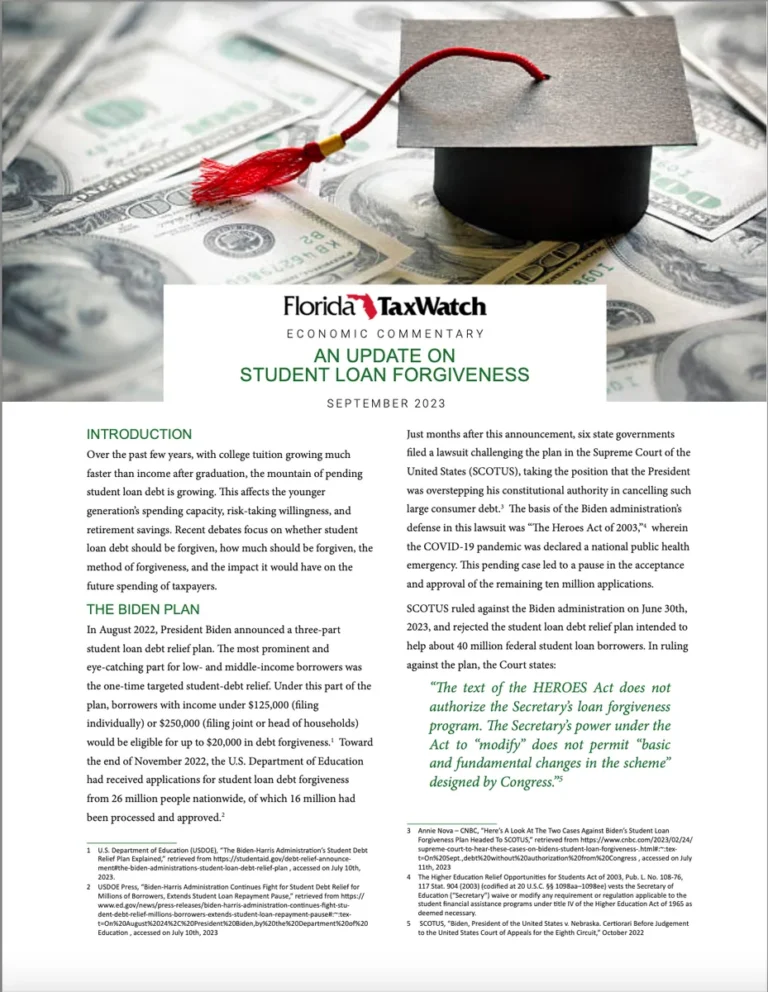
An Update on Student Loan Forgiveness

Cost Savings, Economic Development, Education, Research

Over the past few years, with college tuition growing much faster than income after graduation, the mountain of pending student loan debt is growing. This affects the younger generation’s spending capacity, risk-taking willingness, and retirement savings. Recent debates focus on whether student loan debt should be forgiven, how much should be forgiven, the method of forgiveness, and the impact it would have on the future spending of taxpayers.

Session Spotlight: Not Funding VISIT FLORIDA Would Hurt Tourism Promotion and Florida’s Economy

Blog, Economic Development, Research, Tourism

Tourism plays a major role in Florida’s economic strength. More than 142 million tourists are expected to visit Florida in 2023. In 2019, 131 million visitors spent nearly $100 billion, supporting 1.6 million Florida jobs that paid $57 billion in wages. The spending generated $12.7 billion in state and local taxes. Without the state and local taxes generated by tourism, each Florida household would have to pay as much as $1,420 in additional taxes just to maintain the current level of government services.

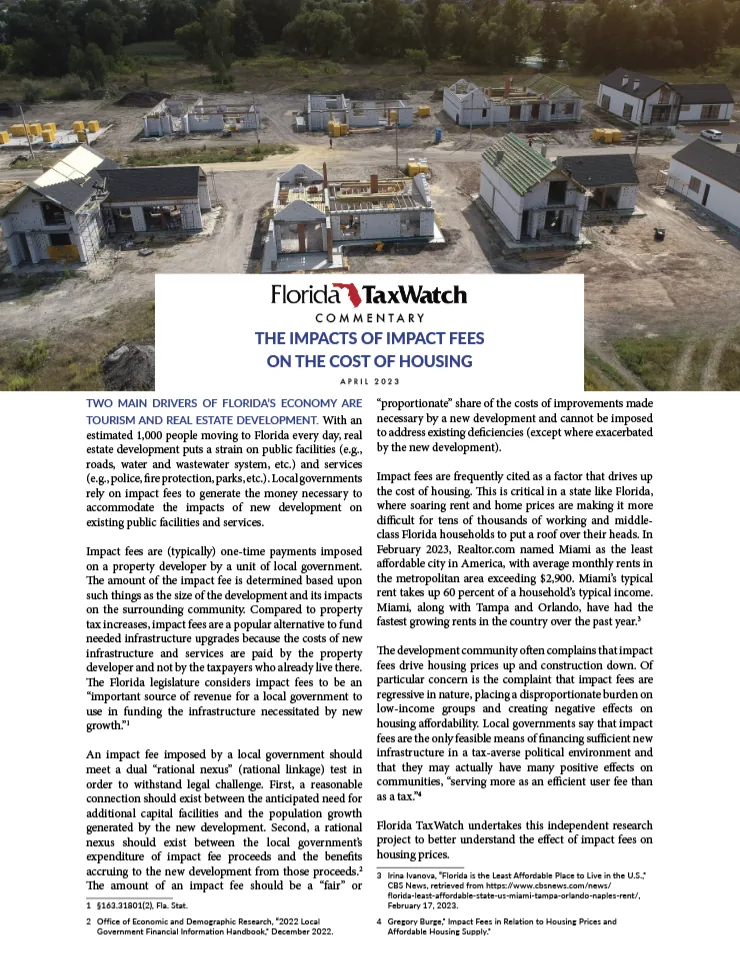
The Impacts of Impact Fees on the Cost of Housing

Economic Development, Housing Affordability, Research

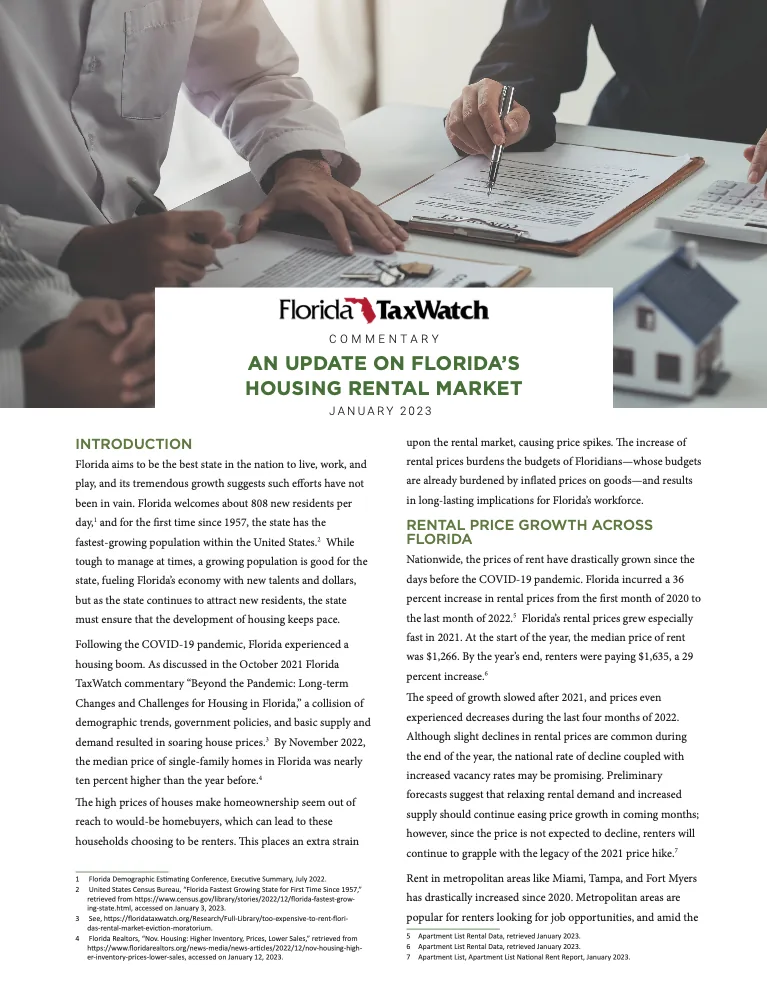
Two main drivers of Florida’s economy are tourism and real estate development. With an estimated 1,000 people moving to Florida every day, real estate development puts a strain on public facilities (e.g., roads, water and wastewater system, etc.) and services (e.g., police, fire protection, parks, etc.). Local governments rely on impact fees to generate the money necessary to accommodate the impacts of new development on existing public facilities and services.

Producing More Talent

Economic Development, Manufacturing, Research, Workforce Development

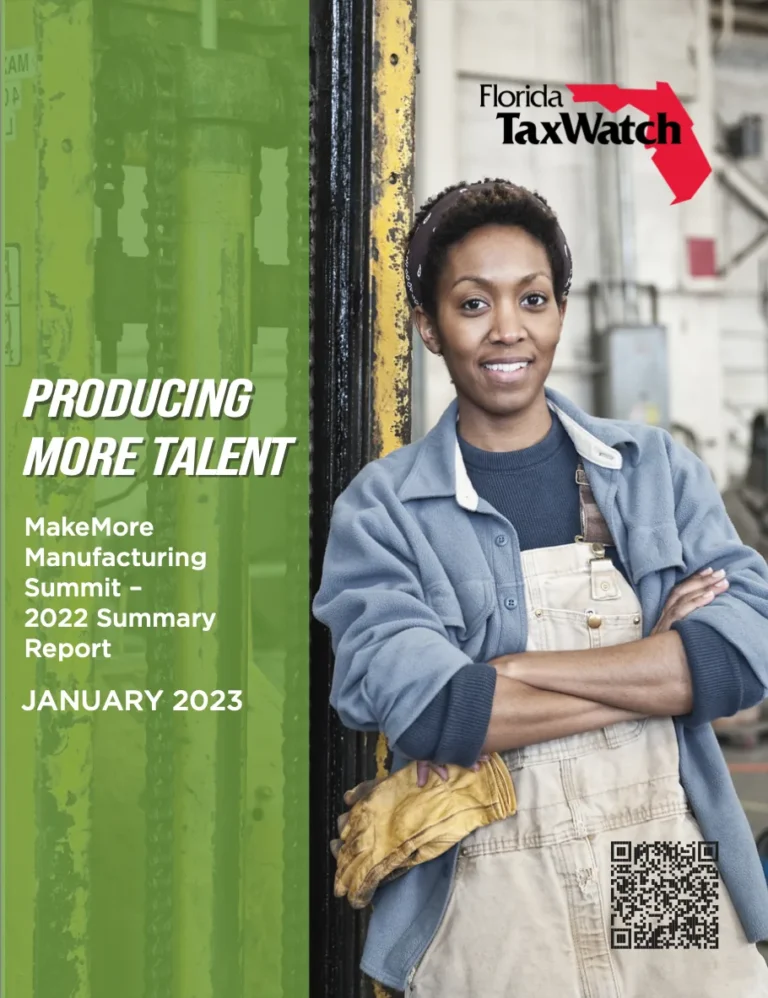
FloridaMakes is the manufacturing extension partnership for the state of Florida. FloridaMakes is managed by the National Institute of Standards and Technology, an agency of the U.S. Department of Commerce, and delivers business growth, talent development, and technology adoption services to manufacturers through regional manufacturers’ associations.

Using Public-Private Partnerships and Public-Public Partnerships to Meet the Growing Demands for Public Infrastructure

Cost Savings, Economic Development, Local Government, Research, Transportation

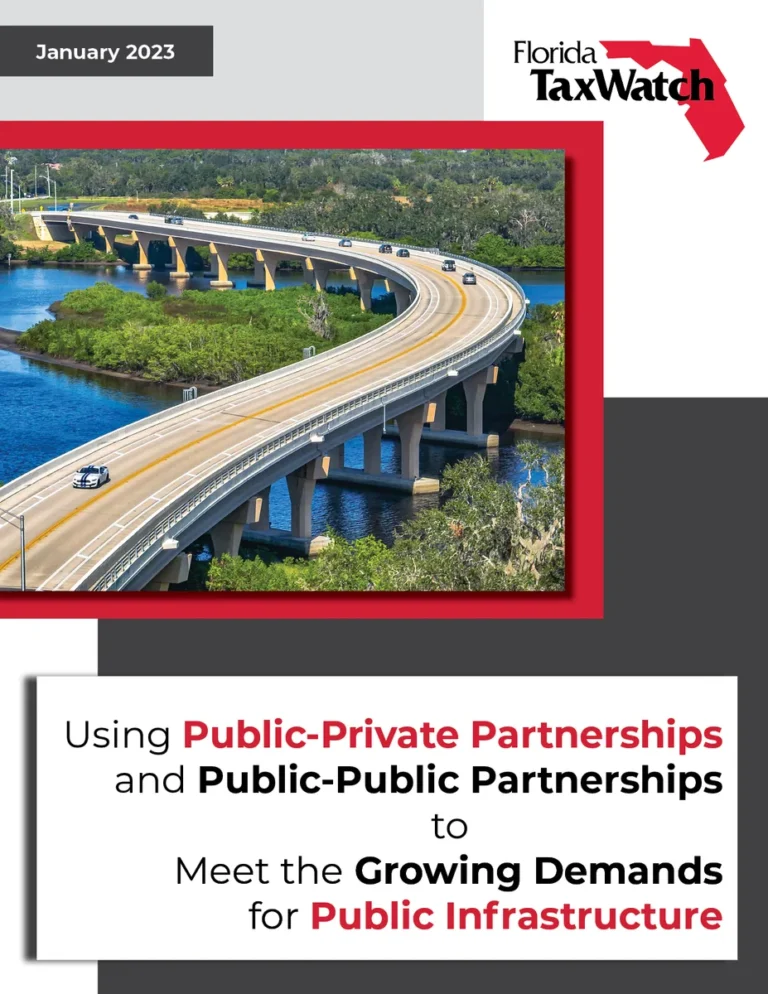
The gap between Florida’s infrastructure needs and what Florida currently has is nearly $2.59 trillion over ten years. By year 2039, a continued underinvestment in Florida’s infrastructure at current rates will have serious economic consequences — $10 trillion in lost Gross Domestic Product (GDP), more than 3 million lost jobs, and $2.4 trillion in lost exports. Two creative solutions are public-private partnerships (PPPs) and public-public partnerships (PUPs). Why then, are there not more PPPs and PUPs? 

A Key to Overcoming Disasters: Complete Census Data Reinforces Resiliency

Census, Economic Development, Hurricane Ian, Research

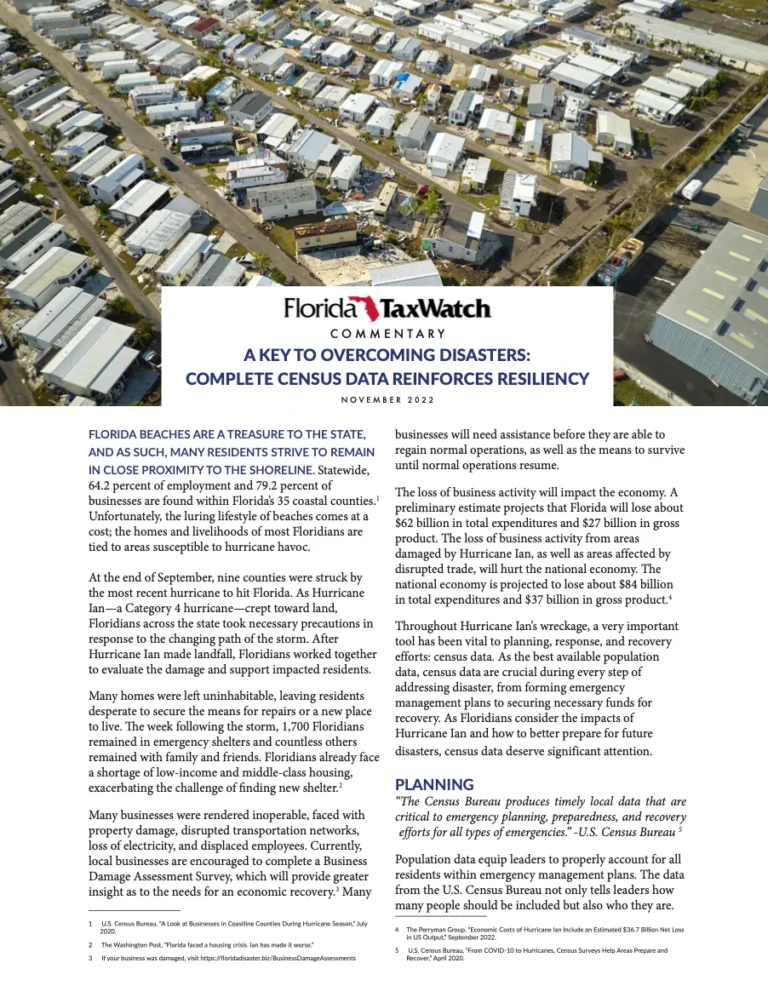
Florida beaches are a treasure to the state, and as such, many residents strive to remain in close proximity to the shoreline. Statewide, 64.2 percent of employment and 79.2 percent of businesses are found within Florida’s 35 coastal counties.1 Unfortunately, the luring lifestyle of beaches comes at a cost; the homes and livelihoods of most Floridians are tied to areas susceptible to hurricane havoc.

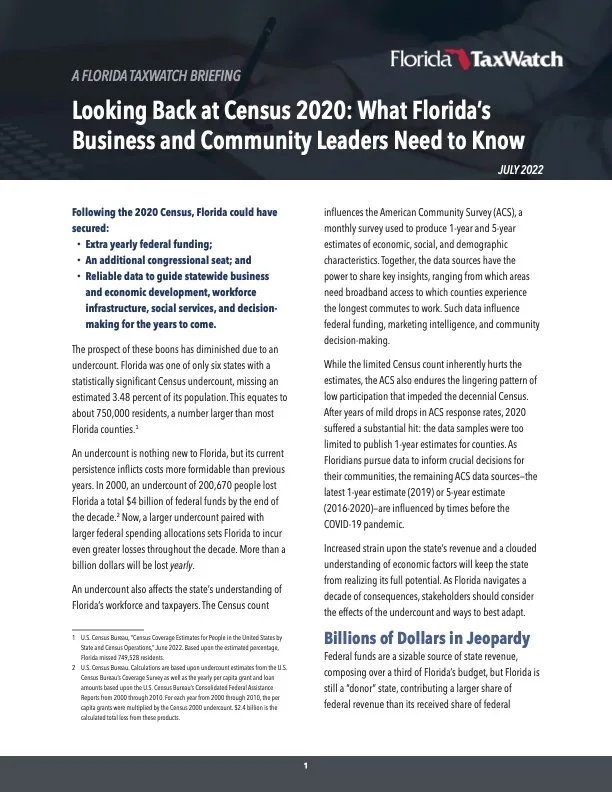
Looking Back at Census 2020: What Florida’s Business and Community Leaders Need to Know

Census, Economic Development, Research, Taxes

An undercount is nothing new to Florida, but its current persistence inflicts costs more formidable than in previous years.  Throughout the decade, Floridians can expect to lose between $11 billion and $21 billion. The decennial Census count and American Community Survey (ACS) help communities understand local patterns of population growth, specialized workers, income, employment statuses, and transportation needs.

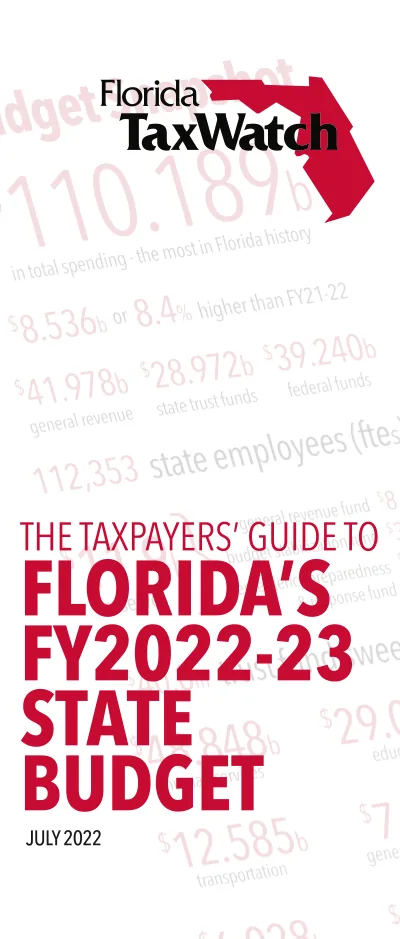
Florida’s FY2022-23 State Budget

Budget/Approps, Corrections/Judicial, Economic Development, Education, Energy & Environment, Health Care, Insurance, Research, Taxpayer Guide, Tourism, Transportation

Florida TaxWatch is pleased to present taxpayers with a guide to the FY2022-23 state budget, which went into effect July 1, 2022. The report includes all appropriations for the new fiscal year— the General Appropriations Act (GAA), “back-of-bill” spending, and general bills—net of the Governor’s vetoes.

BUILT FOR SUCCESS: MANUFACTURING’S ROLE IN FLORIDA’S ECONOMY

Economic Development, Research

Advancing Florida’s standing on the global stage requires a state economy conducive to innovation, capable of withstanding disruptions, and constantly cultivating talent. A robust manufacturing sector stands at the crossroads of these priorities and, as the COVID-19 pandemic demonstrated, the sector’s importance cannot be understated.

Benefits Cliffs—At the Cliffs Edge

Economic Development, Research

This report analyzes public safety net programs and benefits cliffs, a scenario in which a small increase in wages results in the partial or total loss of public benefits. Benefits cliffs occur when a marginal wage increase results in the partial or total loss of public benefits for different public assistance programs. For illustrative purposes, imagine a mother earns a $1,000 annual raise but loses more than $8,000 in childcare assistance—a cliff effect occurs. 

The Economic and Fiscal Significance of the U.S. Census and American Community Survey

Census, Economic Development, Local Government, Research

The once-in-a-lifetime pandemic disrupted the 2020 Census— the 24th in U.S. history—delaying field operations and hampering the public’s ability to respond. This report underscores the COVID-19 pandemic’s impact on 2020 Census data collection efforts, including disruptions to the ACS, and highlights how this impacts federal funding and critical decision-making among policymakers and business leaders alike.

Become a Member

Support Responsible
Taxation & Government Spending

For over 45 years, donor support has made Florida TaxWatch the state’s leading independent voice for taxpayer accountability. There are many ways to support our mission.

Scroll to Top