
Indian River State College Return on Investment
ResearchTBD
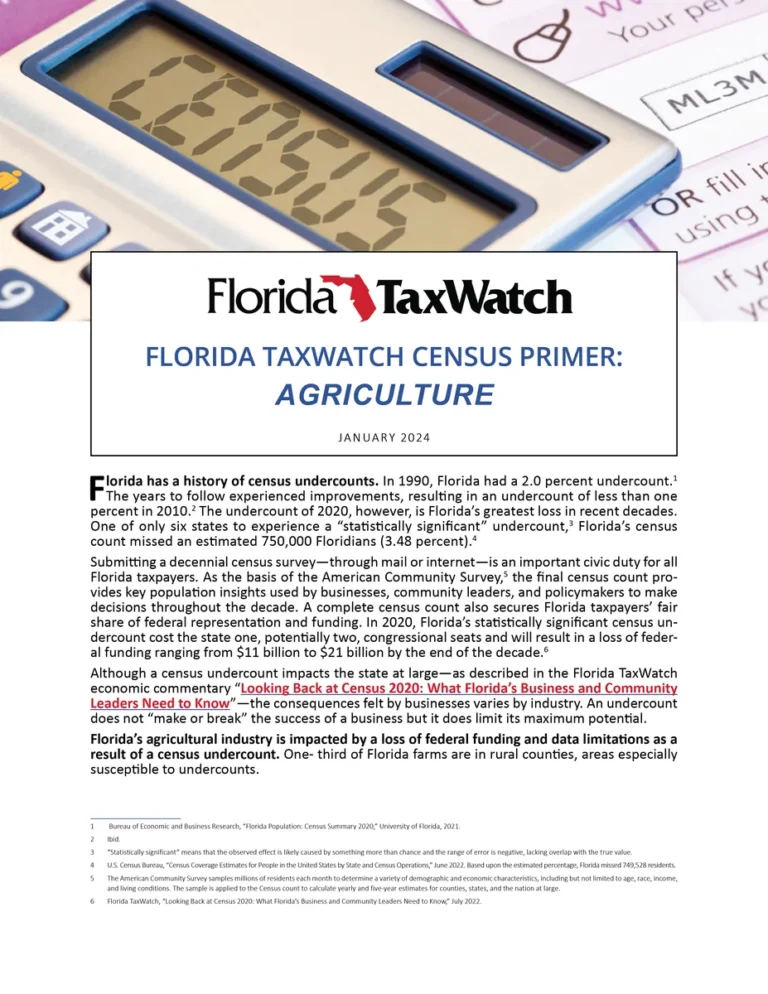
“Florida TaxWatch Census Primer: Agriculture” discusses the impact of census undercounts on Florida’s agriculture sector. It highlights the consequences of the 2020 census, where Florida missed counting 750,000 residents, leading to significant losses in federal funding and representation. The primer emphasizes the importance of accurate census counts for securing federal funding and making informed decisions in agriculture and rural development. It concludes by urging stakeholders to actively prepare for the 2030 Census to maximize accuracy and benefits for Florida’s agricultural community.
Why you should care about the impact of the undercount in the 2020 Census in Florida and outlines strategies to improve census participation for 2030. This primer highlights that Florida missed approximately 750,000 residents in the 2020 count, which could lead to a significant loss in federal funding and possibly an additional congressional seat. The document emphasizes the importance of census data in resource allocation, emergency planning, and business decisions. It suggests actions for legislators, constituents, and businesses, such as funding Complete Count Committees, promoting awareness, and integrating census information into community and business activities.
“Unlicensed Vacation Rentals: An Analysis of Florida’s Tourism-Driven Economy” provides an in-depth analysis of the unlicensed vacation rental market in Florida. It highlights the significant impact these rentals have on the state’s tourism economy, including issues of tax evasion, safety concerns, and unfair competitive advantages over licensed properties. The research reveals a notable prevalence of unlicensed rentals in Florida, which, in 2022, constituted a significant proportion of the state’s temporary public lodging units. The study brings to light how operators of these unlicensed rentals often circumvent tax obligations, thus negatively impacting the state’s revenue and creating an unlevel playing field in the tourism sector. This paper includes recommendations for stricter enforcement of licensing regulations, improved transparency in rental operations, and more efficient tax collection mechanisms to address these challenges. The paper serves as a critical resource for policymakers, business owners in the tourism sector, and tax authorities, providing essential insights to inform decisions and strategies aimed at ensuring a fair and regulated tourism industry in Florida.
Florida TaxWatch, in collaboration with the Associated Industries of Florida (AIF), released a report titled “It’s Time to Reform Florida’s Information Technology Procurement and Oversight.” The report highlights Florida’s 25-year history of inadequately executed large-scale IT projects and offers recommendations for reforming the Florida Digital Service’s (FL[DS]) procurement and oversight processes to ensure their success. Key points from the report include: – FTW and AIF identified recurring problems in statewide technology projects, including poor planning, contracting, and oversight, leading to failures in accountability. – Since 1999, Florida has repeatedly restructured its state agency overseeing these IT projects, with the FL[DS] established most recently in 2020. – Public sector IT agencies like the FL[DS] struggle to compete with the private sector in hiring knowledgeable staff due to salary and work condition limitations, leading to an overreliance on consultants and vendors. – The report proposes 10 recommendations for the Florida Legislature, such as forming a joint committee on IT and offering incentives like signing bonuses to attract IT staff. Florida TaxWatch President and CEO Dominic M. Calabro emphasized the need for the state’s IT projects to be delivered efficiently and within budget. AIF President and CEO Brewster B. Bevis highlighted the importance of Florida improving its IT processes for long-term success. For more details and access to the full report, including all recommendations, interested parties are directed to the Florida TaxWatch website. FTW, a nonpartisan, nonprofit government watchdog, has been working to enhance productivity and accountability in Florida government for over forty years.
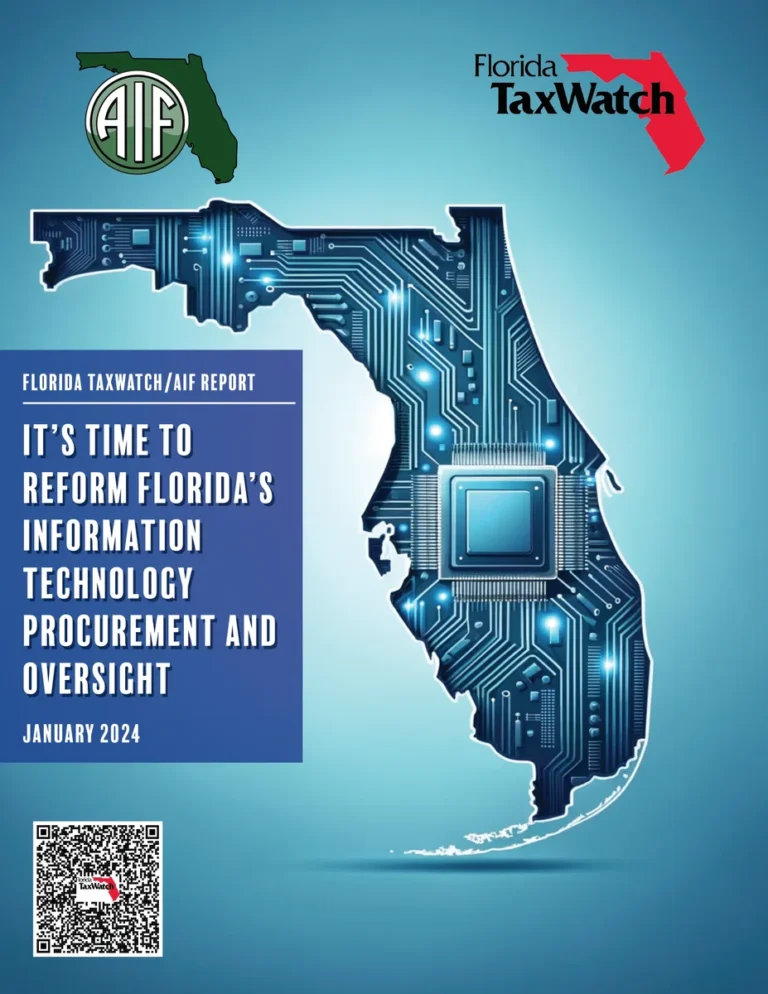
This report highlights the chronic issues plaguing Florida’s large-scale IT projects, such as inadequate planning, contracting, and management. These issues have led to the repeated formation and dissolution of a state agency overseeing these projects, with the most recent being the Florida Digital Service (FL[DS]) established in 2020. The paper provides a series of recommendations to prevent the failure of FL[DS]. These include forming a joint House and Senate IT committee for oversight, adopting a new governance model, standardizing statewide agency business processes, and revising Florida Statutes for better IT project procurement and vendor evaluation. Furthermore, the paper suggests methods to attract and retain IT talent, like offering signing bonuses, revising job descriptions to focus on skills, and creating a talent pipeline from the State University System. The report emphasizes the necessity for effective project management and strategic decisions to ensure the success of Florida’s IT projects and to safeguard taxpayer investments??.

This paper addresses the growing issue of physician shortages in Florida. This shortage is primarily driven by an increasing and aging population, coupled with a high rate of physician retirements. The report evaluates the gap between healthcare demand and the supply of physicians, emphasizing the need for more medical students and improved healthcare policies. It discusses strategies like expanding Graduate Medical Education, utilizing telehealth, and leveraging Advanced Practice Registered Nurses to mitigate this shortage. The paper also considers legal and business aspects of practicing medicine in Florida, suggesting improvements to attract and retain healthcare professionals.

The 2023 Debt Report for Florida highlights the state’s strong financial standing, with a debt ratio below the 6% legislative target for the tenth consecutive year. Florida’s debt and debt service have decreased, while General Revenue collections increased by $3.3 billion. Rating agencies affirmed AAA ratings and a stable financial outlook. The report details Florida’s debt management strategies, including limiting debt accumulation and maintaining high reserves, contributing to a strong debt capacity and reduced future costs. Local government debt, however, remains comparatively high. The state’s prudent financial practices are underscored, benefiting taxpayers and indicating a healthy fiscal future.
The Broward County Public Schools (BCPS) Quarterly Report for Q1 2023-24, presented to the Bond Oversight Committee, marks the midpoint of the school year and Year 10 of the SMART Program. The report acknowledges Resolution 23-109 from May 9, 2023, which recognizes the efforts of the Bond Oversight Committee and Florida TaxWatch in overseeing the SMART Program and notes the Twentieth Statewide Grand Jury’s identification of program deficiencies. The resolution sets an expectation for the SMART Program’s completion by October 31, 2025, including financial close-out and full expenditure of General Obligation Bond funds. The report details various program aspects like safety improvements, technology upgrades, and budget activities, while addressing financial risks and the critical role of oversight committees.
Amidst a national shift towards a cooler labor market with fewer job openings, the study explores the consequent effects on wage trends and inflationary pressures. The focus is on Florida’s unique position and its adaptive response to these economic headwinds, highlighting the state’s labor market resilience. As job openings decline and employee separations remain high, Florida’s experience offers a case study in managing workforce challenges during economic cooldowns. This paper is a must-read for policymakers, economists, and business leaders interested in the interplay between labor markets and inflation, especially those focused on the Sunshine State’s economic climate.
Originally designed to serve specific community segments, credit unions have since expanded their reach and service offerings, making their tax exemptions increasingly valuable. From 1997’s exemption value of $89.1 million, the exemption’s worth has risen to $259 million in 2023. This report sheds light on the industry’s transformations, recent trends like mergers and acquisitions, and reevaluates the rationale behind the tax exemptions. It aims to fuel informed discussions on credit union taxation and their exemption status.
This is the Florida TaxWatch annual independent review of Florida’s FY2023-24 budget process. The report was started in 1983 and promotes oversight and integrity in the state’s budgeting process based on the principle that: because money appropriated by the Legislature belongs to the taxpayers of Florida, the process must be thorough, thoughtful, transparent, and accountable. Every appropriation should receive proper deliberation and public scrutiny. This includes member-requested projects.
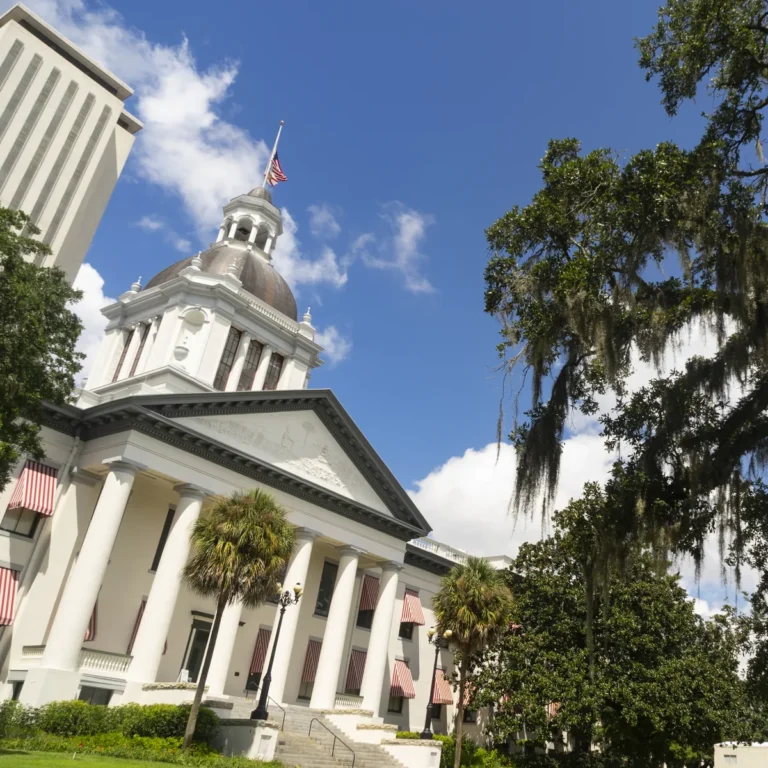
We cannot forget that the money appropriated by the Legislature belongs to the taxpayers of Florida. But what happens when appropriations circumvent the budget process or competitive project selection? Or when they bypass the opportunity for public scrutiny or competitive bidding?
Tallahassee, Fla. – Today, Florida TaxWatch (FTW) released Physician Shortages: Better Utilization of Advanced Practice Registered Nurses in Palliative Medicine Could Provide Relief, a briefing explaining how fully utilizing the advanced practice registered nurse (APRN) workforce has the potential to significantly mitigate the existing physician shortage and similar issues that may arise in the future, particularly in palliative care and hospice facilities.
Orlando, Fla. – Today, Mon., March 27, Florida TaxWatch (FTW) will proudly announce that Rolando Bailey – Evans High School Immediate Past Principal, now Orange County Public Schools’ Area Superintendent for the Southeast Learning Community – is among the nine winners of the Florida TaxWatch 2022-23 Principal Leadership Awards (PLA). Through the program, Principal Bailey has also identified one deserving student to receive a full two-year Florida Prepaid College Scholarship.

As Florida continues to grow, the development of infrastructure (e.g., roads, water and wastewater systems, parks, etc.) must keep pace. In January 2023, Florida TaxWatch released “Economic Commentary: An Update on Florida’s Housing Rental Market,” which evaluated the troubles Florida has experienced with the ever-rising cost of rent. In Florida, the cost of rent has jumped by 36 percent since 2020, with much of the increase occurring in 2021 alone.
One of the fundamental responsibilities of government is to ensure the safety and welfare of those in its care. This includes indigents who are accused of wrongdoing and who would otherwise be unable to afford a private attorney to defend them. It is essential that, in all criminal prosecutions, the accused is afforded all rights under Amendment VI of the U.S. Constitution, including the right to a speedy trial and the right to have the assistance of competent defense counsel, even if they cannot afford it.
The six percent sales and use tax is Florida state government’s largest revenue sourceby far, currently bringing in approximately $36 billion annually. When the almost $6 billion in local option sales tax collections is included with the state tax, the $42 billion total collections make the sales tax the number one tax source for all Florida governments, topping the $40 billion local property tax.
Florida’s economy is strong. If Florida were a country, its gross domestic product (GDP) would rank 14th among economies worldwide, and its ambitions do not stop there. Florida aims to be within the top ten economies by 2030. By this time, two in three jobs are expected to require specialized training, a credential, or a degree. To achieve its economic goal, Florida will need to continue developing its specialized workforce. With 120,000 students completing Florida College System (FCS) programs each year, the FCS plays a critical role in providing the talent pipeline necessary to reach Florida’s economic goal and does so at a very affordable cost to students and Florida taxpayers alike.
While the U.S. Census Bureau is popularly known as the leader of decennial census counts, it is also charged with conducting other surveys throughout the decade to help inform American decision-making. With each survey, the U.S. Census Bureau aims to strike the “best mix of timeliness, relevancy, quality and cost” to gather the data that define our nation’s people and economy. The U.S. Census Bureau cannot achieve its goal alone. Like the census count, the participation of all residents is key to ensuring that Americans can fully reap the benefits that the U.S. Census Bureau has to offer.
