Research Library

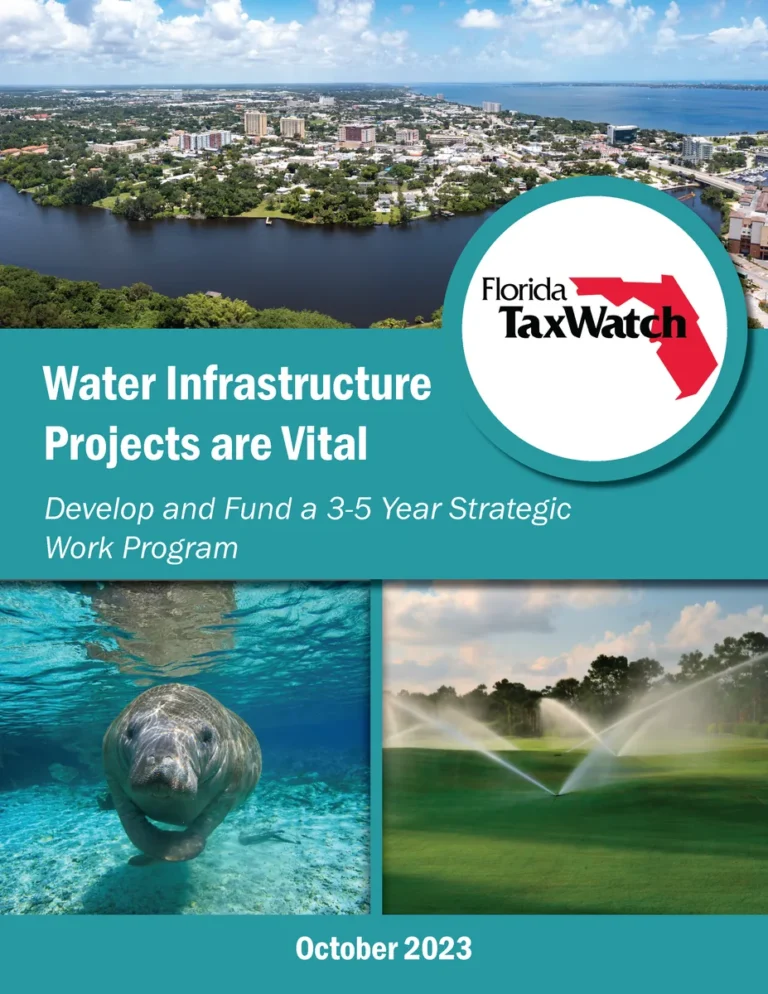
Water Infrastructure Projects are Vital

Research

Water provides varied and vital benefits to Floridians, our businesses, and visitors. We literally could not live without it. Our water resources are a massive, interconnected system, one that is expensive to maintain. Federal, state, and local governments have been spending a lot of taxpayer money on upkeep and enhancements, but there is still much work to be done.

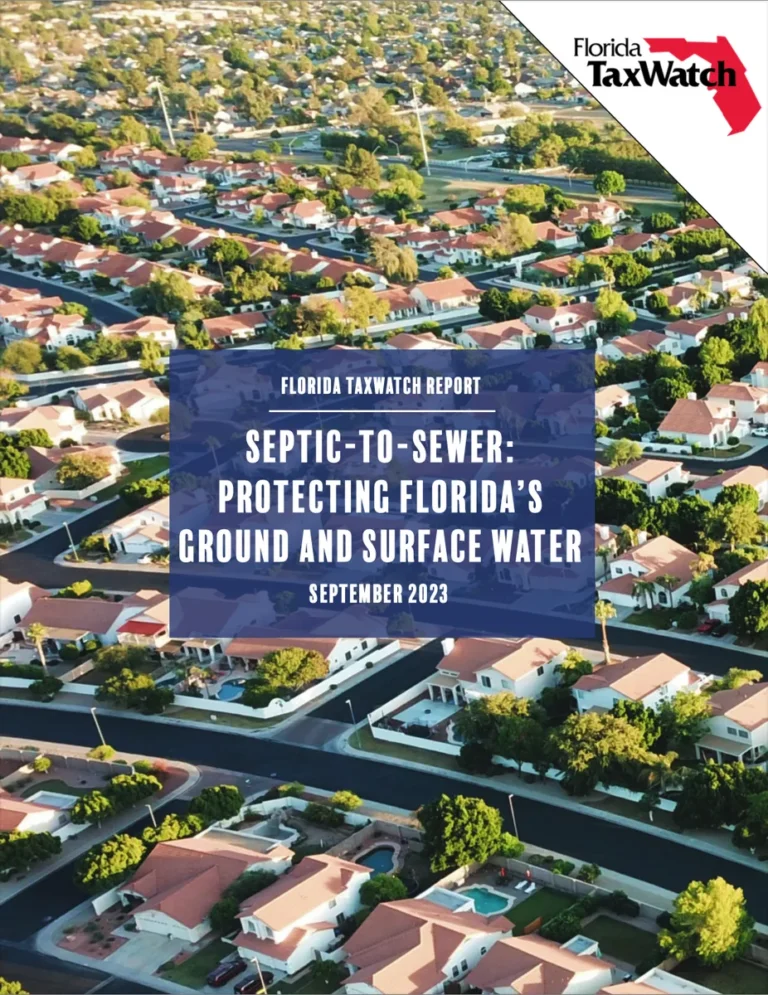
Septic-to-Sewer: Protecting Florida’s Ground and Surface Water

Energy & Environment, Research

From the early days on the edge of the Tigris and Euphrates River to now, water has long been a staple of civilization. As discussed in the Florida TaxWatch report “We Can’t Wait on Water” (January 2020), Florida relies upon high-quality water to maintain the well-being of public health, ecosystem services, recreation, property values, and economic activities, such as fishing, boating, sailing, and other water-based tourism. But Florida’s water quality is at risk.

Extending State Group Insurance to the Florida College System

Blog, Health Care, Insurance, Research

Serving as the eyes and ears of Florida taxpayers, Florida TaxWatch annually reviews the state budget to prepare its Budget Guide, showing how hard-earned taxpayer dollars are spent. This year, consistent with a recommendation by Florida TaxWatch, line item 2923 of the 500-page General Appropriations Act appropriates $500,000 in nonrecurring funds to the Department of Management Services to contract for a comprehensive analysis to determine the fiscal impact and feasibility of extending the State Group Insurance Program (SGIP) to employees of the Florida College System.  

Economic Benefits of a Robust Childcare System in Florida

Research

Access to affordable, quality child care and early learning programs is essential for keeping parents in the workforce. In July 2022, Florida TaxWatch released “How Childcare Impacts the State’s Economy and Shapes Florida’s Workforce” to examine the risk unstable childcare options pose to the state’s economy. The briefing found that childcare-related turnover can cost $5.7 billion in lost earnings for families, $1.2 billion in turnover expenses for businesses, and $518.3 million in tax revenues, annually. Yet, the availability and capacity of high-quality child care and early learning programs remain limited, and often unaffordable, for many Florida families.

Monitoring and Oversight of General Obligation Bonds to Improve Broward County Schools

Broward BOC, Research

As the 2023-24 school year begins and students return to class, Broward County Public Schools (BCPS) begins Year 10 of the SMART Program. This is significant in that former Superintendent Runcie promised the taxpayers that all SMART projects would start within five years and be completed by year seven. On May 9, 2023, the School Board of Broward County (SBBC) adopted Resolution Number 23-109, which acknowledged the commitment of the Bond Oversight Committee and Florida TaxWatch in monitoring the implementation of the SMART Program and acknowledged the work of the Twentieth Statewide Grand Jury in highlighting deficiencies in the SMART Program. The Resolution also expresses the expectation of the SBBC that the SMART Program will be completed no later than October 31, 2025. This expectation includes the financial close-out and the full expenditure of General Obligation Bond funds.

Monitoring and Oversight of General Obligation Bonds to Improve Broward County Schools

BOC, Broward BOC, Releases, Research

As the 2023-24 school year begins and students return to class, Broward County Public Schools (BCPS) begins Year 10 of the SMART Program. This is significant in that former Superintendent Runcie promised the taxpayers that all SMART projects would start within five years and be completed by year seven.

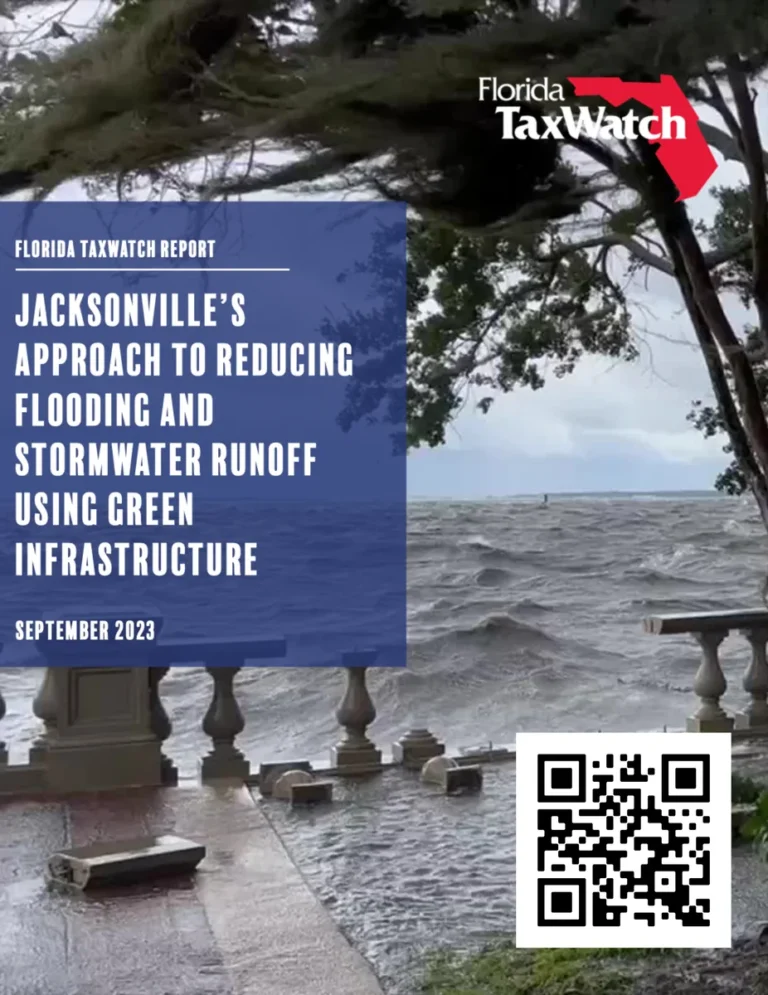
Jacksonville’s Approach to Reducing Flooding and Stormwater Runoff Using Green Infrastructure

Energy & Environment, Research

Green infrastructure, including parks and greenways, is becoming an increasingly important resource for cities to use to help reduce flooding and stormwater runoff, especially in high-risk areas. As seen in Jacksonville, these resources can provide $112.8 million in savings from pollution reduction costs while at the same time helping reduce the impact of flooding and stormwater runoff. Green infrastructure also saves taxpayers and cities a significant amount on maintenance costs over the years by eliminating some of the stress for man-made drainage to handle stormwater during intense rainfalls. Using green infrastructure is a critical resource for building more resilient communities that benefit Florida’s residents and businesses and provide cost savings for taxpayers.

An Update on Student Loan Forgiveness

Cost Savings, Economic Development, Education, Research

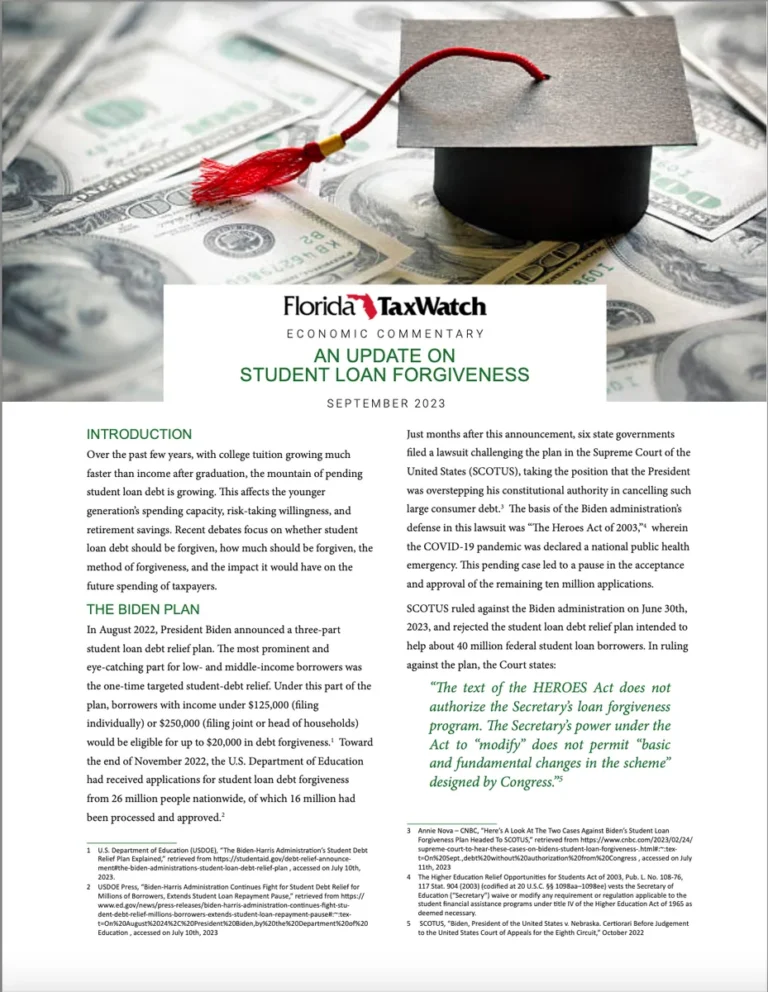
Over the past few years, with college tuition growing much faster than income after graduation, the mountain of pending student loan debt is growing. This affects the younger generation’s spending capacity, risk-taking willingness, and retirement savings. Recent debates focus on whether student loan debt should be forgiven, how much should be forgiven, the method of forgiveness, and the impact it would have on the future spending of taxpayers.

State General Revenue Estimates Increase Again

Budget/Approps, Research

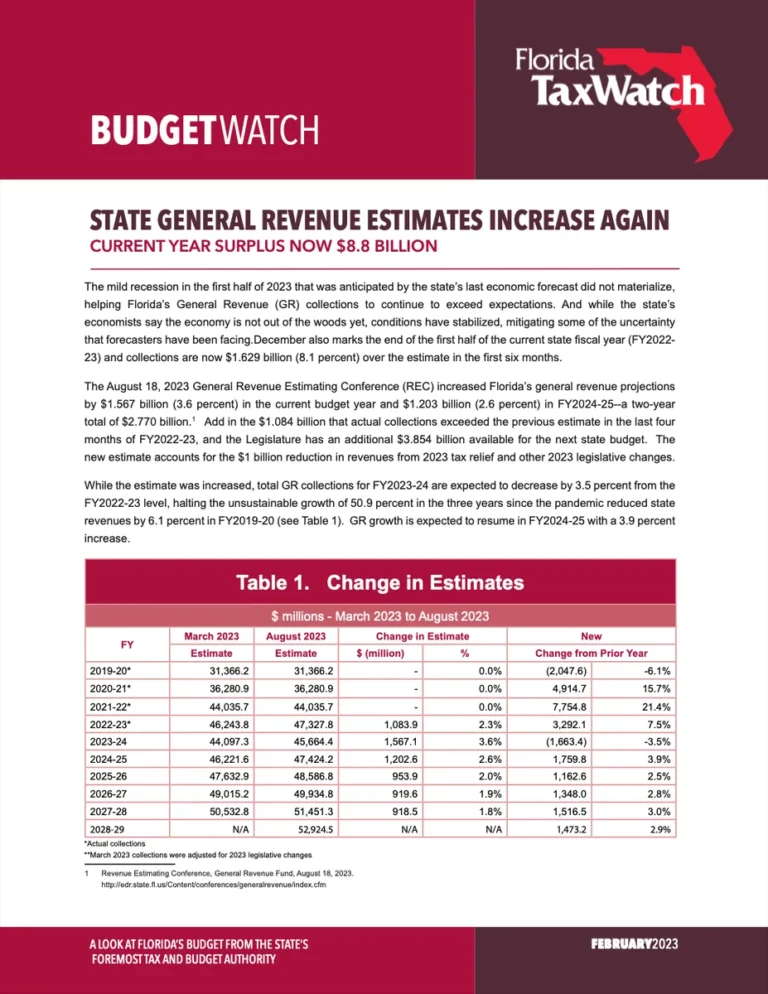
The August 18 General Revenue Estimating Conference (REC) increased Florida’s general revenue projections by $1.567 billion (3.6 percent) in the current budget year and $1.203 billion (2.6 percent) in FY2024-25–a two-year total of $2.770 billion.  Add in the $1.084 billion that actual collections exceeded the previous estimate in the last four months of FY2022-23, and the Legislature has an additional $3.854 billion available for next state budget.  The new estimate accounts for the $1 billion reduction in revenues from 2023 tax relief and other legislative changes. 

The Taxpayer’s Guide to Florida’s FY2023-24 State Budget

Research, Taxpayer Guide

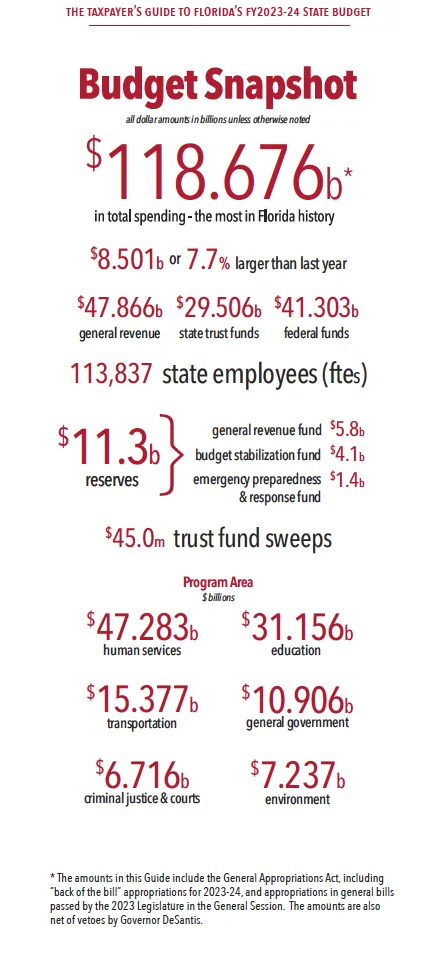
Florida TaxWatch is pleased to present taxpayers with a guide to the FY2023-24 state budget, which went into effect July 1, 2023. The 2023 Legislature appropriated a total of $118.7 billion for FY2023-24. This Budget Guide includes all appropriations for the new fiscal year— the General Appropriations Act (GAA), “back-of-the-bill” spending, and appropriations made in general bills—net of the Governor’s vetoes. 

Florida Medicaid Redetermination

Health Care, Research

There are numerous federal programs administered by states that provide assistance to low-income and needy families. During periods of economic downturn, like the recent COVID-19 pandemic, more Florida families turn to these government programs for assistance. One such safety net program is Medicaid, the joint federal-state health insurance program that provides medical coverage to more than five million low-income, elderly, disabled Floridians and children. Signed into federal law in 1965, Medicaid was created to improve the health of those individuals who might otherwise go without medical care for themselves and their children.

Revisiting Housing Affordability in Florida – SB 102 Offers Good Solutions

Blog, Research

As Florida continues to grow, we must ensure that our state remains affordable for people to live, work, and play. Florida’s current population boom saw the state increase its population by nearly 15 percent between 2010 and 2020. The state added a little less than three million residents in under a decade. Florida is currently the fastest growing state in the nation, and we should increase our housing stock to meet these population pressures. 

Monitoring and Oversight of General Obligation Bonds to Improve Broward County Schools: SMART Program Quarterly Report

Broward BOC, Research

The Broward County Public Schools’ Bond Oversight Committee Quarterly Report for the Quarter Ended March 31, 2023 (“District Quarterly Report”) provides updated information on the implementation of the District’s SMART Program and the use of General Obligation Bond funds to purchase and install technology upgrades; purchase music, arts, and theater equipment; improve school safety and security; upgrade athletic facilities; and renovate educational facilities.

2023 Budget Turkey Watch Report

Budget Turkeys, Budget/Approps, Research, Taxpayer Guide

This is the Florida TaxWatch annual independent review of Florida’s FY2023-24 budget process. The report was started in 1983 and promotes oversight and integrity in the state’s budgeting process based on the principle that: because money appropriated by the Legislature belongs to the taxpayers of Florida, the process must be thorough, thoughtful, transparent, and accountable.  Every appropriation should receive proper deliberation and public scrutiny.  This includes member-requested projects.  

Physician Shortages: Better Utilization of Advanced Practice Registered Nurses in Palliative Medicine Could Provide Relief – Revised

Health Care, Research

A fast-growing and aging U.S. population is posing concerns for physicians’ ability to meet patient demand in the future. Current and future population estimates from the U.S. Census Bureau indicate a projected growth of 34.8 million people from 2019 to 2034. An estimated 66% of this growth is attributed to people aged 65 or older. As such, physician shortages are especially concerning in the hospice and palliative care sector. As the population ages, the need for a higher volume of care and more specialized expertise will grow.

2023 How Florida Counties Compare

Research

Florida relies heavily on local governments to provide services to its residents. The state’s counties, cities, school districts, and special districts raise and spend more money combined than Florida’s state government. The levels of taxing and spending in different jurisdictions across the state vary considerably. This report will help you see how your county stacks up against the other 66 counties. To complement our How Florida Compares series, which compares our state to the rest of the nation, this report looks at the myriad local governments within the state. While property taxes get most of the public attention, they only provide about one-fifth of city and county revenue. The tables, charts, and graphs in this report provide comprehensive information on local tax rates, tax collections, other revenue sources, and government expenditures. Florida TaxWatch provides this report as a reference tool for Florida’s taxpayers, policymakers, and elected officials. 

Florida’s Certificate of Need Program Delivers High Quality Hospice Care

Health Care, Research

The development of hospice programs in Florida is regulated by a Certificate of Need (CON) program. Certificate of Need programs allow the entry of new service providers if the local community has a demonstrated need. Florida is one of 13 states and the District of Columbia that continues to utilize a CON program for the development of hospice services. As Florida’s population increases and ages, it will become more critical to facilitate the growth of hospice services in the way that best serves hospice patients and protects the interests of Florida taxpayers.

$670 Million Added to the New State Budget Through the Sprinkle Lists Deserves Close Scrutiny During the Governor’s Veto Deliberations

Budget Turkeys, Budget/Approps, Research

Florida’s new state budget for FY2023-24 carries a price tag of $117.0 billion, which is a 6.2 percent increase over current spending. The budget also contains a few billion dollars in spending that is technically appropriated for FY2022-23, so it is not included in the $117.0 billion total. 

Become a Member

Support Responsible
Taxation & Government Spending

For over 45 years, donor support has made Florida TaxWatch the state’s leading independent voice for taxpayer accountability. There are many ways to support our mission.

Scroll to Top